
You look at your pup wagging that fluffy or whip-like tail. Then you stop and wonder, what is actually inside there? Is it just muscle and fluff, or is there something harder? Let me save you a trip to Google. The answer is a happy yes, dogs do have bones in their tails. Your dog’s tail is not a weird fluffy noodle. It is a complex part of their spine, full of bones, nerves, and muscles. Understanding this helps you become a better dog parent.
“If you’ve ever watched your dog’s tail swirl like a propeller and wondered, ‘Do dogs have bones in their tails?’, the surprising answer will change how you see every single wag.”
Key Takeaways
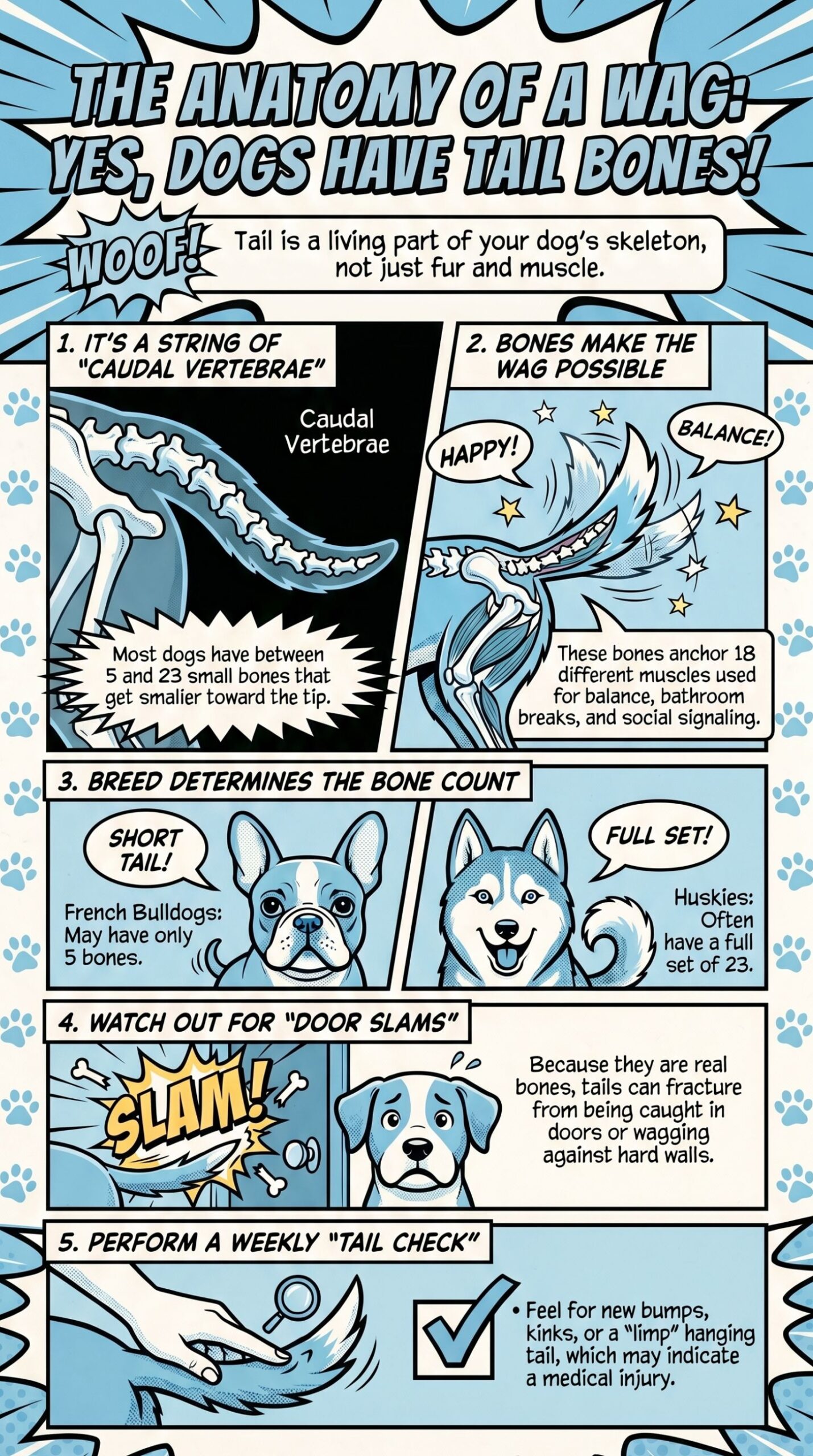
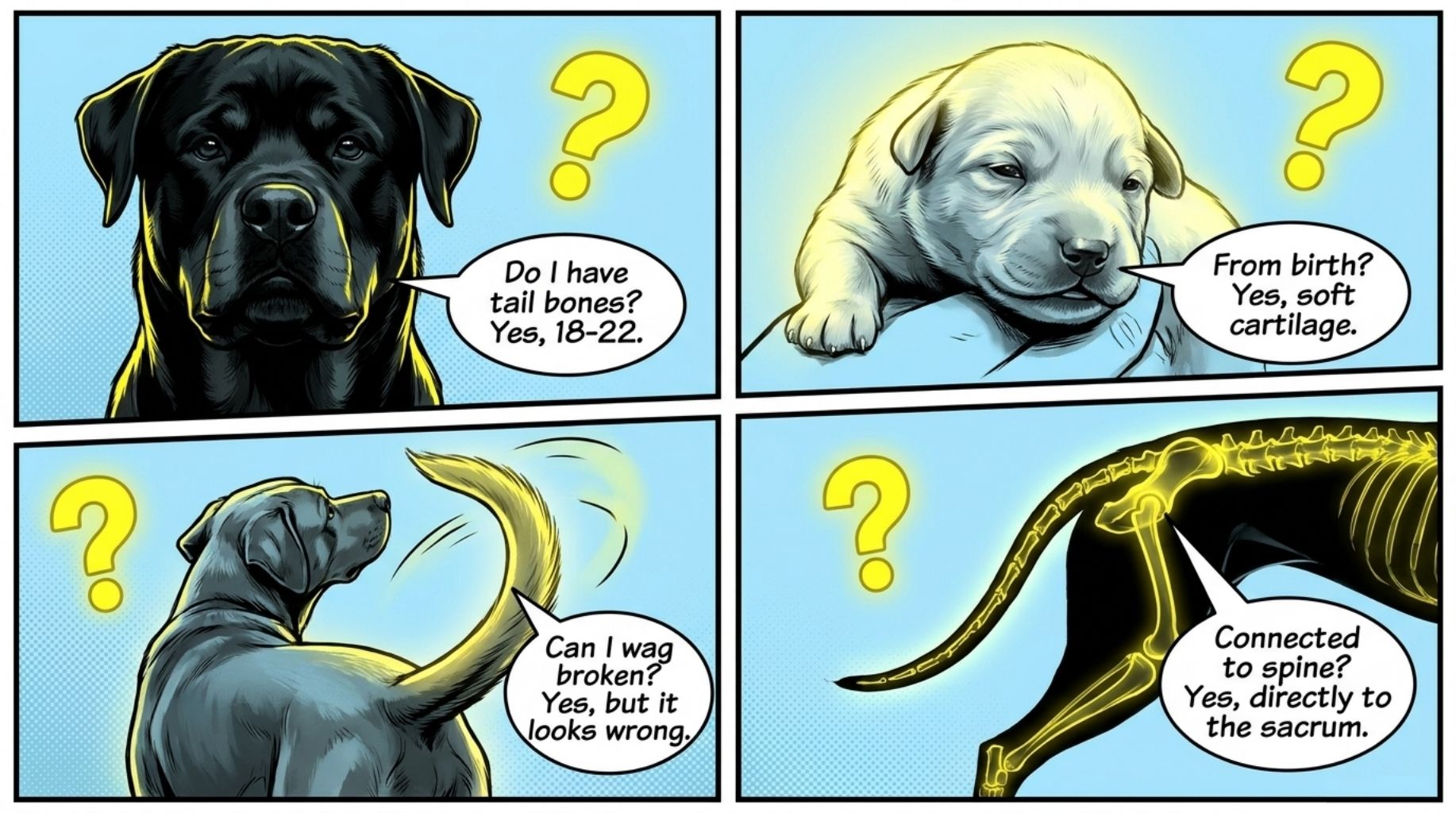
- Yes, dogs have bones in their tails: 5 to 23 small vertebrae called caudal vertebrae.
- Tail bones enable wagging, balance, and communication: without them, the tail would flop like a wet sock.
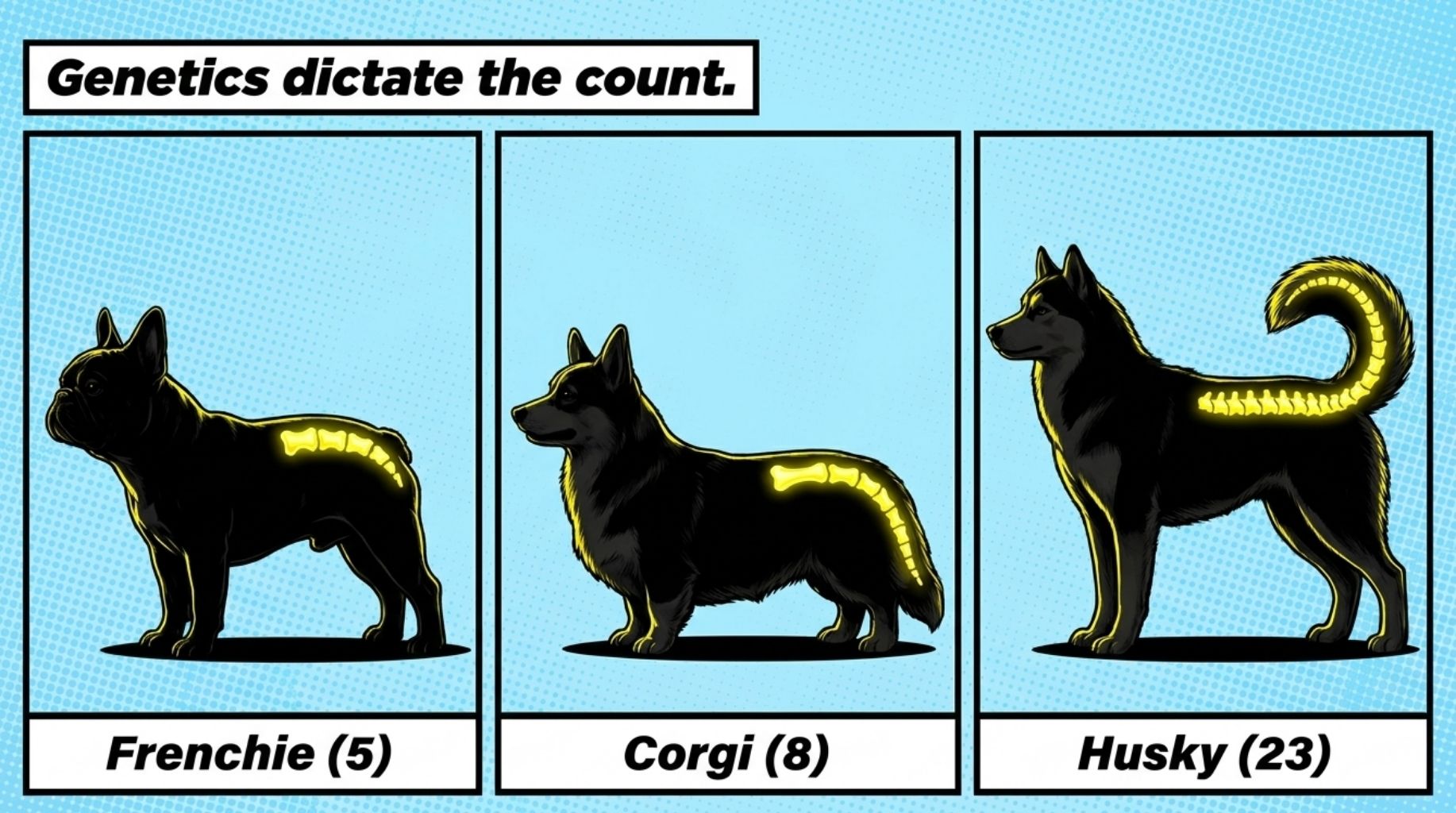
- Breeds vary greatly: French Bulldogs have as few as 5; Huskies can have 23.
- Common causes when tail bones can break: slammed doors, sitting on the tail, or hard wagging.
- Most fractures heal in 2–4 weeks with rest: severe breaks may need a splint or surgery.
- Check your dog’s tail weekly for bumps, kinks, or limpness: see a vet if issues persist.
Quick Summary About The BONES IN YOUR DOG’S TAIL
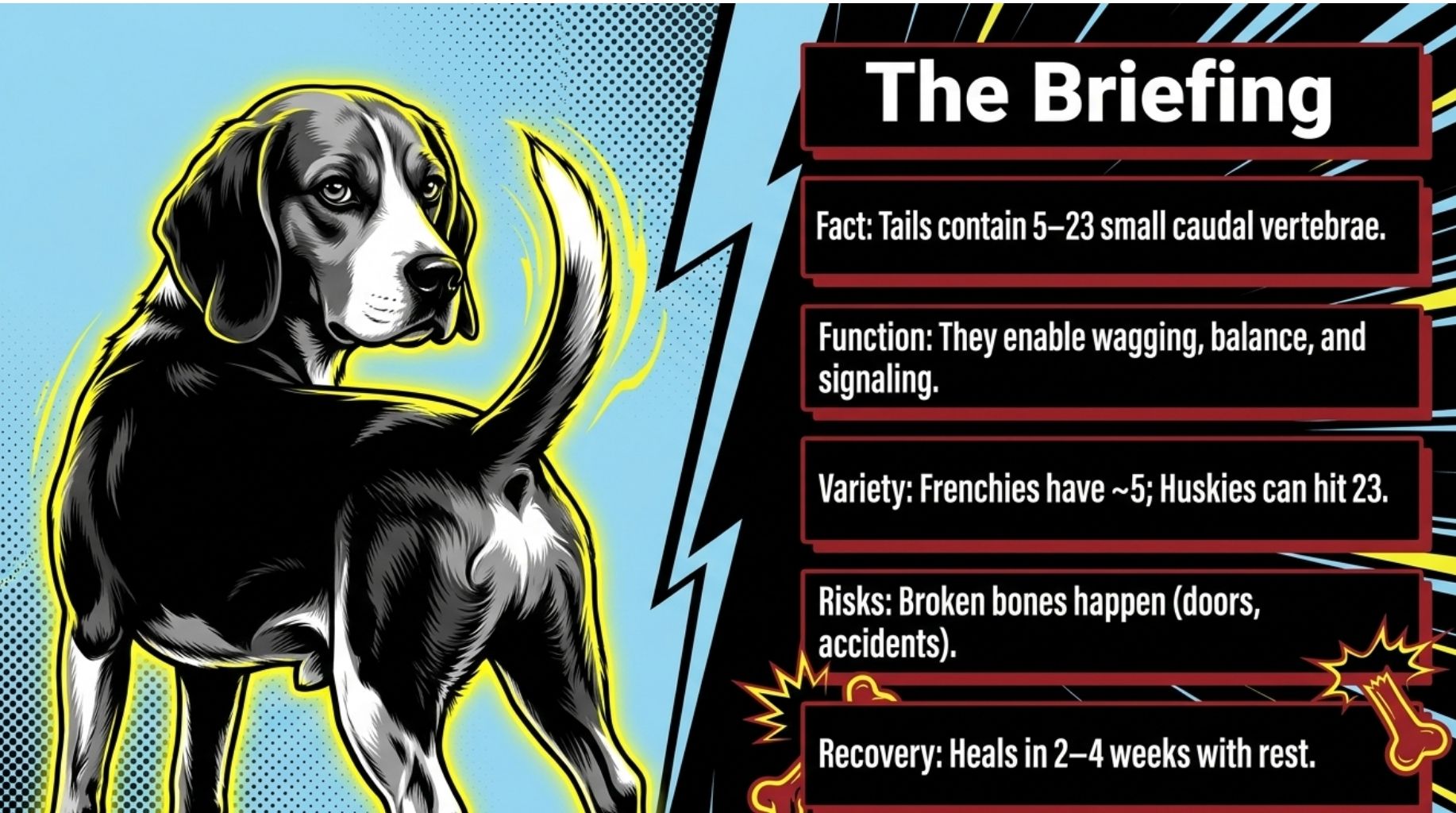
This vet-approved guide confirms that dogs absolutely have bones in their tails, specifically small vertebrae called caudal vertebrae. The number varies by breed, from as few as five (in natural bobtails) to as many as twenty-three (in long-tailed breeds). These bones anchor muscles, enable wagging and balance, and are a true extension of the spine. The article explains how tail bones differ from the rest of the spine, common injuries (like fractures from doors or accidents), healing times, and how to care for your dog’s tail. Science (x-rays, evolutionary biology, and a 2023 neurology study) backs up the fact that dogs have bones in their tail from birth through old age.
Listen the Podcast Episode About The Bones in Your Dog’s Tail!
THE SURPRISING TRUTH REVEALED: DO DOGS HAVE BONES IN THEIR TAILS?
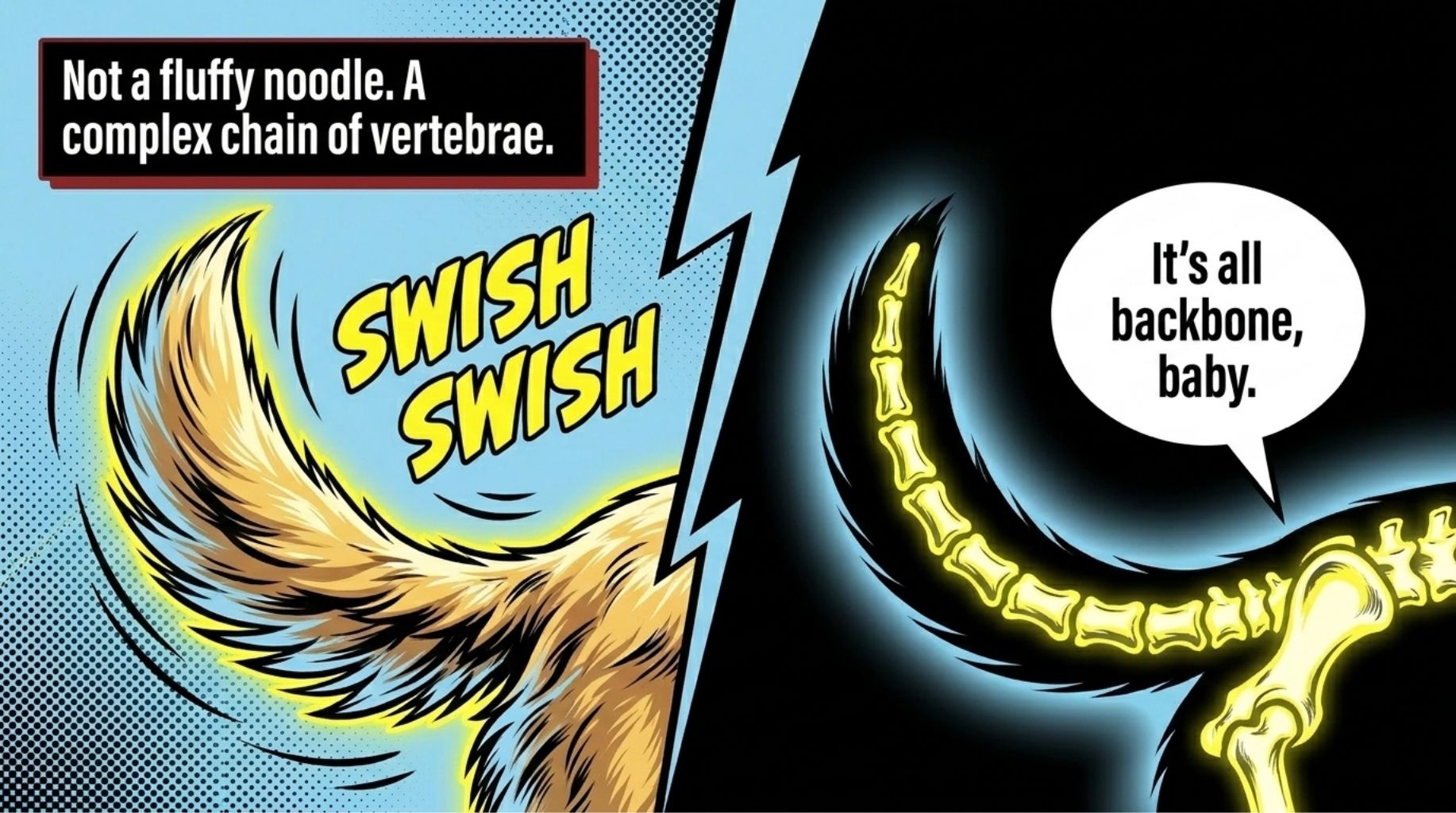
Yes, dogs absolutely have bones in their tails. These bones are actually small vertebrae that extend straight from the end of the spine. Do dogs have bones in their tails? They do, and the tail is basically the last part of the backbone. Without these bones, a dog could not lift, wag, or curl their tail at all. So next time you see a happy wag, remember you are looking at a bony structure at work. The simple fact is that in their tails, dogs do have bones, and those bones make every wag possible.
Do Dogs Have Bones In Their Tails? Let Us Count The Vertebrae
Do dogs have bones in their tails? They do, and the number varies a lot by breed. A typical dog has between six and twenty-three tail vertebrae. These bones are called “caudal vertebrae” by vets. They get smaller as you move from the base to the tip of the tail. Short-tailed breeds like French Bulldogs may have only six to eight bones.
Long-tailed breeds like Beagles or Greyhounds can have twenty or more. Each bone connects to the next with a small joint and a spongy disc. This design allows the tail to bend, twist, and wag in many directions. Yes, dogs have bones in their tails, it is not a solid rod but a flexible chain of tiny bones.
How Tail Bones Differ From The Rest Of The Spine?
The bones in a dog’s tail are unique compared to the main backbone. They lack a central spinal canal because the spinal cord stops well before the tail starts. Instead of protecting nerve tissue, these tail bones anchor important muscles and nerves.
The nerves that control the tail come out from the last true vertebrae and travel between the tail bones. These bones also do not have a large body like the neck or back vertebrae. They are simply smaller, simpler blocks.
That is why a tail injury hurts but rarely causes paralysis of the back legs. The real spinal cord stays safe within the main spine. So, when pet parents ask, “Do dogs have bones in their tails?” the answer is a definite yes, just not the same kind as in the backbone.
Why A Tail Without Bones Would Never Work?
Imagine a tail made only of skin and fat. It would flop around like a wet sock. Your dog could not lift it to pee or poop. They could not use it for balance while running or turning fast. The tail bone structure is what gives the tail its power and precision. Wolves and wild dogs use their bony tails to signal rank and emotion.
A floppy, boneless tail would send zero signals. So, evolution gave dogs these small but mighty bones. Dogs have bones in their tail for a reason, those bones are essential for communication and movement. Your dog thanks those bones every time they wag hello or tuck tail in fear.
WAG ANATOMY: DO DOGS HAVE BONES IN THEIR TAILS AND HOW MANY?
Now let us get a bit more detailed. The average dog has roughly twenty bones in the tail, but this is not a fixed number. Do dogs have bones in their tails? Yes, and the count varies. Breeds with naturally short tails, like Pembroke Welsh Corgis, have way fewer. Breeds with long, sweeping tails, like Golden Retrievers, have many more. The exact count depends entirely on genetics and breeding history.
From Base To Tip: Dogs Do Have Bones In Their Tails – Meet The Caudal Vertebrae Family
The tail bones are named C1, C2, C3, and so on. C1 is the first tail bone, right where the tail meets the rump. From there, each bone gets a little smaller and thinner. The last few bones at the very tip are tiny nubs, almost like a pinky fingernail. These tiny bones often have no real disc between them. They just float inside the tail skin.
Some breeds have a “kinked” tail where two bones fused together naturally. This is harmless and just a quirky trait. Your vet can x-ray the tail and count every single bone if needed. And every time, the x-ray will confirm that dogs do have bones in their tails.
Muscle Attachments: How Bones Make The Wag Happen?
The tail bones serve as anchor points for eighteen different muscles. Each muscle pulls on a specific bone or group of bones. When your dog wants to wag his tail to the right, one set of muscles contracts. When they want to tuck, another set pulls downward.
Without the bones, the muscles would have nothing to pull against. It would be like trying to open a door without a hinge. The bones also protect the small blood vessels that run alongside them.
A happy, high wag requires healthy bones at the base of the tail. A low, slow wag uses the middle and tip bones more. So the next time you see a wag, remember, have bones in their tails, dogs do, and those bones make every movement possible.
Breed Differences: Why Some Dogs Have Almost No Tail Bones?
Do dogs have bones in their tails if the tail is only a tiny stump? Yes, even those tiny stumps contain small bones. Breeds like the Old English Sheepdog or Australian Shepherd are often born with a natural bobtail. They usually have just three to five small caudal vertebrae. Meanwhile, a Whippet or a German Shepherd has a full set of eighteen to twenty-three.
Docked tails (surgically shortened) leave a short stub with the remaining bones cut or amputated. Some breeders argue that tail docking in dogs is cosmetic, but many countries now ban it. Regardless, any tail you see, long, short, or stubby, has bones in it. Do dogs have bones in their tails? Always yes.
DO DOGS HAVE BONES IN THEIR TAILS? HERE IS WHAT SCIENCE SAYS
Science has studied dog tails for decades. Researchers have mapped every bone, nerve, and muscle. They have also looked at tail injuries and healing. The evidence is crystal clear. The tail is a true bony extension of the spine, and dogs absolutely have bones in their tails.
X-Ray Studies Confirm The Bone Structure
Veterinary radiology textbooks show beautiful x-ray images of dog tails. You can see each small vertebra lined up like a string of pearls. This imaging proves beyond any doubt that dogs do have bones in their tail. In fact, x-rays are the standard way to diagnose a tail fracture.
A broken tail bone shows up as a white line with a dark crack. Without bones, there would be nothing to break. So every time a dog gets “limber tail” or “cold tail,” it involves strained muscles around those bones. The bones themselves may not break, but they get stressed.
Evolutionary Biology: Why Tails Kept Their Bones?
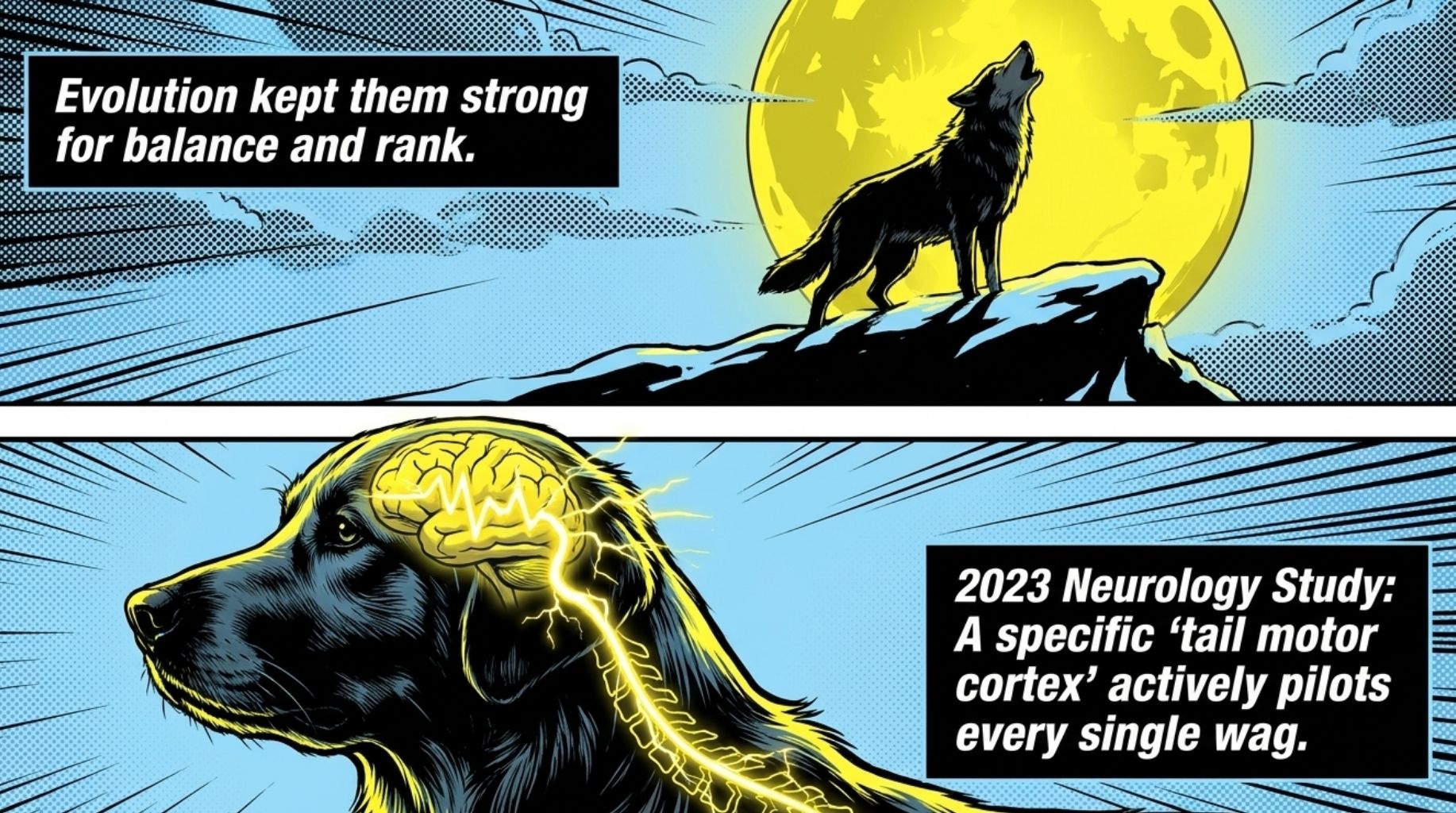
Evolutionary biologists point to the dog’s ancestor, the gray wolf. Wolves need bony tails for balance while chasing prey. They also need stiff tails for social signaling. A boneless tail could not lift high to show dominance. It could not tuck completely to show submission.
Over millions of years, natural selection kept tail bones strong. Even domestic dogs, who do not hunt for survival, still inherit this full bone structure. Some breeds lost length but never lost the bone blueprint. So the answer to “Do dogs have bones in their tails?” is a firm yes from an evolutionary view.
Recent Neurological Research On Tail Movement
A 2023 study from the University of Helsinki looked at tail movement and brain signals. They found that dogs have a specific “tail motor cortex” in their brain. This area sends signals down the spinal cord to the tail nerves. The nerves then tell the tail muscles to pull on the bones. Without bones, the muscles would just squish without effect.
The study also showed that older dogs lose some tail bone density. This makes their tails stiffer and less expressive. So, tail bones are not just there, they change with age just like any other bone. Once again, research confirms, in their tails, dogs have bones that are living, changing tissue.
INJURIES AND BROKEN BONES IN THE TAILS OF MANY DOGS
Because tails have bones, they can break. A broken tail is painful and confusing for a dog. You might see a droopy tail that will not lift. Your dog might yelp when you touch the base of the tail. Some dogs even lose control of their poop because tail muscles help hold the anus closed.
How A Dog Breaks A Tail Bone? (Common Accidents)
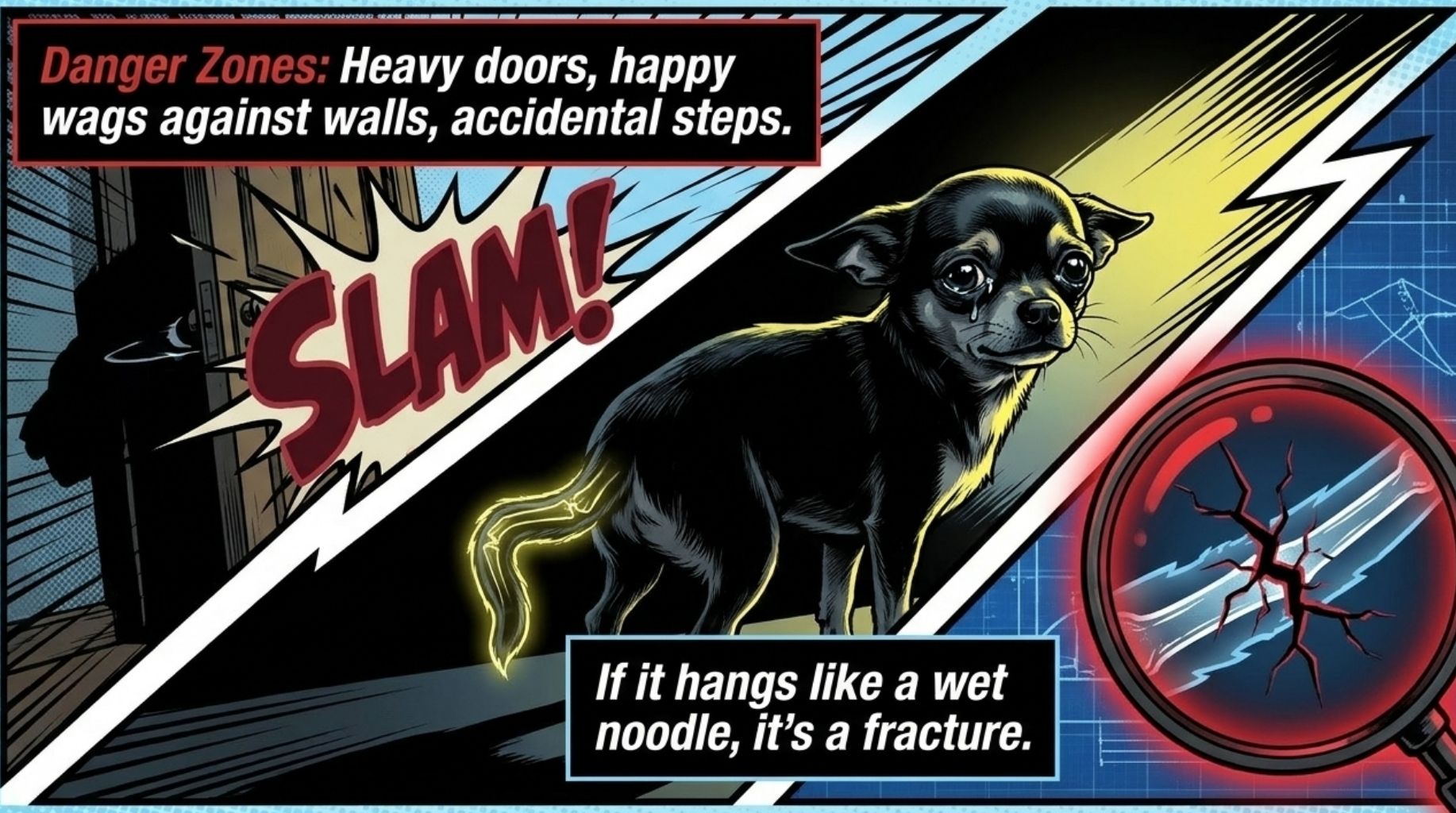
Do dogs have bones in their tails that can break? Yes, and they break more often than you think. A door slamming on the tail is the number one cause. A heavy toy or a person sitting on the tail by accident also does damage.
Outdoor dogs sometimes get their tail caught in a fence. Even wagging too hard against a sharp table corner can cause a fracture. Small breeds with thin tails are especially at risk.
A broken tail usually heals on its own within a few weeks, but sometimes it needs a splint. Never ignore a dangling tail that looks out of place. Because yes, dogs do have bones in their tail, and those bones can fracture.
Signs Your Dog Has A Tail Bone Injury
Look for a tail that hangs straight down like a wet noodle. Your dog may refuse to sit because sitting presses on the injury. They might lick or bite at the tail base constantly. You may see swelling or a visible kink where the bone broke.
If the break happens near the very tip, the area may turn black from poor blood flow. That tip may eventually fall off or need surgical removal. Take your dog to the vet if the tail stays limp for more than a day. The vet will take an x-ray to see which bone broke and how bad it is.
Treatment And Healing Time For Tail Fractures
Most simple tail fractures need only rest and pain medication. Your vet may give you anti-inflammatories to reduce swelling. You need to prevent your dog from wagging hard for about two weeks. This is harder than it sounds because happy dogs wag. Use a tail brace or a soft wrap to limit movement.
If the bone is badly displaced, surgery may put a pin inside to hold it straight. The recovery time for a minor tail fracture is two to four weeks. A severe break with nerve damage can take two months or more. Remember, do dogs have bones in their tails? Yes, and those bones need time to heal just like any other fracture.
RESEARCH AND STUDIES EXPLAINED HOW DOGS HAVE BONES IN THEIR TAILS
We have decades of peer-reviewed research on this topic. Veterinary journals and university studies have measured tail bones, tested their strength, and analyzed their blood supply. This section gives you the highlights so you can trust what you read. And the short answer to “Do dogs have bones in their tails?” is a resounding yes backed by science.
The 2019 Canine Caudal Vertebrae Count Study
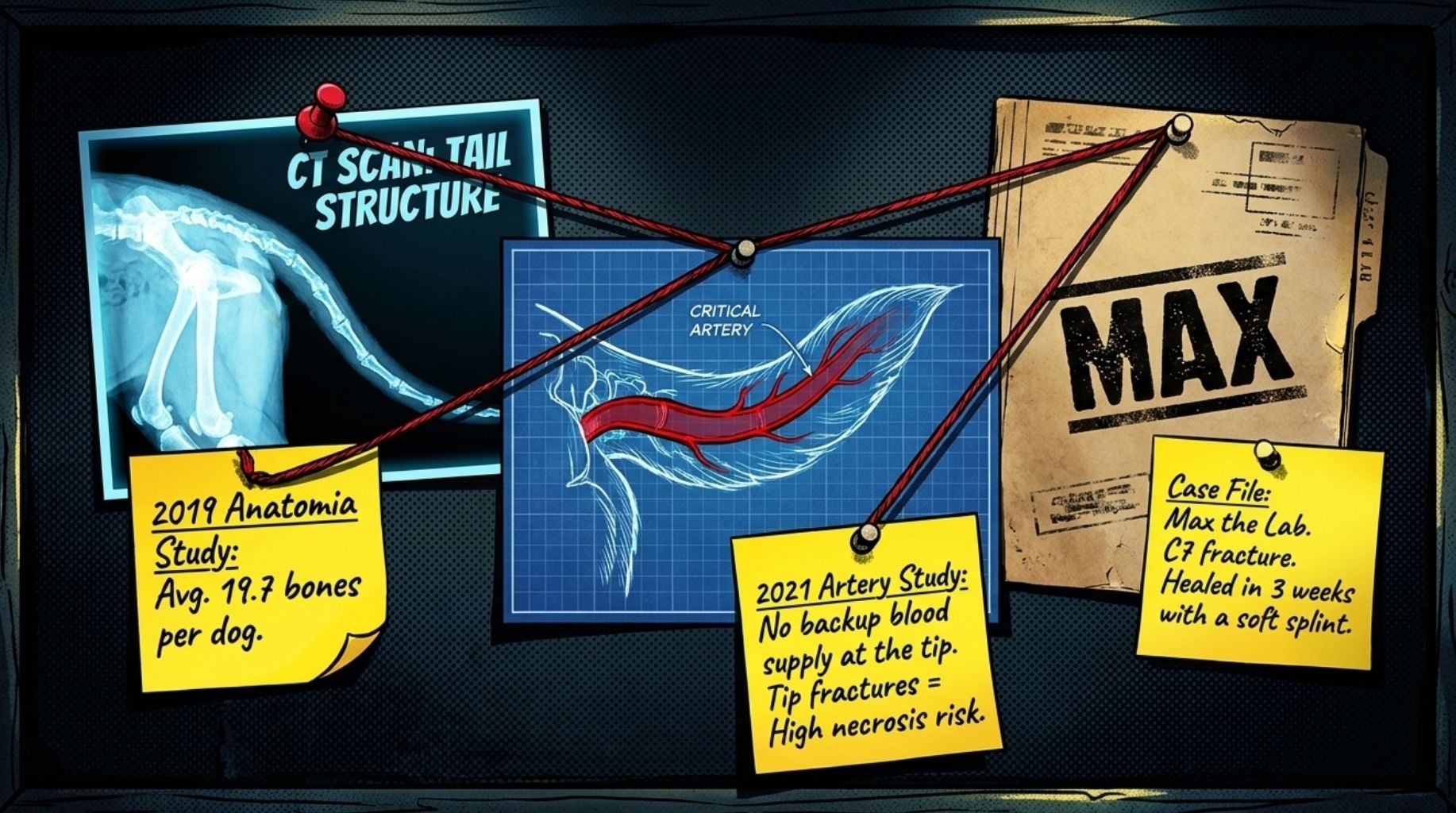
A study published in the journal Anatomia examined 120 dogs from 15 breeds. Researchers counted every tail bone using CT scans and dissection. They found an average of 19.7 caudal vertebrae per dog. The smallest count was 5 (in a French Bulldog).
The largest count was 23 (in a Siberian Husky). They also found that larger dogs generally have more tail bones. The study confirmed that female dogs average one fewer tail bone than males. This research is the current gold standard for tail anatomy, and it leaves no doubt, dogs have bones in their tails.
Blood Supply Research And Tail Necrosis
A 2021 veterinary study looked at why tail tips die after injury. They injected dye into the tail arteries of deceased dogs. The dye showed a single “end artery” feeding the last three to five tail bones. This artery has no backup blood supply.
If that artery gets crushed, the tip bone loses all oxygen. Within days, the bone and skin die and turn black. That is why vets often recommend amputation of a dead tail tip. The research proved that saving a dying tip is almost impossible.
So a broken tail tip is more serious than a break further up. Even in these extreme cases, the fact remains that do dogs have bones in their tail, and those bones have unique blood vessels.
Real Case Study: A Labrador With A Broken Tail
A five-year-old Labrador named Max wagged his tail into a metal kennel door. He yelped and then held his tail sideways. The owner asked, “Do dogs have bones in their tails that can break this way?”
The vet took an x-ray and found a clean break in the C7 caudal vertebra. Max could not wag or lift his tail to poop. He wore a soft splint for ten days and took anti-inflammatory drugs. After three weeks, the bone healed and Max wagged normally again.
This case shows how common and treatable tail fractures are. The vet sent the x-ray to the owner as a souvenir of Max’s “bony tail.” And it proved once more that dogs do have bones in their tails.
HOW TO CARE FOR The BONES IN YOUR DOGS TAILS?
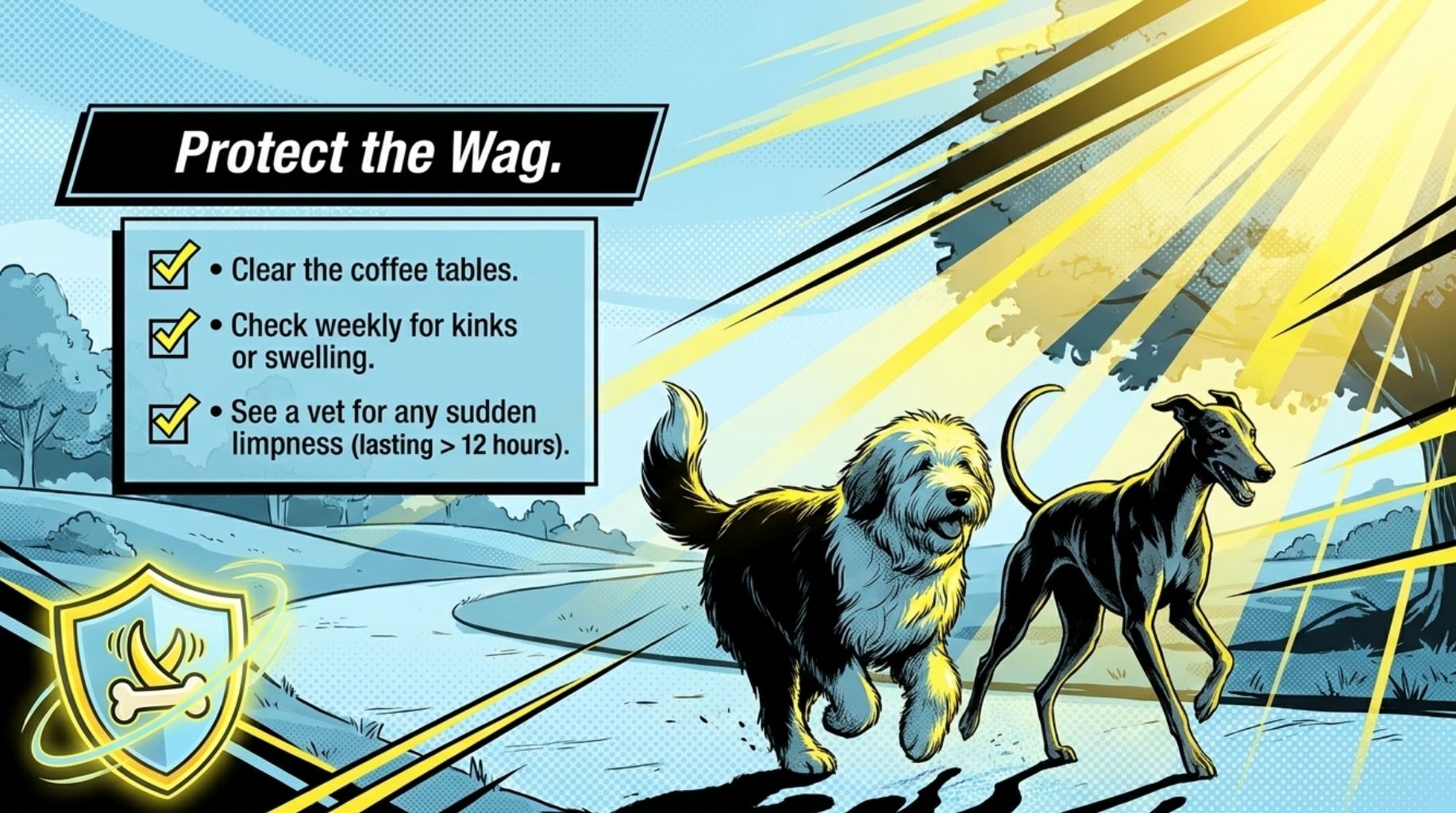
Now you know the truth. Your dog’s tail is a bony, complex structure that deserves respect. You can take simple steps to keep those tail bones safe and happy.
Daily Checks For Tail Health
Run your hand down your dog’s tail once a week. Feel for bumps, kinks, or tender spots. Look at the tail tip for any dark discoloration. Watch how your dog wags. Does the tail move in a smooth curve or a stiff line? A sudden change in wagging style often means pain.
Check between the tail and the body for matted fur or skin infections. Healthy tail bones mean a happy, expressive dog. And always remember, in their tails, dogs have bones that need just as much care as the rest of their skeleton.
Preventing Tail Injuries At Home
Move low coffee tables and sharp corners away from wagging height. Do not shut doors quickly when your dog is nearby. Teach children not to pull on the tail. Use a crate with smooth bars, not sharp wire gaps. If you have a big dog with a powerful wag, give them open space.
Keep the tail area clean during potty breaks. A little prevention saves you a costly vet visit. Because do dogs have bones in their tails? Yes, and those bones are fragile in their own way.
When To See A Vet About The Broken Bones In Your Dogs Tails?
See a vet if the tail hangs limp for more than twelve hours. Also go if you see swelling, bleeding, or a crooked angle. A tail that smells bad or has oozing sores needs immediate care. If your dog cries when you touch the tail base, do not wait.
Older dogs with arthritis may have stiff tail bones that crackle when moved. That crackling sound needs a vet check too. Your dog’s tail tells you a lot. Listen to it. And listen to the science, dogs have bones in their tail from birth to old age.
FREQUENTLY ASKED QUESTIONS (FAQ)