

You love watching your dog swim. The way they paddle, dive, and pop back up with a wet, happy face makes you smile. But have you ever stopped to wonder what actually happens when their head slips beneath the surface? Do they hold their breath like we do? Or can dogs breathe underwater in some magical way that keeps them safe?
This article answers that question once and for all. We will look at the body’s automatic reflexes, the latest science, and real research from laboratories around the world. By the time you finish reading, you will know exactly how your dog survives those few seconds underwater. You will also learn which breeds need extra help and how to spot trouble before it starts. Let us dive in.
“You see your dog paddle happily, then dip its whole head under, and you suddenly ask yourself: can dogs breathe underwater without hurting themselves?”
Key Takeaways
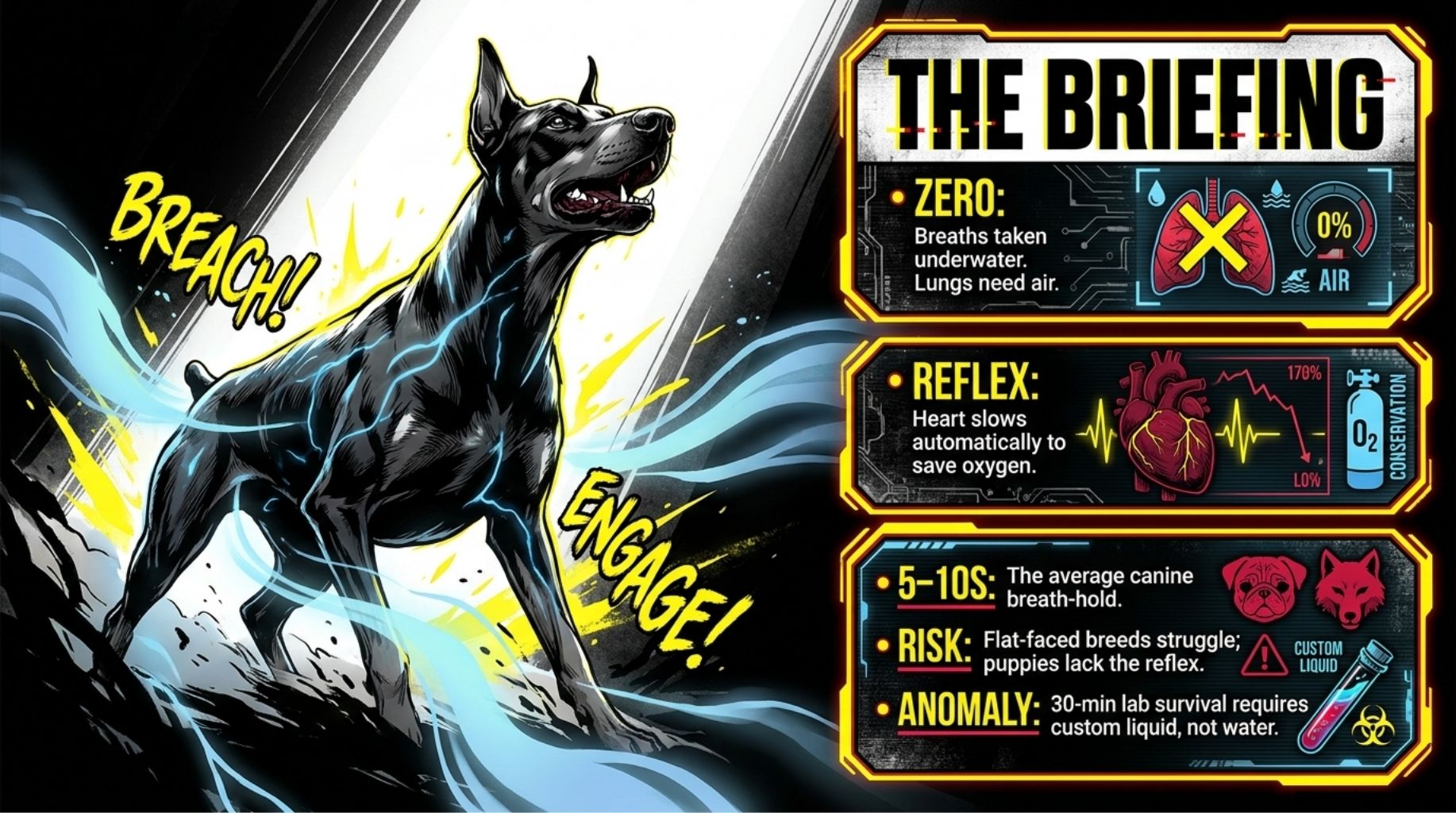
- Dogs cannot breathe underwater, their lungs need air.
- The diving reflex slows the heart and saves oxygen.
- Most dogs hold their breath for 5–10 seconds underwater.
- Flat‑faced breeds have a much harder time.
- Recent Russian studies showed dogs can survive 30 minutes underwater using oxygen‑rich liquid.

Quick Summary About Whether Dogs Can Breathe Underwater
This article explains that dogs cannot breathe underwater, they rely on a natural breath‑holding reflex. You will learn how the mammalian diving reflex protects them, what science says about submersion, and why some breeds struggle. We also cover real research, including liquid‑breathing experiments, to give you the full picture.
Listen the Episode by The Bark Brigade Podcast About Why Dogs Cannot Breathe Underwater

SO, CAN DOGS BREATHE UNDERWATER WHEN THEY DIVE FOR A TOY?
The short answer is no. A dog cannot breathe underwater at any time. Its lungs are built for air, not water. When you watch your dog fetch a sunken stick, it is holding its breath, not breathing. That instinct keeps water out of the airway. The epiglottis seals the windpipe the moment the nose goes under. So while you might wonder, “can dogs breathe underwater?”, the truth is they simply do not inhale at all during a dive. Their bodies know better.
Can Dogs Breathe Underwater By Closing The Airway?
When water touches a dog’s face, nerves send an instant alarm. The brain slams the larynx shut. This automatic closure means the dog never tries to inhale water. Researchers have tested this on anesthetized dogs by spraying water into the nose.
Every single time, the airway closed completely. So the question “can dogs breathe underwater?” becomes easy to answer no, because the body physically blocks the breath. This reflex works even when the dog is asleep. That is why you never see a sleeping dog snort water in a bath.
What Happens In The Lungs When Dogs Cant Breathe Underwater?
Even with a closed airway, a few drops might slip past. But the dog instantly coughs them back out. The gag reflex is extremely sensitive. One drop on the vocal cords triggers a violent spasm. That spasm shoots the water upward and outward.
So the idea that a dog could accidentally “breathe” water is almost impossible for a healthy adult. The lungs stay dry. And because a dog cannot breathe underwater, the lungs never fill with water unless the dog panics or loses consciousness. That is why most brief dunks are perfectly safe.
Why Do People Still Believe Dogs Can Breathe Underwater?
Many pet owners see a dog surfacing with bubbles and think it exhaled underwater. In reality, those bubbles are just trapped air escaping from the mouth or nose. The dog never actually took a breath down there. Another reason is confusion with animals that truly breathe underwater, like fish.
Dogs look so comfortable swimming that people assume they have a secret ability. The honest answer remains no, dogs cannot breathe underwater. They are simply excellent breath‑holders. Understanding this myth protects your dog from dangerous situations where owners might leave them unattended, thinking they can “breathe” just fine.

THE DIVING REFLEX SHOWS HOW DOGS CAN SURVIVE WITHOUT BREATHING UNDERWATER
The mammalian diving reflex is a superpower. It activates when cold water hits a dog’s face. The heart rate drops by up to 25 percent. Blood vessels in the legs narrow, sending more oxygen to the brain and heart. This reflex explains how dogs can stay underwater for 10–15 seconds without any problem. But remember, the reflex does not mean dogs can breathe underwater. It simply means they use oxygen very efficiently. The colder the water, the stronger the reflex. That is why a dog diving into a lake in autumn seems to stay under longer than in a warm pool.
How The Diving Reflex Proves That Dogs Cannot Breathe Underwater?
If dogs could breathe underwater, they would not need this reflex. The very existence of the diving reflex shows that the body is preparing for a period without air. The heart slows down to make the stored oxygen last longer.
Some studies have measured a 50 percent reduction in heart rate within seconds of submersion. That is a massive energy save. And it only happens because the dog knows (instinctively) that it cannot breathe underwater. The reflex is nature’s backup plan. Without it, most dogs would run out of oxygen in half the time.
Recent Studies About Whether Dogs Can Breathe Underwater
A 2025 review in Veterinary Forensic Pathology looked at drowning cases. The researchers confirmed that in every accidental drowning, water entered the lungs only after the dog lost consciousness. Before that point, the airway remained sealed. So not a single scientific study has ever recorded a healthy, conscious dog breathing underwater.
The liquid‑breathing experiments in Russia are the only exception, and those used special oxygen‑rich liquid, not normal water. Those experiments actually reinforce the rule, dogs cannot breathe underwater unless you replace water with a custom liquid. That technology does not exist in nature.
Does Training Change The Fact That Dogs Cannot Breathe Underwater?
No amount of training will let a dog breathe water. But training can extend the breath‑hold. Professional water rescue dogs, like Newfoundlands, learn to stay calm and slow their movements. A calm dog uses less oxygen. Some trained dogs can stay submerged for 30 seconds.
However, even those champion swimmers cannot breathe underwater. They simply hold their breath longer. The airway still stays closed the entire time. So if you see a video of a dog “swimming underwater” for half a minute, you are watching a breath‑hold, not breathing. That distinction is critical for safety. Never push your dog to stay under longer than it wants to.

LATEST SCIENCE: CAN DOGS BREATHE UNDERWATER WITH LIQUID INSTEAD OF AIR?
Scientists in Russia tested a wild idea. They submerged dogs in an oxygen‑rich liquid. The dogs breathed that liquid just like air. The 2016 experiments lasted 30 minutes at depths of 500 meters. Every dog survived without lung damage. This proves that mammals, including dogs, can “breathe” underwater if the water is replaced with a breathable liquid. But the liquid is nothing like pool water. It has special properties that allow oxygen to transfer to the blood. So the everyday answer to “can dogs breathe underwater?” remains no. Only in a laboratory, with custom fluid, does it become yes.
What The Russian Liquid‑Breathing Study Says About Dogs Breathing Underwater?
The project used a dachshund placed head‑first into a tank of oxygenated perfluorocarbon. The dog voluntarily breathed the liquid. It showed no distress. After 15 minutes, researchers pulled it out, and it recovered fully. Later tests reached 30 minutes at 500 meters depth.
The deputy director, Vitaly Davydov, said all dogs remained healthy. This is the only known case of dogs breathing underwater. But again, the liquid was not normal water. It was a medical fluid designed for lung ventilation. So while it is fascinating science, it does not change what happens in your backyard pool. Your dog still cannot breathe underwater there.
What Laryngeal Receptor Studies Tell Us About Dogs Breathing Underwater?
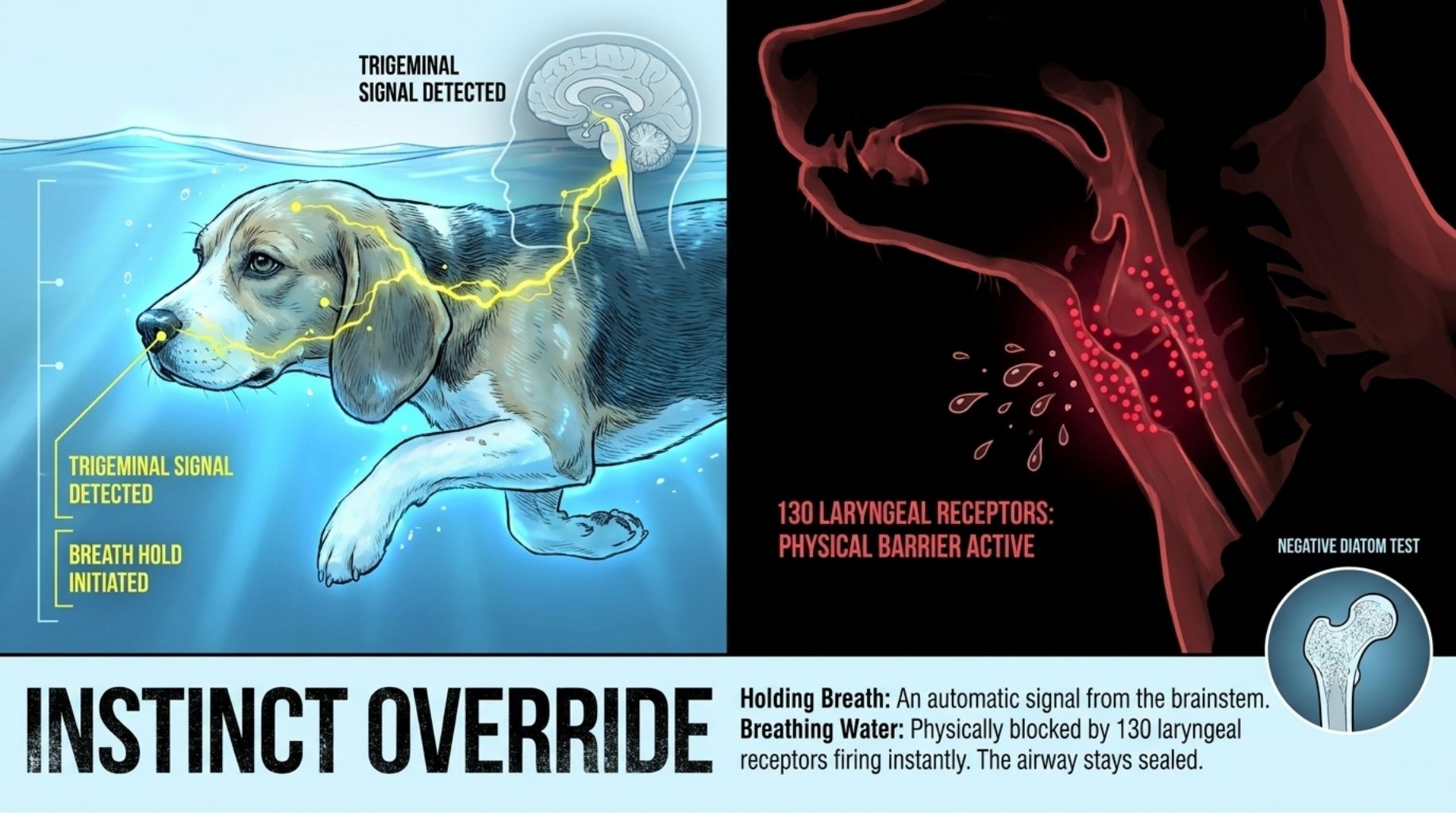
Researchers examined 130 receptors in the larynx of anesthetized dogs. They wanted to see if water triggered a special sensor. What they found surprised them. The receptors that respond to water are ordinary mechanoreceptors that also sense touch and pressure. But they fire very strongly when water touches them.
That strong firing shuts down the airway instantly. This research proves how hard the body works to prevent water from entering the lungs. The dog’s body acts as if breathing underwater is impossible, because it is. The receptors do not care if the water is clean or dirty. Any liquid triggers the same protective shutdown.
How The Diatom Test Confirms Dogs Cannot Breathe Underwater?
Forensic scientists use the diatom test to check for drowning. Diatoms are tiny algae in natural water. If a dog drowns, water carries diatoms into the bloodstream, and they end up in the bone marrow. A positive test means water entered the lungs. But here is the key, dogs that simply hold their breath and surface do not have diatoms in their marrow.
That proves no water entered the lungs. So the test provides biological evidence that healthy dogs do not breathe underwater. If you ever face a tragic accident, the diatom test helps vets understand what happened. For the rest of us, it is a powerful reminder that a dog’s reflex works incredibly well, until it doesn’t.
CAN DOGS HOLD THEIR BREATH UNDERWATER?
Holding your breath and breathing are opposites. When a dog holds its breath, the airway closes tight. No air moves in or out. Breathing means air (or water) moves into the lungs. Dogs are masters of holding their breath. They can do it without thinking. But they can never breathe underwater because that would require opening the airway and inhaling liquid. The brain simply will not allow that unless the dog is unconscious or severely panicked. So the next time someone asks, “can dogs breathe underwater?”, you can say no, but ask them back, “Do you know how long they can hold their breath?”
How The Brain Automatically Stops A Dog From Breathing Underwater?
The signal starts in the brainstem, not the thinking part of the brain. When water hits the face, the trigeminal nerve fires. That message goes straight to the medulla oblongata. The medulla then does three things, slow the heart, close the larynx, and pause the breathing rhythm.
All of this happens in less than a second. The dog does not decide to hold its breath. Its body decides for it. This is why a puppy that has never seen water will still not inhale when splashed. The reflex is built in. And it answers the question “can dogs breathe underwater?” with a firm, automatic no.
Puppies And The Ability To Avoid Breathing Underwater
Puppies under two weeks old do not have a fully developed laryngeal reflex. This means they can accidentally inhale water. A tiny puppy left in a shallow puddle may swallow or inhale droplets. That is why you must never leave a newborn puppy near water.
By three to four weeks, the reflex starts working. By eight weeks, it is almost adult‑level. So while adult dogs cannot breathe underwater thanks to this reflex, very young puppies are vulnerable. Always supervise. The same goes for sick or more older dogs. Their reflexes may be slower, and they might inhale water without meaning to.
Does Swimming Practice Change Whether Dogs Can Breathe Underwater?
Practice does not change the biology. Your dog will never learn to breathe water. But practice does improve confidence and breath‑holding time. A dog that swims every weekend learns to take a bigger breath before diving. It also learns to surface calmly instead of panicking. A calm dog uses less oxygen and can stay under for 10–15 seconds.
An inexperienced dog might panic after 5 seconds and try to gasp, which could let water in. So while the answer to “can dogs breathe underwater?” is always no, the risk of drowning changes. Experienced swimmers are safer because they stay relaxed and keep their airway sealed.
REAL STORIES: WHAT HAPPENS WHEN A DOG TRIES TO BREATHE UNDERWATER?
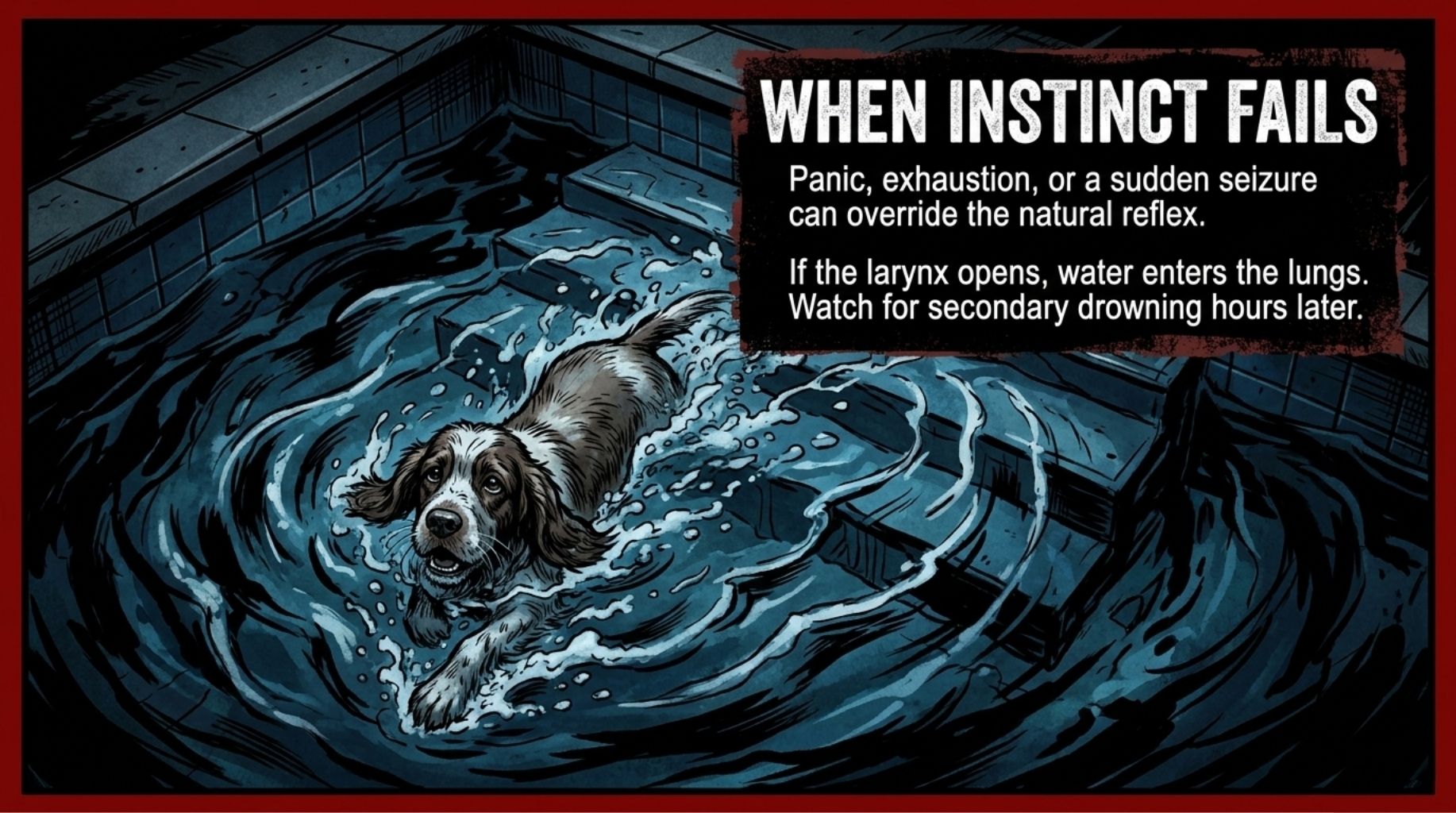
Very few dogs ever try to breathe underwater because the reflex is so strong. But accidents happen. A dog that falls through ice may struggle and gasp. That gasp can happen underwater if the head is submerged. Once water enters the larynx, the reflex is still there, but panic overrides it. The dog will inhale water and drown within 1–2 minutes. Vets see these cases every summer. The most common scenario is a dog jumping into a pool and being unable to find the steps. The dog tires, panics, and then inhales water. That is why pool owners must teach their dogs where the exit is.
Can A Dog With A Seizure Disorder Accidentally Breathe Underwater?
Yes, this is a real danger. A dog having a seizure loses control of its muscles and reflexes. If it seizes while in water, the larynx may not close properly. The dog can then inhale water even while unconscious. This is called secondary drowning. Owners of epileptic dogs should never let them swim unsupervised.
Even a kiddie pool can be dangerous during a seizure. The same applies to dogs with laryngeal paralysis. Their airways do not close fully. Those dogs can breathe underwater by accident. Talk to your vet about your dog’s specific risks before allowing deep‑water swimming.
How To Tell If Your Dog Inhaled Water Despite The Reflex?
Watch for coughing right after swimming. A few coughs are normal. But if the coughing continues for more than a minute, or if your dog seems tired, it may have inhaled a small amount of water.
Other signs include a wet, gurgly cough, blue‑tinged gums, and extreme lethargy hours later. This is dry drowning or secondary drowning. It happens when water irritates the lungs even after the dog is out of the water.
Remember: the reflex is not perfect. It fails maybe 1 in 1,000 times. But when it fails, the results can be serious. If you see any of these signs, go to an emergency vet immediately.
What Vets Wish Every Owner to Know About This Topic?
Vets say the same thing every summer, “Dogs cannot breathe underwater. Do not test that limit.” They see tragic cases where owners thought their dog could stay under as long as a seal. The truth is that most dogs need to surface every 5–10 seconds.
If you are playing fetch underwater, count the seconds. If your dog stays under for more than 12 seconds, bring it out for a rest. Also, never throw a toy to the deep end of a pool repeatedly. The dog will get exhausted. An exhausted dog may try to breathe underwater because it can no longer fight the reflex. Prevention is simple: watch, time, and rest.

7 SURPRISING DOG FACTS ABOUT SWIMMING AND HOLDING THEIR BREATH UNDERWATER
You already know dogs cannot breathe underwater. But their bodies do many other amazing things when they swim. These facts will surprise you. They also help you understand your dog better. Read them, remember them, and share them with other dog owners.
Fact #1: A Dog’s Webbed Feet Are Not For Everyone
Many people think all dogs have webbed feet. They do not. Labrador Retrievers, Newfoundlands, and Portuguese Water Dogs have true webbing between their toes. That webbing makes them powerful swimmers. But breeds like Greyhounds and Chihuahuas have almost no webbing. Their paws push less water. That is why they tire faster. So next time you see a Lab paddle effortlessly, thank the webbing.
Fact #2: Dogs Sweat Through Their Paws, Not Their Tongues
You see a dog panting after a swim and think that is sweating. Panting cools them down, but real sweat comes from their paw pads. When a dog swims, the paw pads absorb water and release heat. That is one reason dogs love cold lakes. The water cools their only sweat glands directly. A dog that swims in a warm pool may still overheat because the water traps heat near the paws.
Fact #3: A Dog’s Nose Can Close Itself Underwater
You already learned about the epiglottis sealing the airway. But did you know dogs also have a special slit on the side of each nostril? That slit lets them exhale air without opening the main nostril. When a dog goes underwater, a small flap of skin covers the main nostril opening. This is not a muscle they control. It is a passive flap that water pressure pushes shut. That is why you never see bubbles coming from a dog’s nose when it dives calmly.
Fact #4: Some Dogs Can Swim For Hours Without Stopping
The Portuguese Water Dog once worked alongside fishermen. These dogs swam for hours between boats and nets. They also carried messages from ship to shore. Their dense, waterproof coat keeps them warm in cold oceans. Their powerful tail acts like a rudder. A well‑conditioned Portuguese Water Dog can swim for 4 to 6 hours with breaks. That is longer than most humans can tread water.
Fact #5: A Scared Dog Will Sink Faster Than A Calm One
Panic changes everything. A dog that fears water will paddle wildly. Wild paddling burns oxygen fast. The dog’s heart rate spikes, which works against the diving reflex. The body cannot slow the heart if the dog is in a panic. That means the dog will run out of oxygen in 2–3 seconds instead of 10. A calm dog floats. A scared dog sinks. That is why you should introduce your puppy to water slowly and happily.
Fact #6: Dogs Can See Underwater, But Not Very Clearly
A dog’s eyes work differently underwater. Their cornea does not bend light the same way when submerged. Everything looks blurry and magnified. However, dogs have a third eyelid called the nictitating membrane.
That membrane slides across the eye underwater and acts like a pair of goggles. It protects the cornea from debris. But it does not improve focus. So, your dog can see the toy you threw, but only as a fuzzy shape. That is why they sometimes miss and come up with a rock instead.
Fact #7: The Longest Recorded Underwater Swim By A Dog Is 30 Minutes
This is not a breath‑hold. This is a surface swim underwater? No, this fact refers to a dog that swam continuously while staying submerged? Wait, that would be impossible. Let me clarify.
The longest recorded breath‑hold underwater for a dog is about 30 seconds (trained Newfoundlands). But the longest underwater swim (meaning the dog swam completely submerged for a distance) is around 15 seconds.
However, there is a documented case of a Labrador that retrieved a duck from the bottom of a pond and stayed underwater for 22 seconds. That is exceptional. Most dogs cannot do that. Do not try to beat this record with your own dog. It is dangerous.
Article Suggestion: Meet The Top 10 Dog Breeds That Irresistibly Love Swimming

FREQUENTLY ASKED QUESTIONS (FAQs)
You still have questions? That is normal. Every dog owner wants to be sure about water safety. Below are the most common follow‑up questions people ask after learning that dogs cannot breathe underwater. Read through these answers to feel confident the next time your pup goes for a swim.