
The moment your dog’s nose hits the ground, their tail starts wagging, and their entire world narrows to the scent they’re tracking, it’s pure puppy joy. To teach your dog to search on cue isn’t just a party trick! It’s a doorway into their natural instincts, providing powerful mental exercise and building unshakable confidence.
The command “Find It!” transforms everyday life into an engaging game, tiring out an energetic pup more effectively than a long walk. This complete guide breaks down how to teach your dog to search into simple, joyful steps. Whether you have a curious puppy or a seasoned senior dog, you’ll discover how to unlock their incredible nose and turn “Find It” into their favorite game.
“What if the secret to a calmer, happier, and more brilliant dog is hiding in plain sight, waiting to be discovered by their incredible nose?”
Quick Summary About HOW TO TEACH YOUR DOG TO SEARCH ON CUE
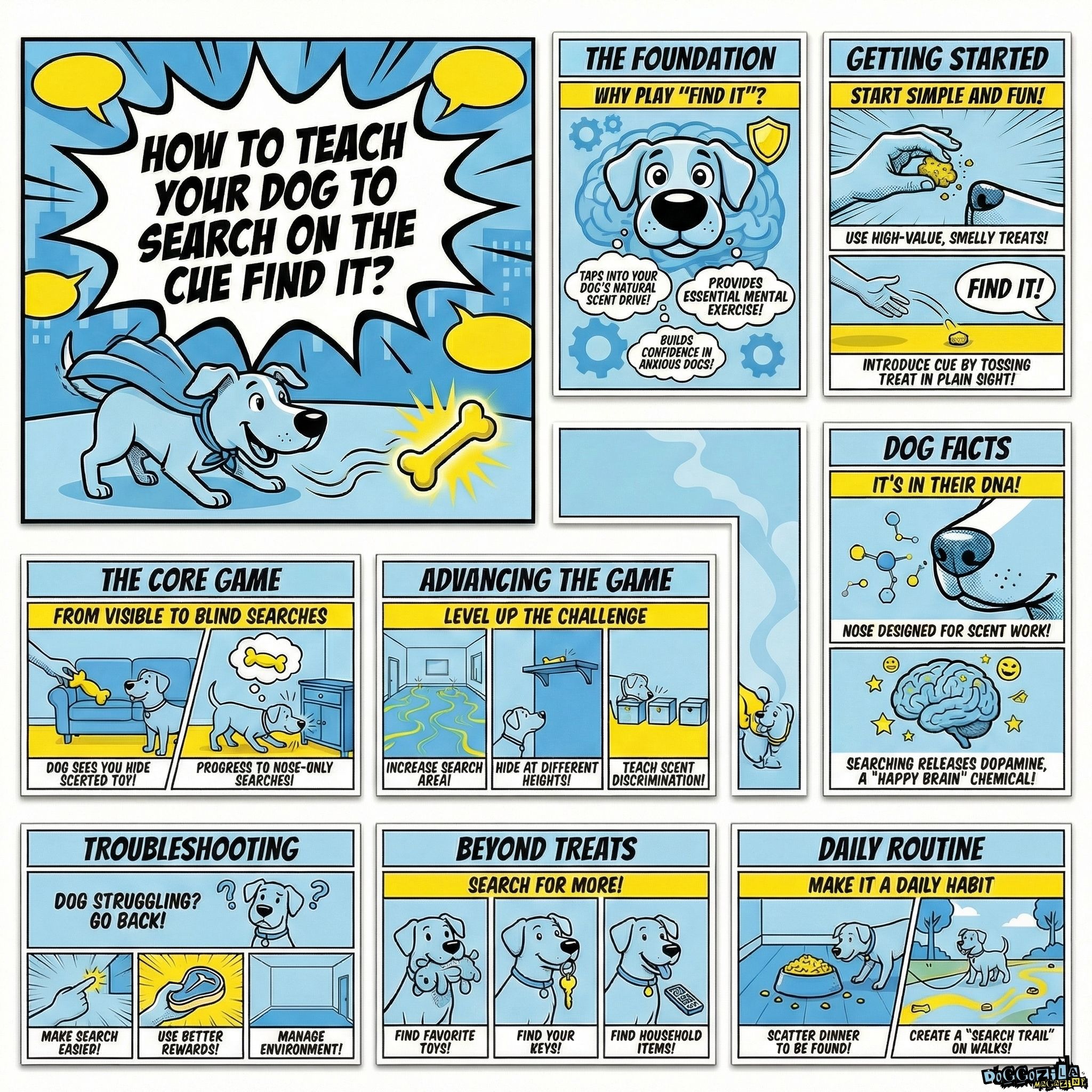
This comprehensive guide unlocks the fun and functional world of scent work, breaking down exactly how to teach your dog to search. You’ll learn why this game is a powerful tool for mental exercise and confidence-building, follow a simple step-by-step training plan from first steps to advanced finds, discover troubleshooting tips for common hurdles, and explore creative ways to weave searching into your daily life for a more engaged and satisfied canine companion.
WHY YOU NEED TO LEARN HOW TO TEACH YOUR DOG TO SEARCH?
Before you hide a single treat, it’s crucial to understand the profound “why.” Searching taps into your dog’s most powerful and primal sense, smell. For a dog, following a scent is as natural as breathing. Structured searching channels this instinct into a positive, controlled activity that provides deep mental exercise. It builds focus in distracted dogs and offers gentle physical engagement for older pets.
Mastering how to teach your dog to search starts with appreciating the incredible gift you are about to develop together. This foundational understanding turns training from a task into a rewarding journey of connection.
When You Teach Your Dog How to Search You Tap Into Their Natural Scent Drive
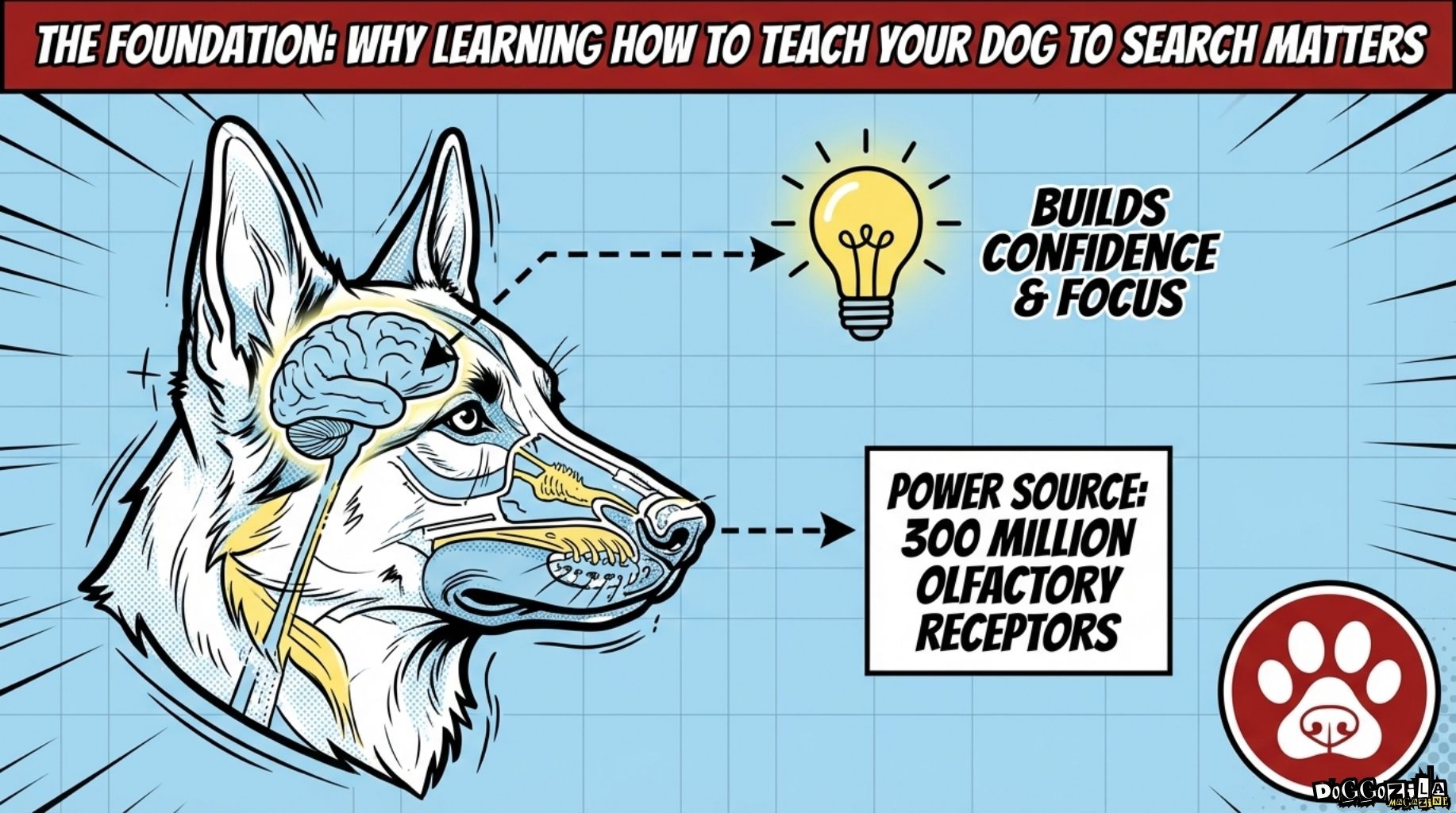
Every dog is a born scent detector. Their noses possess up to 300 million olfactory receptors. When they sniff, they are reading a complex story of their environment. A search game directly engages this hardwired biology, providing deep mental satisfaction.
It turns a fun activity into a species-specific job that feels inherently right to them. Recognizing this innate ability is the first step in how to teach your dog to search effectively. You are not creating a new skill from scratch. Instead, you are giving a natural, powerful instinct a name and a positive outlet they will love.
Build Confidence and Reduce Anxiety As You Teach Your Dog How to Search
Searching is a powerful tool for building a shy or anxious dog’s confidence. The game has clear, achievable rules, search, find, get rewarded. Success is almost guaranteed when you set it up right, creating a powerful positive feedback loop. Anxious dogs often feel a lack of control in the world.
The “Find It” game gives them a job where they are the successful problem-solver. This controlled success can translate to greater confidence in other unfamiliar situations. For any owner, this confidence-building aspect is a beautiful benefit of learning how to teach your dog to search.
You Provide Essential Mental Stimulation When You Teach Your Dog How to Search
A tired dog is a good dog, but physical exhaustion alone is rarely enough. Mental exercise is crucial for preventing boredom-based behaviors like chewing or barking. Just fifteen minutes of focused searching can be more exhausting than an hour-long walk. It forces your dog to concentrate, problem-solve, and work persistently.
This mental workout is a cornerstone of a balanced, happy dog life. Integrating search games is a critical part of how to teach your dog to search for a calmer household. It addresses the root cause of many behavioral issues by fulfilling their innate need to work.
🔑 Key Points: Teaching your dog to search taps into their powerful natural instincts, providing essential mental exercise, building confidence, and reducing anxiety by giving them a satisfying, success-oriented job.
GETTING STARTED: FIRST STEPS TO TEACH YOUR DOG HOW TO SEARCH
The journey begins with joyful simplicity. Your goal in the first sessions is to build one strong association, “Find It” means “Use your nose to get amazing treats.” Keep sessions short, sweet, and wildly successful. If you or your dog get frustrated, you are moving too fast. This phase is all about setting the stage for a lifetime of fun. Patience here pays off immensely later.
Remember, you are building enthusiasm and trust, not testing limits. Celebrate every small success to fuel their desire to play again. This positive start is the most important part of learning how to teach your dog to search.
Choose High-Value Rewards to Teach Your Dog How to Search
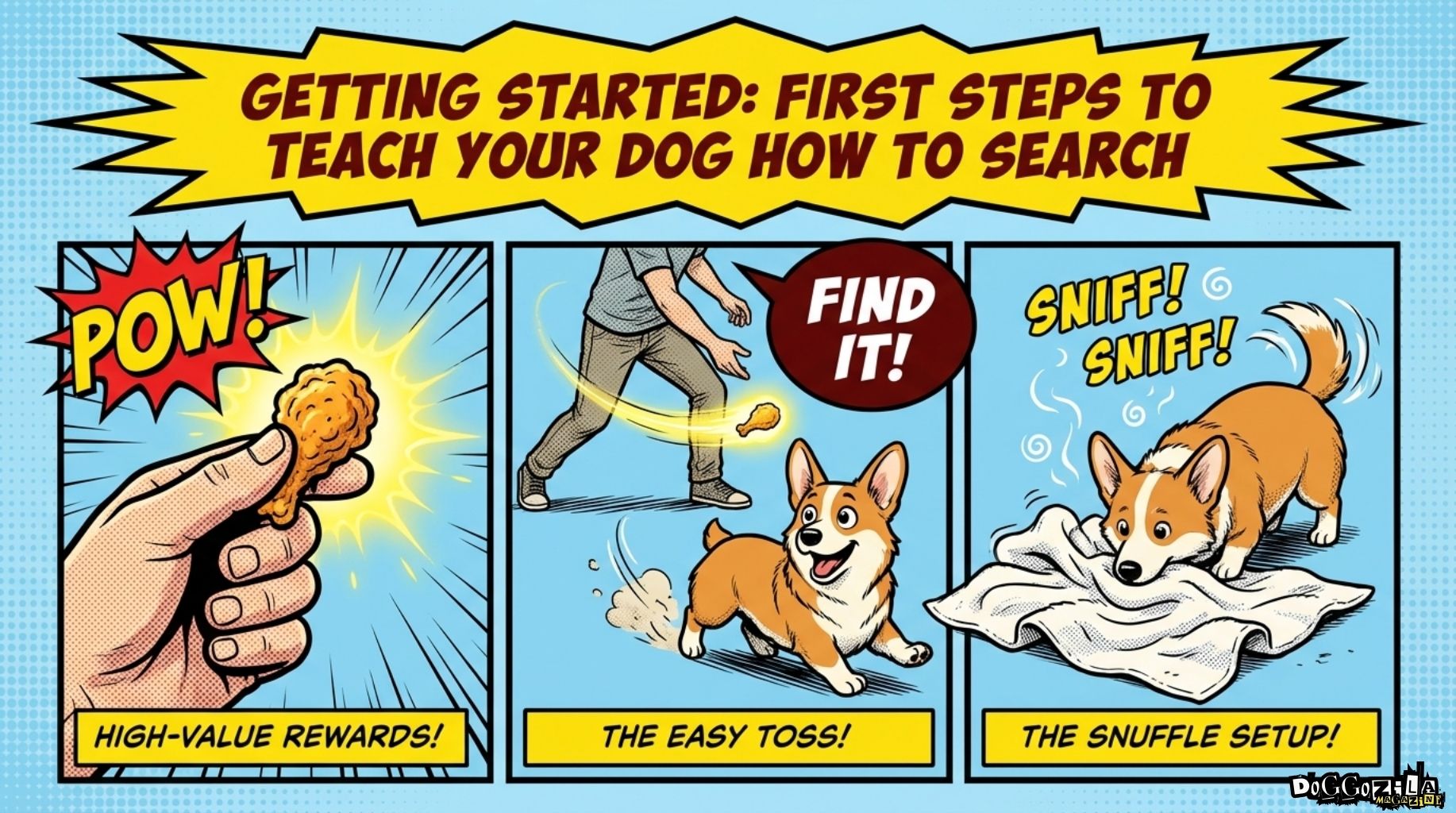
Your training currency must be truly irresistible to your dog. Start with small, smelly, soft treats they love, like diced chicken, hot dog bits, or cheese. The reward must be worth the effort of the “search.” Reserve these special treats exclusively for search training to maintain their high value.
Before you even say the cue, let your dog sniff a treat in your hand to build immediate excitement. This step in how to teach your dog to search is non-negotiable for solid progress. A mediocre reward leads to mediocre motivation. Find what makes your dog’s tail wag fastest and use it!
Introduce “Find It” Cue Without Hiding to Start Your Search Training
Begin with absolutely zero pressure for your dog. With your dog watching you, simply toss a treat a few feet away on an open floor. Happily say, “Find It!” as they go to get it. Repeat this 5-10 times in a row. You are teaching the verbal cue while the action is obvious and easy.
The dog quickly learns that the sound “Find It” predicts the chance to snag a tasty morsel. This is the foundational association for how to teach your dog to search. Never say the cue when your dog is not paying attention, it must be tightly linked to the action of seeking and finding.
Create a “Snuffle Mat” Setup as You Teach Your Dog How to Search
Before hiding anything, increase your dog’s engagement with a fun scatter. Take a handful of their kibble or treats and scatter them in a small area of plain grass or on a towel laid on the floor. Hold your dog back gently for a second, say “Find It!” with excitement, and then release them to snuffle out the goodies.
This teaches them to hunt for treats in a broader area, not just retrieve a single visible one. It is a low-stress, high-success method that builds strong drive and is a core technique in how to teach your dog to search. It makes the game easy and immensely rewarding right from the start.
🔑 Key Points: Begin with simple, rewarding steps: use high-value treats, introduce the “Find It” cue with visible throws, and use scatter feeding to build excitement and a positive association with the game.
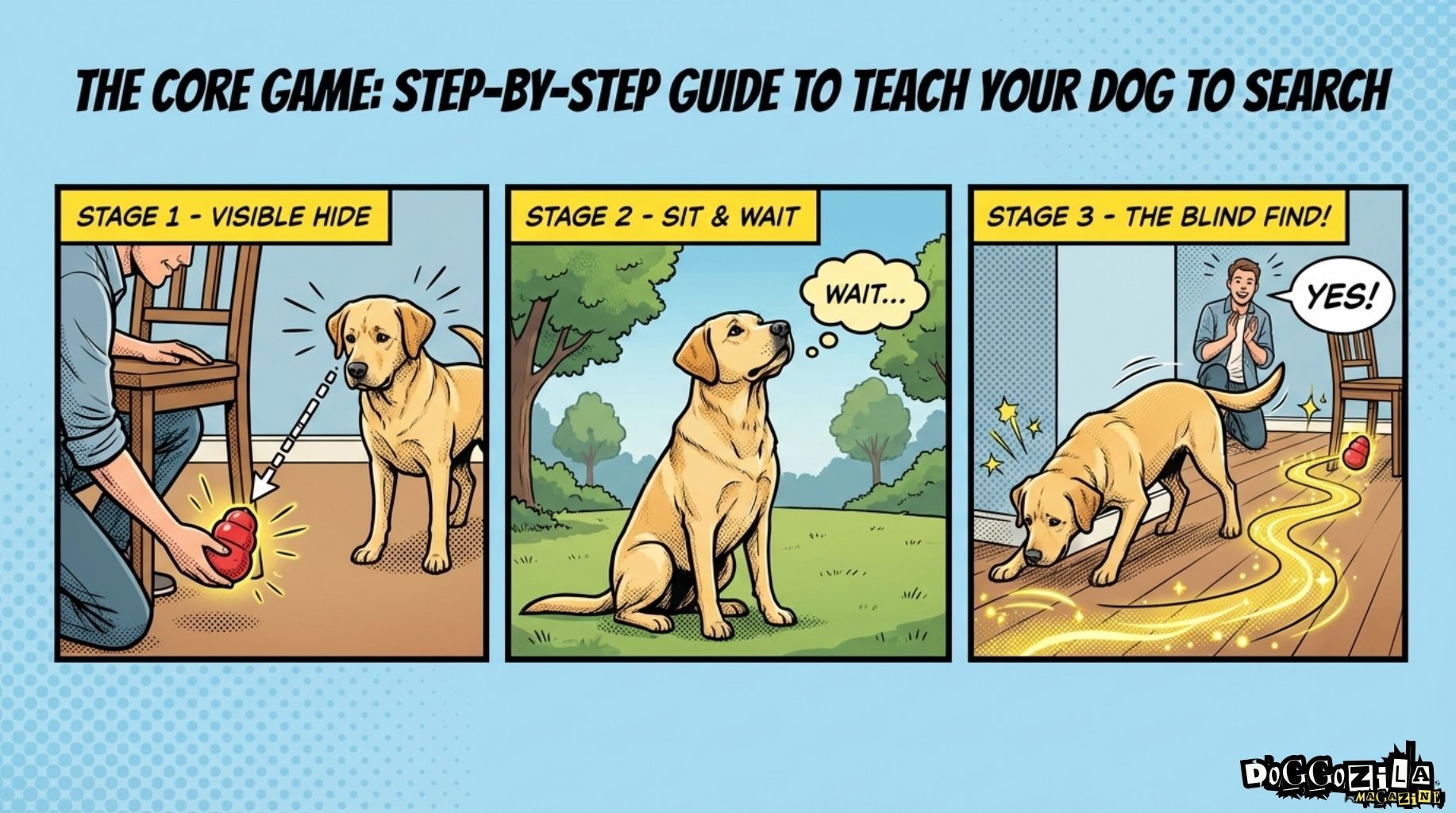
STEP-BY-STEP GUIDE TO TEACH YOUR DOG HOW TO SEARCH ON CUE
Now we build the classic search game. Your dog will learn to find a hidden target, first with visual help, then using scent alone. This process requires a “target scent article“, an object that always holds the treats. A classic Kong, a small fabric pouch, or a specific plastic container works perfectly.
Consistency with this article helps your dog understand the game’s objective, find that specific smell. This is where the real detective work begins for your pup. Following the steps methodically is the secret to how to teach your dog to search successfully. Go at your dog’s pace and keep it fun.
Stage 1: Hide and Seek Method to Teach Your Dog How to Search
Start with your dog out of the room or on a solid “stay.” Let them see you place their target article, with treats inside, in plain sight behind a simple obstacle like a chair leg. Return to your dog, build some excitement, and say “Find It!” Encourage them to go get it. Celebrate wildly with praise and treats when they do.
Repeat this, letting them watch you “hide” it in a few different easy spots. This builds a clear understanding, “My job is to go to that thing when I hear the words.” This visible stage is a critical first move in how to teach your dog to search for a specific object. It builds confidence by making the goal obvious.
Stage 2: Add the “Sit and Wait” for Better Search Training
Now, add a little distance and impulse control to the game. Have your dog “Sit and Wait” while they watch you walk a few steps away. Place the article in another easy spot, like just around a doorframe. Return to their side, pause for a second, then give the command “Find It!“
This builds anticipation and teaches them to search only on your cue. Keep the hides very easy at this point. Success builds confidence and solidifies the rules of the game, a fundamental principle in how to teach your dog to search with good manners. This step turns the game into a cooperative activity with structure.
Stage 3: The First Blind Search to Solidify The Dog Training
This is the magic moment where scent takes over. With your dog waiting out of sight, hide the scented article in a new but still very easy location, on a low shelf or behind a single cushion. Bring your dog into the area, give your excited “Find It!” command, and let them work.
Do not help or point! Let them use their nose. If they struggle, simply move closer to the hide and encourage them verbally. The “aha!” moment when they find it purely by scent is incredible and rewarding for both of you. Achieving this blind find is the core goal of how to teach your dog to search. It unlocks their natural abilities.
🔑 Key Points: Progress methodically from visible hides to blind searches using a specific scent article, teaching your dog to use their nose to find a target, which is the core skill of scent work.
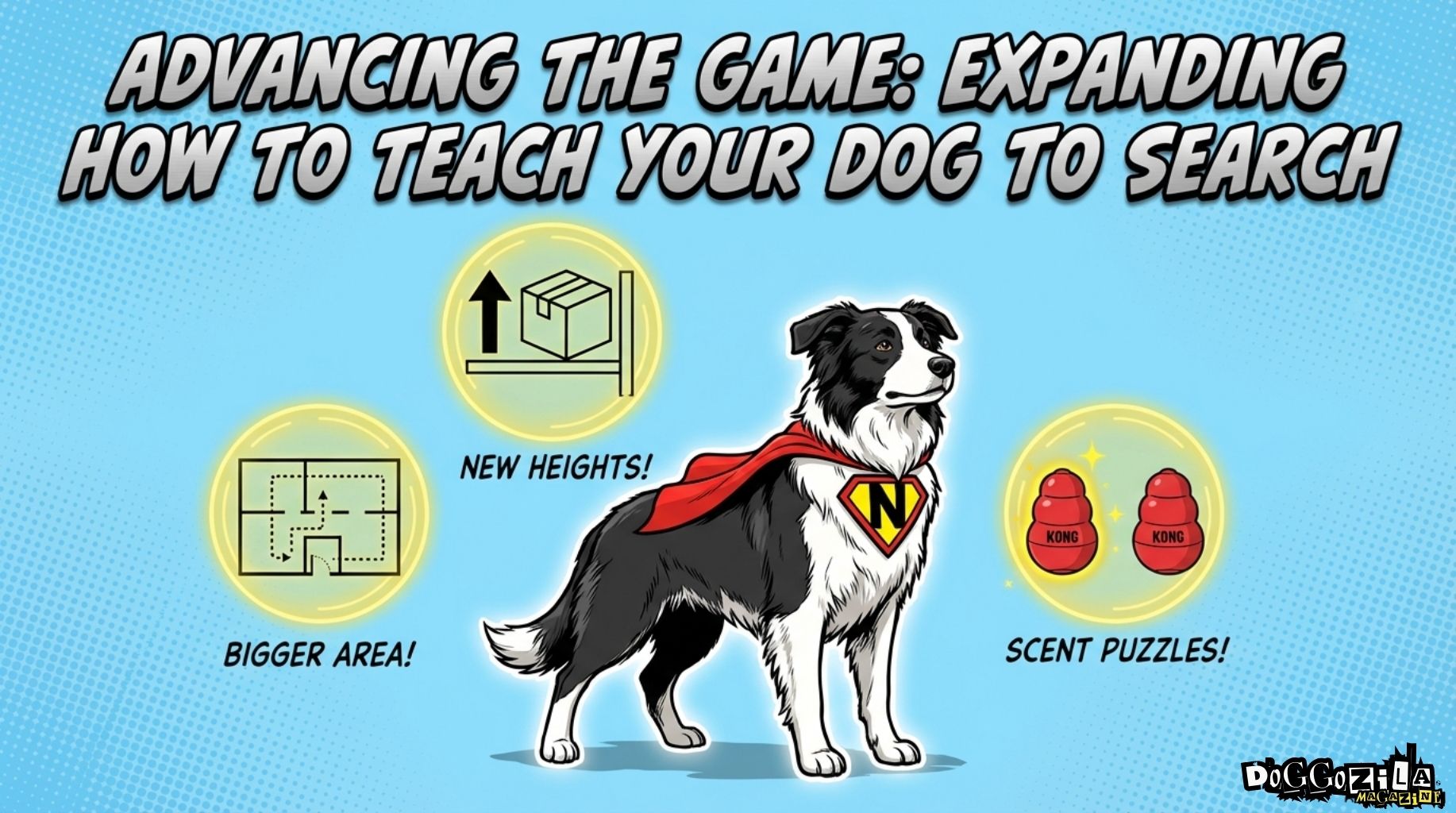
ADVANCING THE GAME: EXPANDING HOW TO TEACH YOUR DOG TO SEARCH
Once your dog masters finding the target article in easy room hides, the real fun expands. You can grow the game in three dimensions, area, difficulty, and duration. This keeps the game fresh and challenging, continuously working your dog’s brain.
The key to advancement is the “Rule of Three“, only increase one variable at a time. If your dog fails twice in a row, go back to an easier step to keep the game positive. This strategic approach is the next level of how to teach your dog to search like a pro. Always end on a successful find to keep their motivation high.
Increase the Area Gradually As You Teach Your Dog How to Search
Start by expanding the hide-and-seek within a single room. Then, move to a two-room search, and later to the entire floor of your house. For outdoor training, always start in a small, fenced, familiar area before expanding further. Ensure the new area is safe and has minimal distractions at first.
As your dog’s skill and confidence grow, you can practice in more complex environments like a quiet park. Managing the search area size is a strategic part of how to teach your dog to search in varied locations. It teaches them to systematically cover ground and not give up.
Add Height and Complexity to Hides in Your Search Training
Move beyond floor-level hides to challenge your dog’s mind. Place the article on a sturdy chair seat, a low windowsill, or inside an open drawer. Use happy verbal encouragement if they need guidance, but let their nose do the primary work. You can also begin to hide it inside or under objects that require a little manipulation.
For example, under a loose blanket or behind a door. Teaching them to search at different heights is a fun and important evolution in how to teach your dog to search every nook and cranny. It teaches them that the target scent can travel and be found anywhere.
How to Introduce a Second Article to Refine Your Dog’s Search Skills?
To refine their scent discrimination skills, introduce a second, identical-looking article that does not contain food. Hide both in plain sight at first, but only reward for finding the “hot” one that smells like treats. This teaches them to ignore visual cues and focus purely on the target scent, which is a more advanced and valuable skill.
This step elevates your understanding of how to teach your dog to search for a specific odor, not just a familiar object. It sharpens their natural abilities and prepares them for more formal scent work tasks.
🔑 Key Points: Expand the challenge gradually by increasing the search area, adding height and complexity to hides, and introducing scent discrimination to keep your dog mentally engaged and sharp.
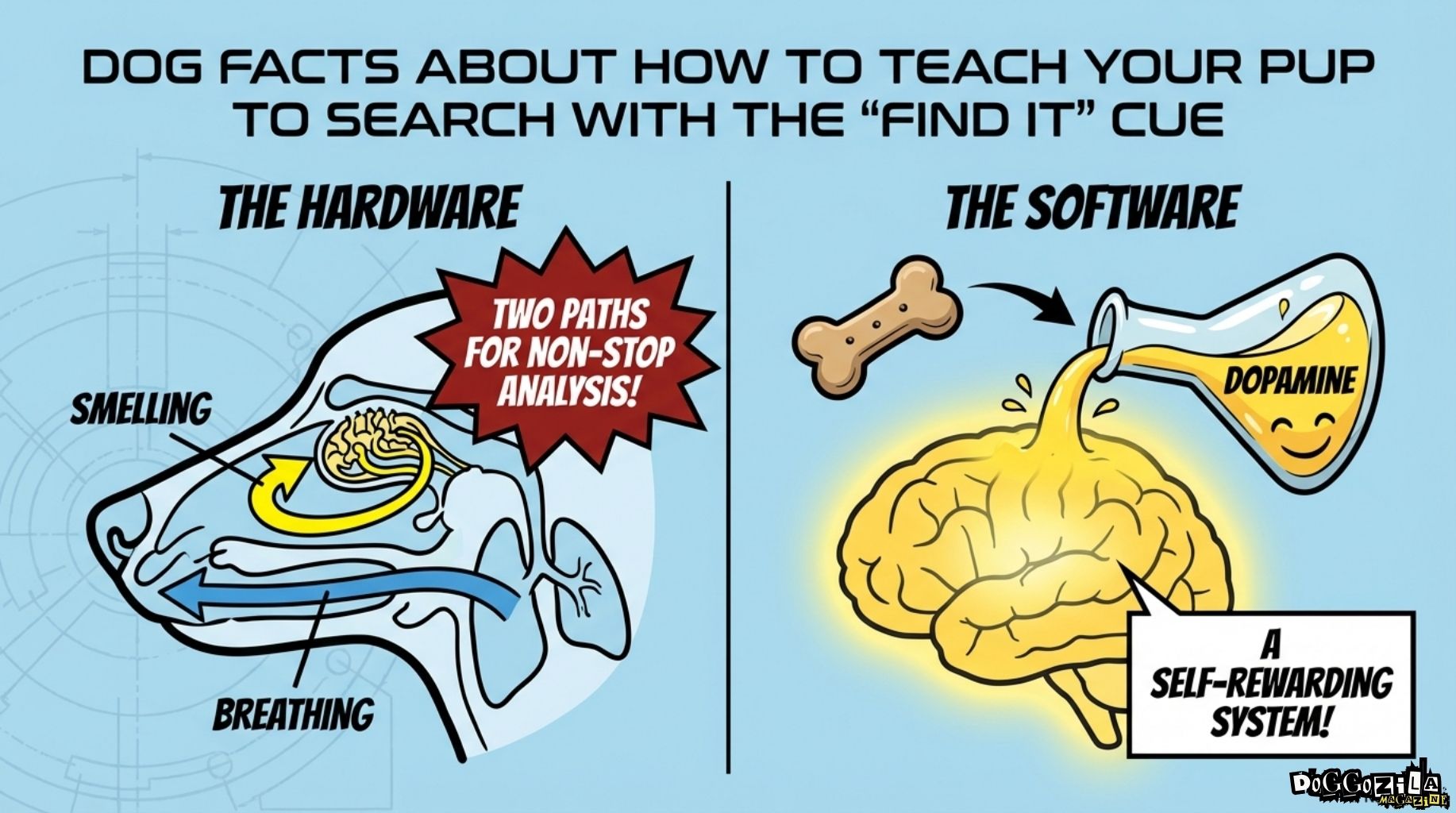
DOG FACTS ABOUT HOW TO TEACH YOUR PUP TO SEARCH ON CUE
Beyond being a fun game, the “Find It” activity connects you to the very essence of canine nature. Understanding some fascinating dog facts about this process deepens your appreciation and can make you a more effective teacher. It transforms training from a simple task into a collaborative exploration of your dog’s amazing abilities. Knowing why certain methods work so well helps you apply them with greater confidence and patience.
These facts highlight that when you learn how to teach your dog to search, you’re not just training a behavior. You are communicating in a language their biology understands perfectly. This knowledge is a powerful tool for any owner and makes the journey more rewarding for both ends of the leash.
A Dog’s Nose is Designed for the “Find It” Game You’re Teaching
The dog nose is a masterpiece of biological engineering, and the “Find It” game is its ultimate playground. When dogs sniff, they can separate air into two paths, one for breathing and one dedicated solely to smelling. This allows them to analyze scents continuously without interruption. Their wet nose even helps capture scent particles, making detection more efficient.
This incredible hardware means that searching is not hard work for them, it’s a fulfilling and natural action. When you learn how to teach your dog to search, you are essentially providing the software update that directs this incredible hardware toward a fun and rewarding goal. This fact reminds us that we are working with a born expert, not creating one from scratch. Your job is simply to guide and reward their innate genius.
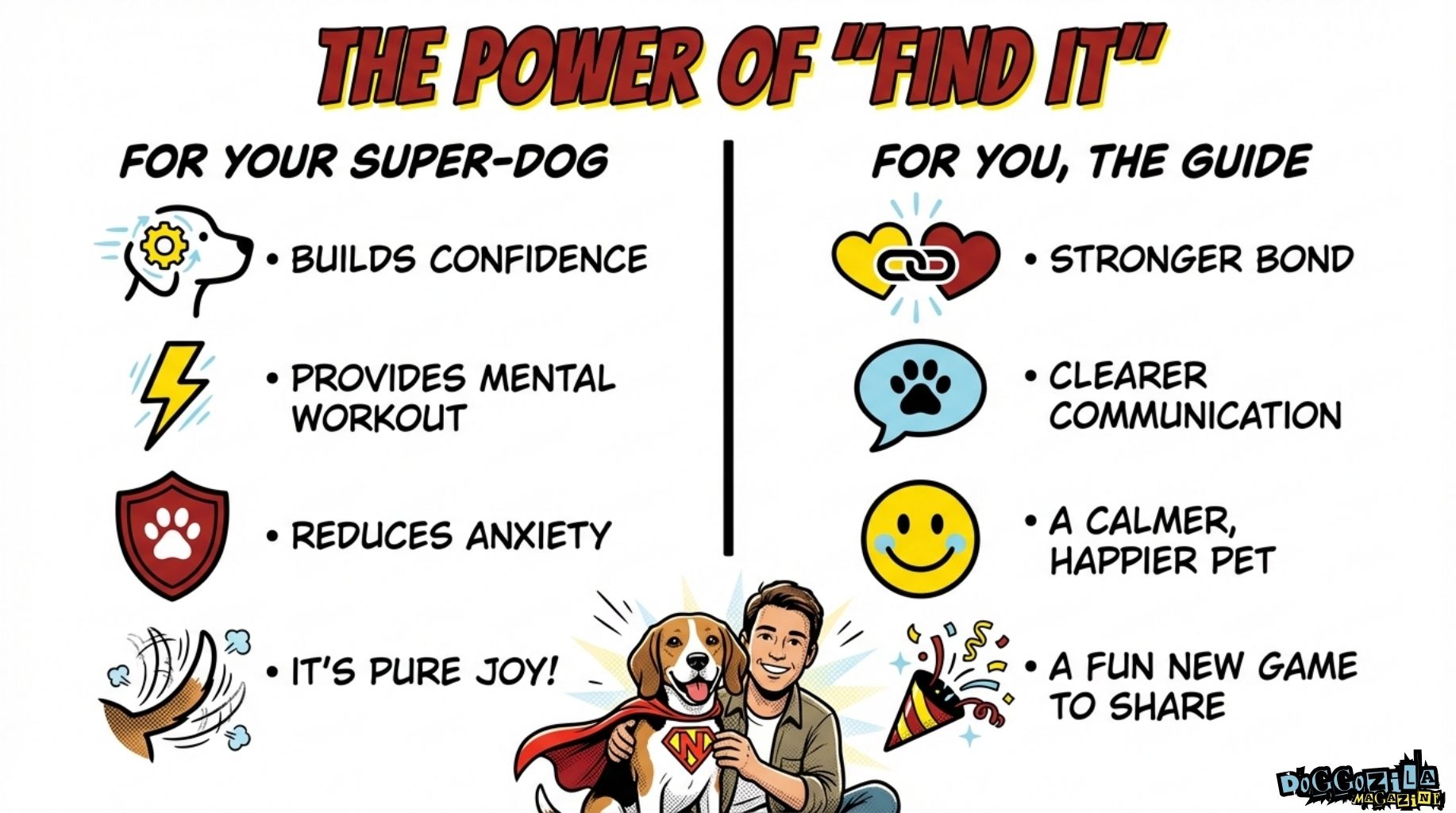
Searching Triggers a “Happy Brain” State in Your Dog
The act of searching and finding is neurologically rewarding for your dog, much like solving a puzzle is for us. Successful scent work has been shown to release dopamine, a neurotransmitter associated with pleasure, reward, and motivation. This creates a powerful positive feedback loop where the activity itself becomes the reward.
This is why a dog who loves “Find It” will often get excited just seeing you get the training pouch, they anticipate the brain boost. This biological reward system is a key reason how to teach your dog to search is so effective for building confidence and reducing stress. It literally changes their brain chemistry for the better in a safe and controlled way. Tapping into this natural reward circuit is the secret to a happy, motivated trainee.
Related Article and Video Guide with Scent Games for Dogs!
Access The Article from This Link: Scent Games for Dogs!
Watch The Video Guide Below!
🔑 Key Points: Understanding canine biology, like their incredible scenting hardware and the dopamine release from searching, makes you a more effective, empathetic trainer and deepens your bond.
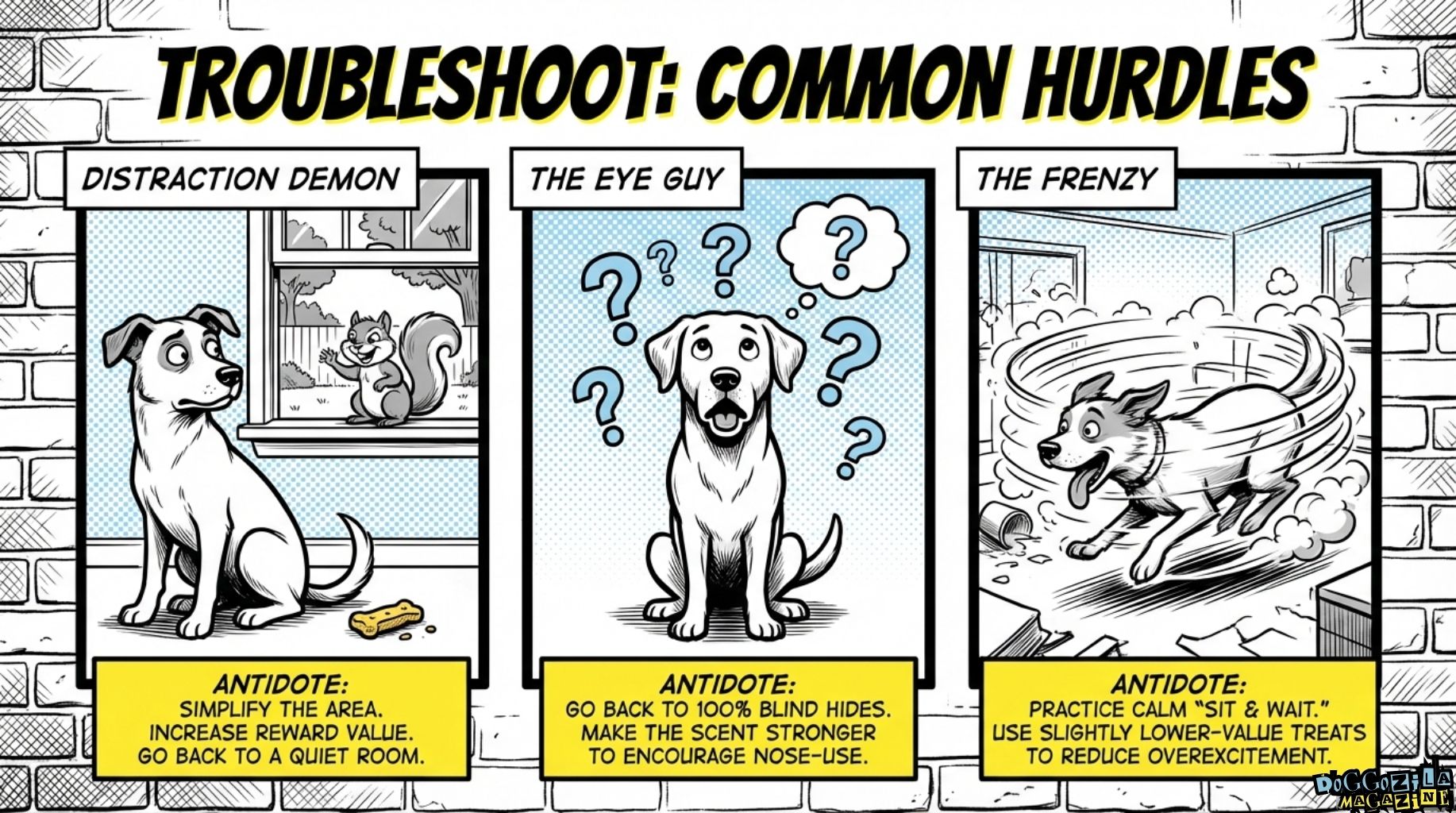
TROUBLESHOOT HURDLES WHEN YOU TEACH YOUR DOG HOW TO SEARCH
Not every training session will go perfectly. Hitting a plateau or a problem is completely normal. The key is to diagnose the issue calmly and back up a step. Frustration is the enemy of learning, for both of you. Most problems stem from moving too fast, rewards that aren’t motivating enough, or distractions that are too high.
View each hurdle not as a failure, but as valuable feedback from your dog. This feedback tells you to adjust your approach for better results. Problem-solving is an integral, expected part of learning how to teach your dog to search. Stay patient and positive.
Why My Dog Get Distracted and Give Up During Search Training?
This usually means the environment is too challenging or the rewards are not valuable enough. The fix is simple, go back to a simpler, familiar space like a quiet hallway or bathroom. Use a much higher-value treat, like real meat or fish. Make the hide super easy again to rebuild success and excitement.
Shorten the search distance so the reward comes quickly. Building focus is a gradual process, and managing distractions is a key lesson in how to teach your dog to search effectively. Ensure you have their full attention before you even begin the game.
Why My Dog Finds It Visually But Doesn’t Use Their Nose in Searches?
If your dog relies on sight, you have likely made the visual component too easy for too long. Go back to basics with complete “blind” hides where they cannot see the article from the start. Use containers or hiding spots that visually obscure the object entirely.
You can also rub the treat on the outside of the article to create a stronger, more obvious scent trail for them to follow. Transitioning from sight to scent is a specific and important phase of how to teach your dog to search properly. Be patient as they learn to trust their nose over their eyes.
Why My Dog Get Overexcited and Forget to Search When Playing?
Frenzied excitement can short-circuit your dog’s thinking brain. If your dog is zooming without sniffing, they are in an emotional state, not a thinking one. Practice calm “Sit and Wait” exercises before starting the search. Sometimes, using slightly lower-value treats can help reduce frenzy.
Do a few very simple, almost boring finds to calm the energy before attempting a new challenge. Teaching emotional regulation is part of the broader picture of how to teach your dog to search in a controlled, focused manner. A calm dog is a better searching dog.
🔑 Key Points: If your dog gets distracted, relies on sight, or becomes overexcited, simply go back to an easier step, increase your reward value, and manage the environment to rebuild focus and calm.
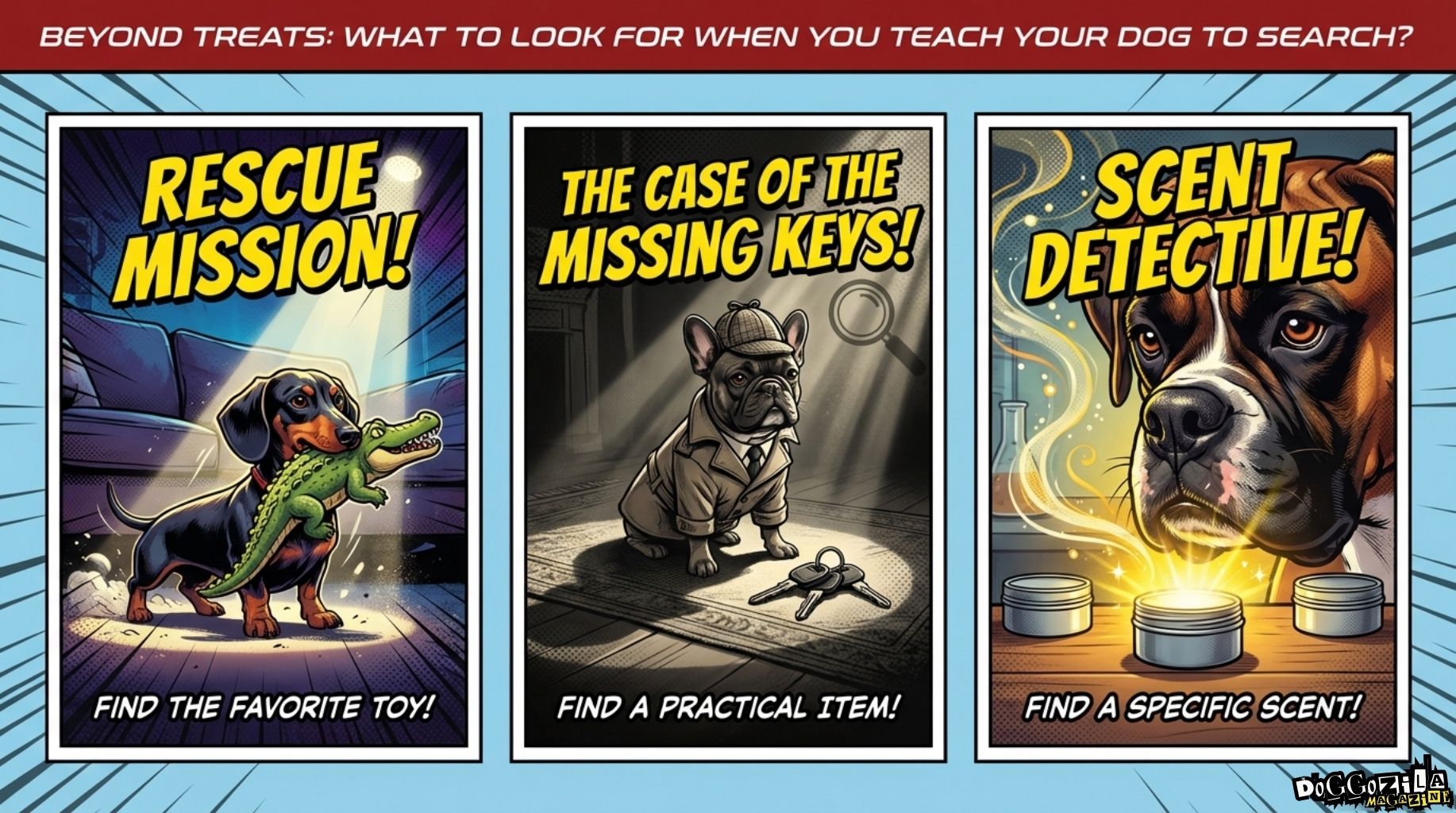
WHAT TO LOOK FOR WHEN YOU TEACH YOUR DOG HOW TO SEARCH?
The “Find It” game has incredibly practical and fun applications far beyond finding a treat pouch. Once your dog understands the game, you can search for virtually anything that has a unique scent. This turns a fun activity into a useful skill, deepening your dog’s understanding. It provides even more purposeful mental work and strengthens your bond.
Expanding the targets showcases the true versatility of the foundation you’ve built. It answers the broader question of how to teach your dog to search for real-world objects. Get creative and tailor the game to what your dog loves most.
Teach Your Dog How to Search with The Favorite Toys
Many dogs have a beloved toy like a ball or a stuffy. Use this as a search target! Let them see and smell the toy, then hide it while they wait. The reward is the fun play session that happens after they find it. This is a fantastic way to engage toy-motivated dogs who might not be food-driven.
It can even help a dog who has lost a toy under the couch learn to find it themselves. Integrating toys is a joyful and natural expansion of how to teach your dog to search. It blends play with work perfectly.
Find My Keys: Practical Game To Teach Your Dog How to Search
Teach your dog to find specific household items by scenting them up. Rub the item (like your keys or TV remote) in your hands to transfer your scent, then let your dog sniff it. Hide the item in an easy spot and give a new command like “Find the keys!”
Reward lavishly with treats and praise when they succeed. With consistent practice, they can learn to differentiate between items. This practical application is a brilliant and useful outcome of learning how to teach your dog to search. It turns a game into a helpful household behavior.
Introduce Scent Discrimination to Advance The Search Training
For dogs who truly excel and love the game, you can introduce formal scent work concepts. Start by teaching them to identify a specific, dog-safe essential oil (like birch) on a cotton swab placed in a perforated metal tin. The process is similar, they learn that finding the tin with the birch smell earns a reward, while other tins do not.
This can lead to organized dog nose work sports, which is the competitive and deeply satisfying pinnacle of how to teach your dog to search with precision. It offers a fantastic hobby for both of you.
🔑 Key Points: Once the basics are mastered, you can search for toys, lost items like keys, or even introduce specific scents, transforming the game from a fun activity into a practical and advanced skill.
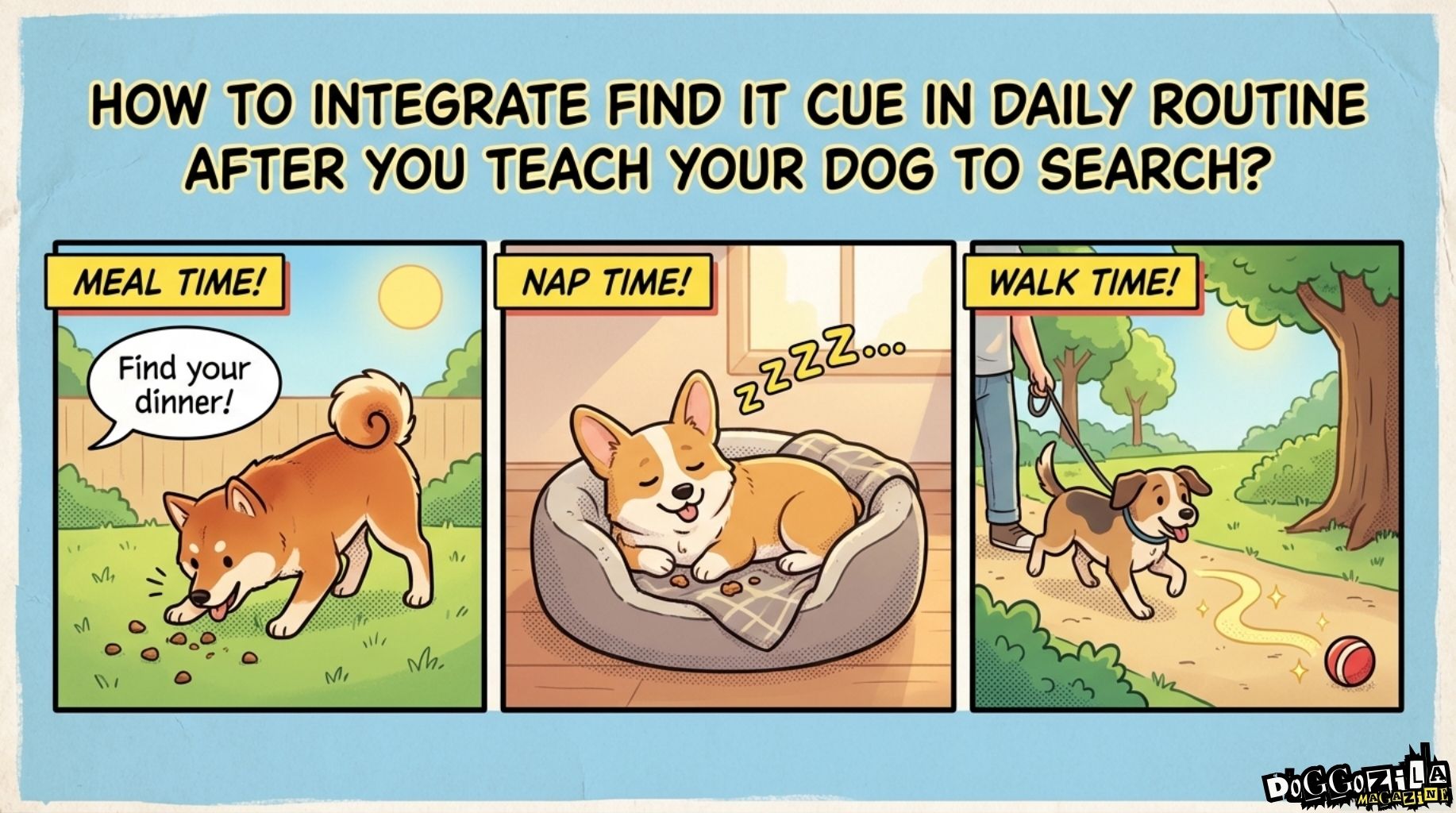
HOW TO INTEGRATE THE “FIND IT” CUE IN YOUR DAILY ROUTINES?
The ultimate goal is to weave searching seamlessly into your daily life. It should not feel like a formal “training session,” but a spontaneous game that enriches your routine. This integration provides constant low-dose mental stimulation. It reinforces your dog’s skills in a variety of contexts without extra effort. It turns your dog from a passive pet into an active participant in household activities.
This strengthens your bond in countless small,fun ways. This is the final, rewarding stage after you teach your dog to search. It makes their new skill a natural part of their world.
The Pre-Dinner “Find Your Kibble” Scatter After Search Training
Instead of feeding from a boring bowl, scatter your dog’s entire dinner across a large section of lawn or hide it in multiple spots in a room. Give the “Find It!” release command. This turns every mealtime into a 15-minute foraging expedition that satisfies their natural scavenging instincts.
It is a simple, daily way to practice how to teach your dog to search without any extra time commitment on your part. It slows down fast eaters and makes them work for their food in a healthy, engaging way.
The “Seek and Settle” Wind-Down Game Using Search Skills
Use a short, easy search as a calming ritual before quiet time or crate time. Hide a few treats in their dog bed or blanket and have them “Find It” there. The act of searching and then eating in their bed helps them associate their resting place with positive, calm activity.
It uses mental energy to promote physical relaxation. This clever application shows how to teach your dog to search can directly support good behavior and relaxation. It’s a perfect pre-nap or pre-bedtime activity for an antsy pup.
Create a “Search Trail” on Walks With Your Trained Dog
On a safe, familiar path, have your dog wait or be held by a helper. Walk 20-30 feet ahead and drop a trail of treats or their favorite toy, ending with a small pile. Double back, release them with an enthusiastic “Find It!” and let them track the trail to the big reward at the end.
This brilliantly incorporates searching into your regular walks and builds the dog’s natural tracking ability. It is the ultimate fusion of physical exercise and mental work, perfectly illustrating how to teach your dog to search in the great outdoors.
Final Thoughts About How To Teach Your Dog to Search on Cue
The ultimate reward of this training goes far beyond a dog who can find a treat. It forges a deeper, more empathetic bond built on clear communication and mutual enjoyment. You learn to read your dog’s subtle body language, the focused sniffing, the alert ear flick, the triumphant tail wag.
They learn to trust your cues and see you as a partner in a rewarding adventure. This shared language of discovery strengthens your connection in a unique way. Remembering that the journey is the goal is the most important part of how to teach your dog to search.
Celebrate the partnership, the silly moments, and the quiet successes. In the end, you aren’t just teaching a command, you are building a richer, more understanding relationship with your best friend, and that is the most victorious outcome of all.
🔑 Key Points: Weave searching into daily life through activities like scattering kibble for meals, creating calming “Seek and Settle” rituals, or laying scent trails on walks for sustained mental enrichment.
FREQUENTLY ASKED QUESTIONS (FAQ)