
Do you know what your dog is saying? Your dog talks to you every day. They do not use words. They use their face. A twitch of the whiskers. A shift in the eyes. The position of the ears. This is your dog’s facial expressions.
Learning this language helps you bond. You will know if your dog is happy or scared. New science shows how dogs learned to talk to us. This guide will make you an expert. You will learn the signals and the stories behind each look.
“Want to know what your dog is thinking? Their face holds the answers.”
Quick Summary About DOG’S FACIAL EXPRESSIONS
This article teaches you to read your dog’s face. Learn the simple science of their expressions. Discover how to see happiness, fear, and curiosity. Follow an easy step-by-step guide. Avoid common mistakes. Understand your furry friend like never before.
THE SCIENCE BEHIND DOG’S FACIAL EXPRESSIONS
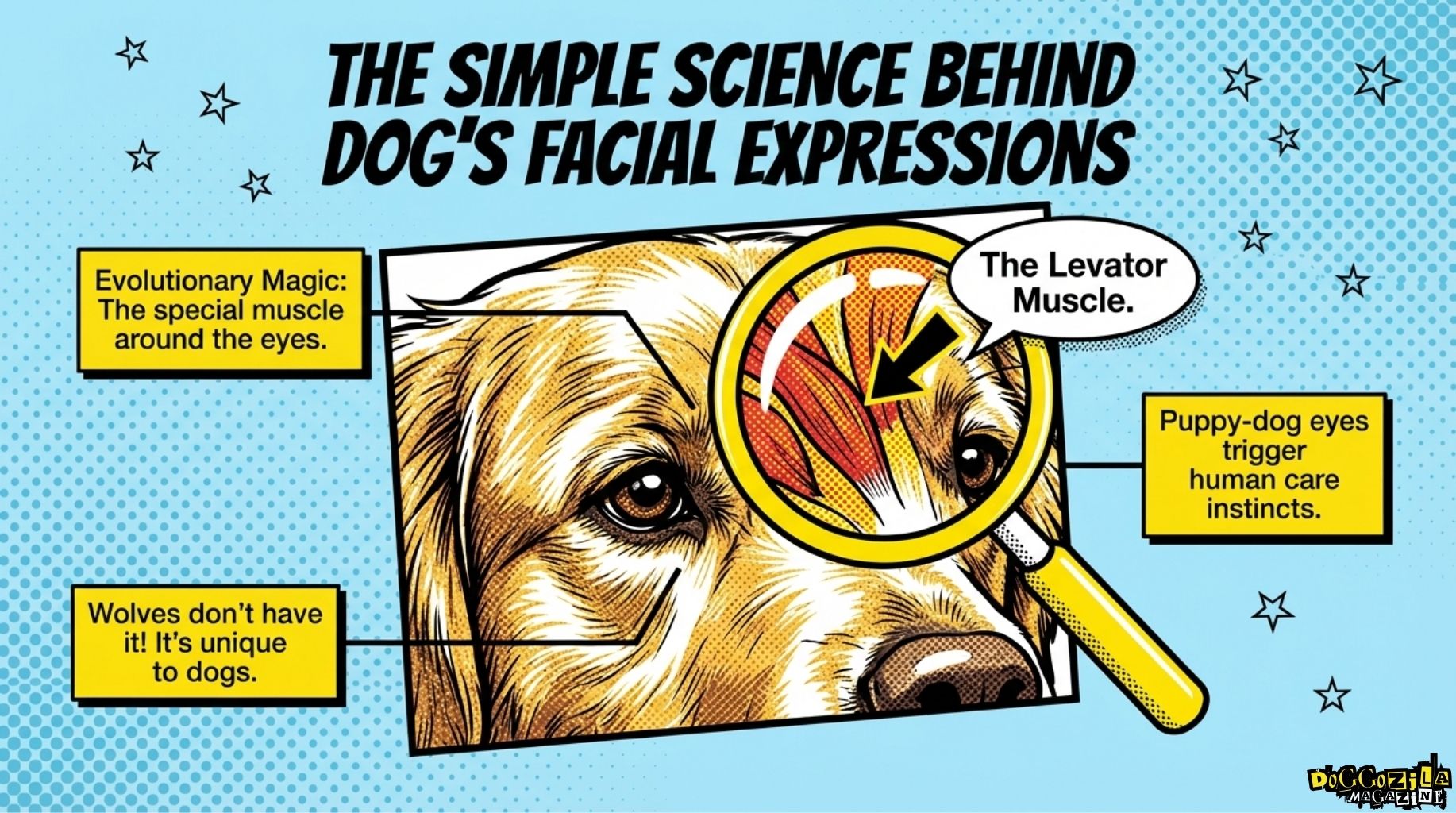
Dogs are great at making faces. This is not by chance. It is because of evolution and biology. New studies have looked at this. Scientists used slow-motion video. They saw tiny muscle movements. They found something cool. Dogs have a special muscle around their eyes. Wolves do not have it. It lets dogs make those sweet puppy-dog eyes. This look makes humans want to care for them.
Another study found dogs make more faces when people watch them. They are talking to us with their faces. The science of dog’s facial expressions shows they do it on purpose.
The Muscle Power of a Dog’s Facial Expressions
A dog’s face has many muscles. They are like human face muscles. Scientists have mapped many separate movements. Raising the inner eyebrow is a big one. A special muscle controls it. This makes the eyes look bigger and sadder. It looks like a sad human baby. Other muscles control the ears. They pull ears back or prick them forward. Mouth muscles can pull lips back in a grin. Every little move in your dog’s facial expressions is deliberate. It is a form of silent talk.
Dog Brains and Feelings
What happens in a dog’s brain when it makes a face? New science gives us clues. Researchers use safe brain scans. They see which brain areas light up. They look when a dog sees its owner or a treat. The brain’s happy centers activate with good dog’s facial expressions. The fear area activates with bad ones. This proves their faces show real feelings. It is not just a reflex. When your dog looks at you softly, its brain is likely happy. This science links the outside face to the inside feeling.
How Dogs Evolved to Talk With Faces?
Why are dogs so good at this? The answer is their history with us. Over thousands of years, expressive dogs did better. The puppies that looked cuter survived. The adults that could signal friendliness did well. This created an evolutionary loop. Humans liked expressive dogs more.
We bred them more. This shaped the modern dog’s face. It gave them expressive eyebrows and mobile ears. The evolution of dog’s facial expressions is a partnership story. Dogs evolved to be understood. We evolved to understand them.
🔑 Key Points: Dogs have special face muscles to communicate with us. Their expressions are a real language.
HOW DOMESTICATION MADE EXPRESSIVE FACES?
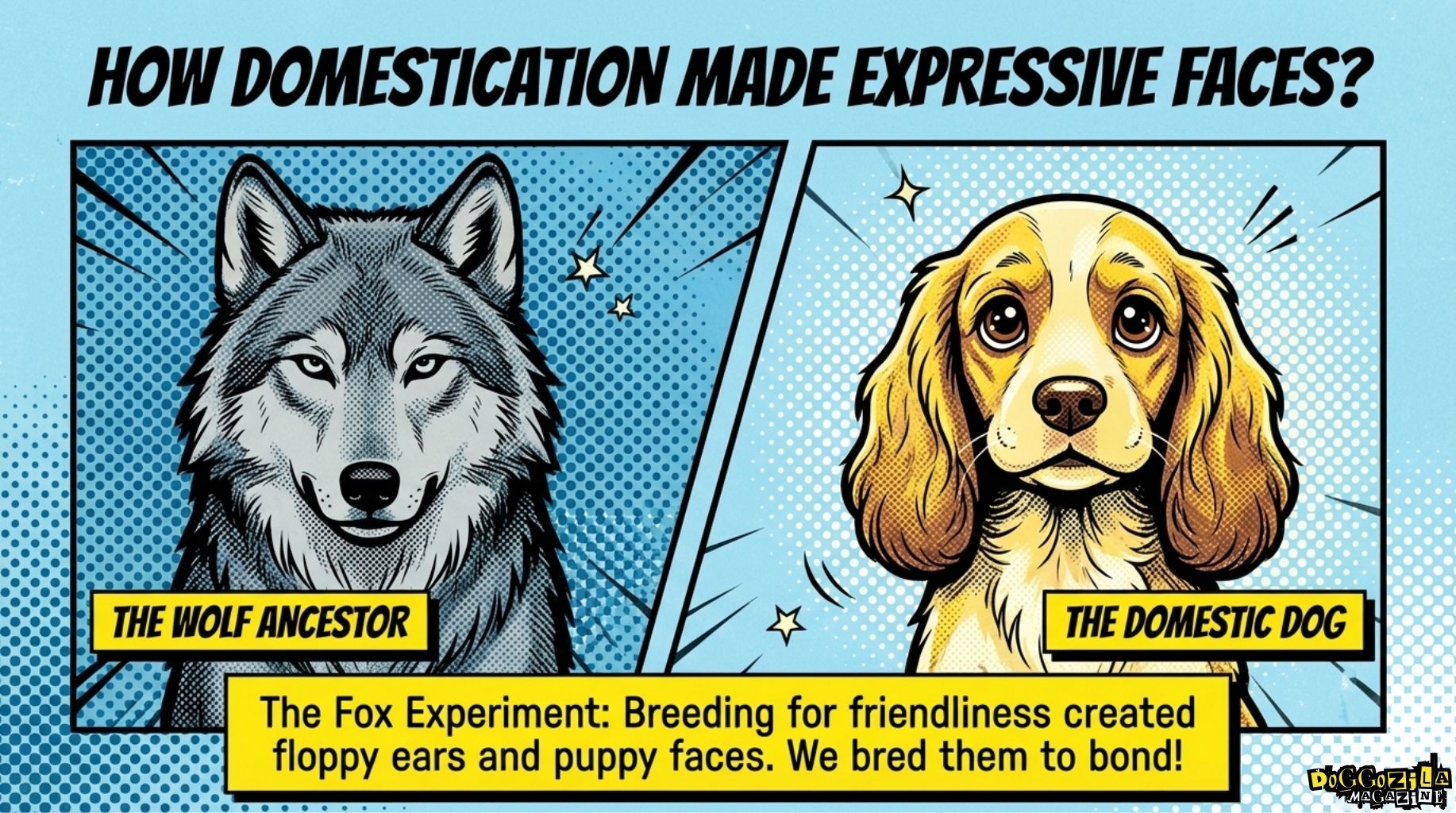
The change from wolf to dog reshaped the face. It made communication better. This is a key part of domestication. Wolves have stiffer faces. They talk with body posture. Dogs have flexible, expressive faces. Our bond shaped their dog’s facial expressions.
The famous “Fox Experiment” proves this. Researchers bred foxes for tameness. After a few generations, the tame foxes looked different. Their ears got floppier. Their faces became more puppy-like. This shows a direct link. Friendly personality connects to a communicative face.
The Power of “Puppy Dog Eyes“
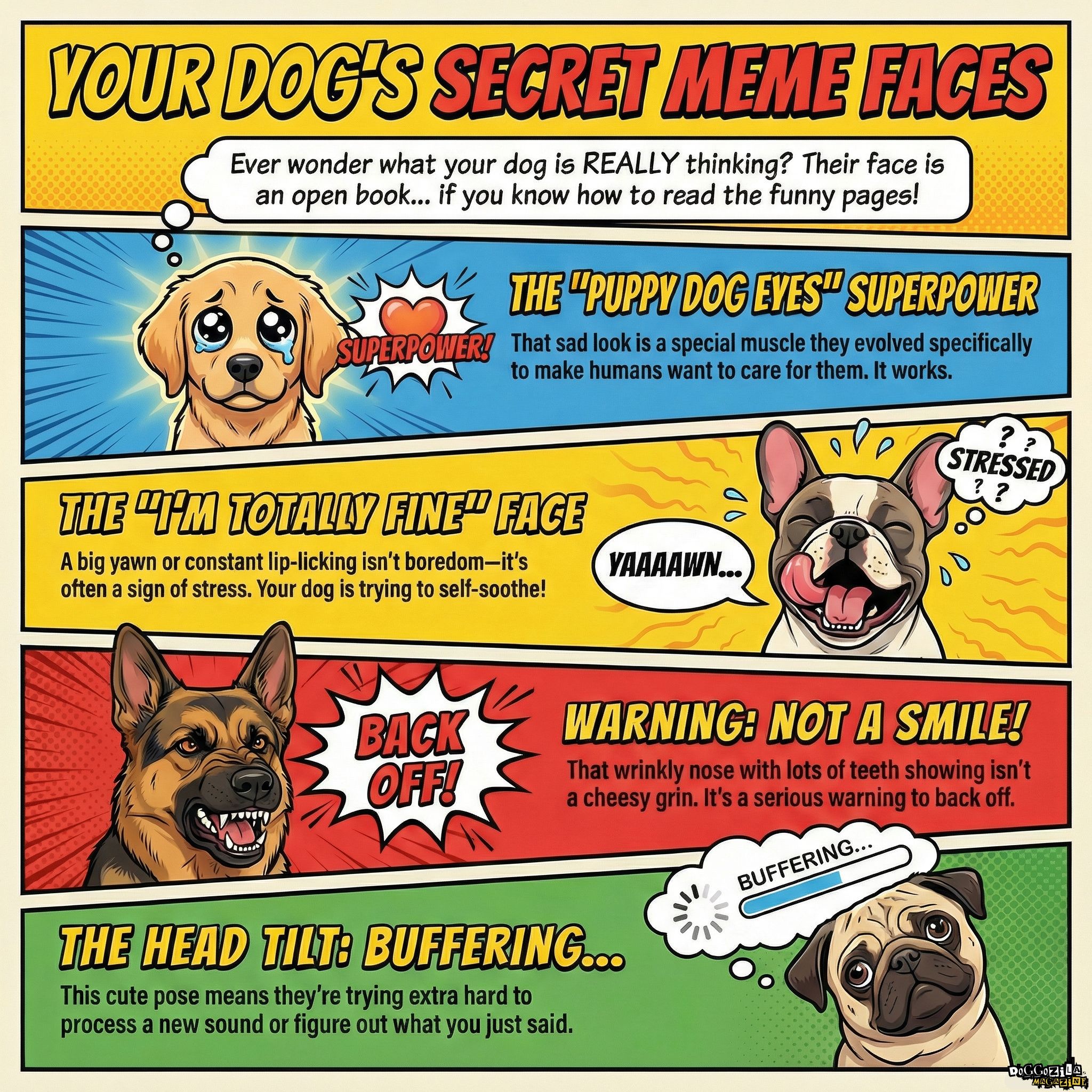
The best example is “puppy dog eyes.” This dog’s facial expressions is a biological tool. Dogs have a muscle to raise the inner eyebrow. Wolves do not. When a dog uses it, their eyes look bigger. Humans are wired to respond to this. Studies show dogs use this look more when people watch them. It is direct communication. Shelter dogs that do this get adopted faster. This single look helped dogs survive. It helped them find homes with humans.
From Survival to Bonding
First, clear dog’s facial expressions helped with survival. A cute puppy was more likely to be fed. An alert dog could warn its family. Over time, it became more. It became about social bonding. Expressive faces allowed for deeper relationships. A dog could show thanks or patience. This turned the partnership into a real friendship. Reading each other’s faces built our unique bond. It is why we feel so close to them.
Breeding for Specific Looks
Later, humans took control. We bred dogs for specific traits. This made natural dog’s facial expressions stronger. We bred Border Collies for a focused “eye” to herd sheep. Than we bred Spaniels for a soft look. We bred Terriers for an alert face. Every breed’s “look” is an exaggerated face. Human selection created amazing variety. From a Shar-Pei’s wrinkles to a Labrador’s smile, each face tells a job’s story.
🔑 Key Points: Living with people made dogs’ faces more expressive. This helped us bond.
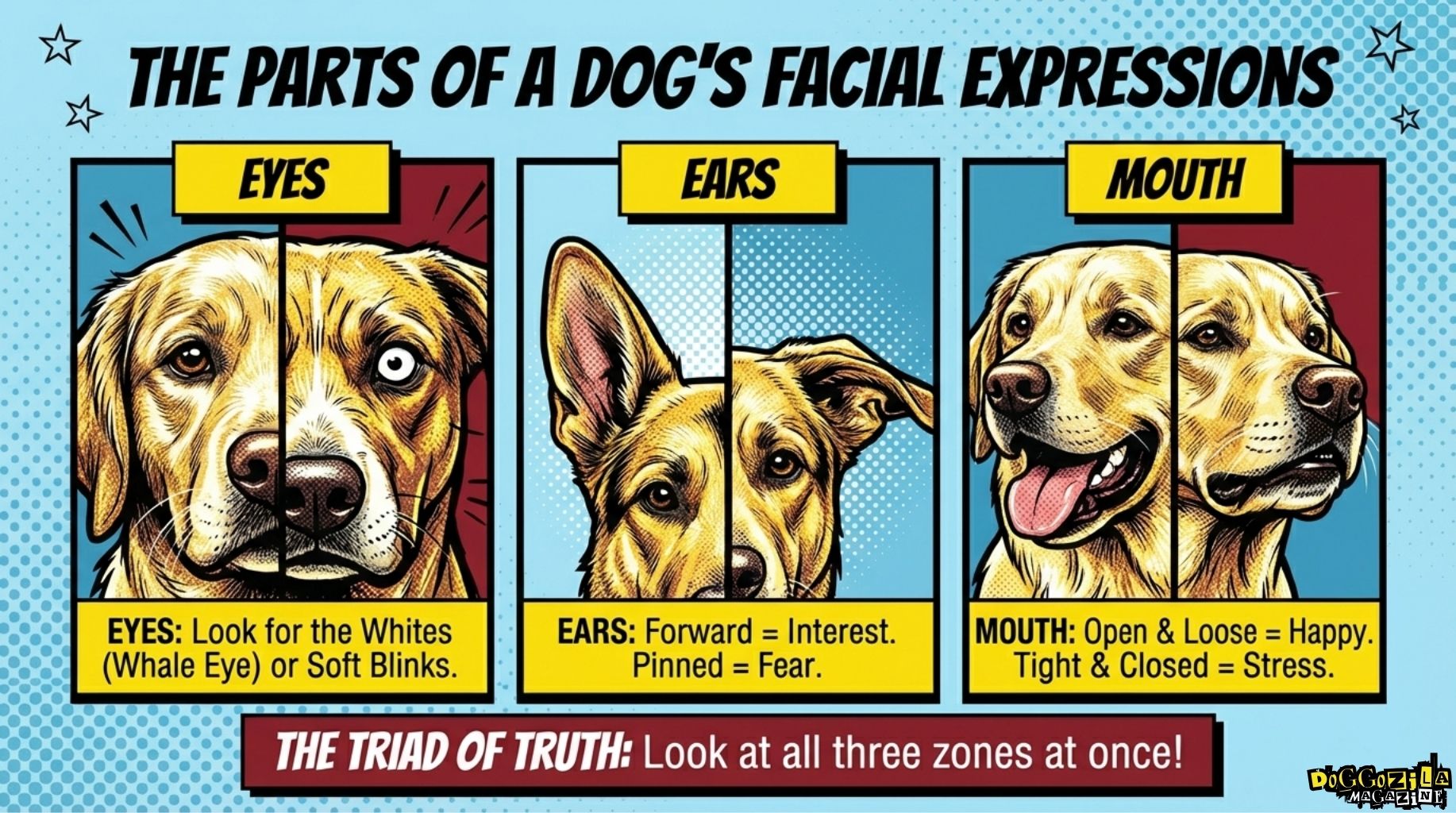
THE PARTS OF A DOG’S FACIAL EXPRESSIONS
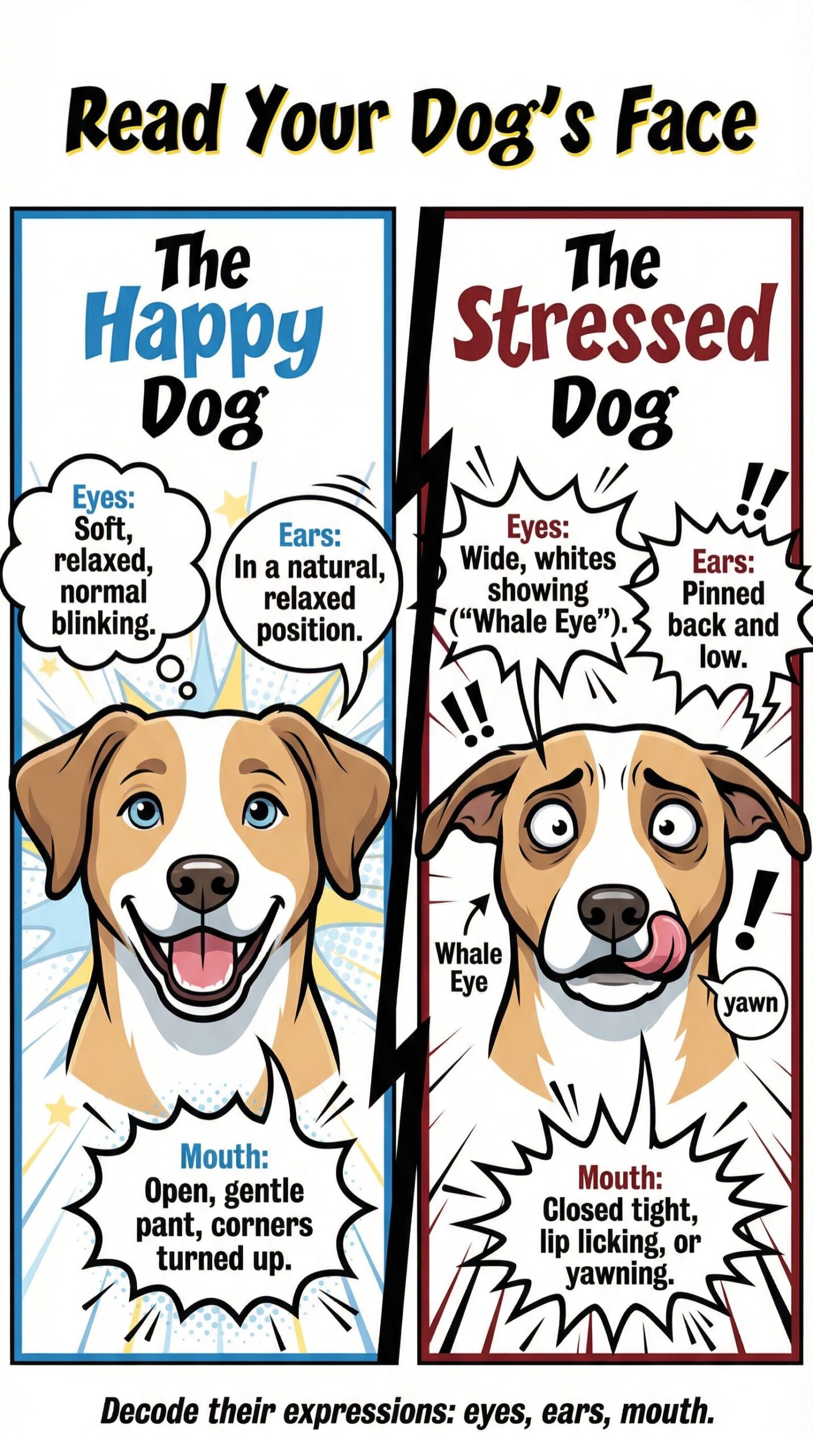
To read a face, know its parts. A dog’s face has three main zones, eyes, ears, and mouth. Each zone moves on its own. But they work together to tell the full story. Eyes can be soft or hard. Ears can be forward, back, or relaxed. The mouth can be open, closed, or showing teeth.
Look at all three zones at once. One signal can be misleading. The true meaning of your dog’s facial expressions comes from the combination.
Reading the Eyes
The eyes are the most important part. Look at the eye shape and gaze. Look for the whites of the eyes. Soft, relaxed eyes with normal blinking mean a happy dog. Hard, staring eyes mean a threat. When a dog looks away and shows the eye whites, it is stressed. This is called “whale eye in dogs.” A slow blink is a dog’s kiss. It shows trust. You can blink back to calm a nervous dog. Always see the eyes with the rest of the face.
What Ears and Mouths Say?
Ears are great mood signs. Forward ears show interest. Relaxed ears to the side show a calm dog. Ears pinned back mean fear or worry. The mouth finishes the story. A relaxed, open mouth with a hanging tongue is happy. A tight mouth with lip licking can mean stress. A wrinkled muzzle with teeth is a warning. But know the “submissive grin.” Some dogs pull lips back in a smile with a wiggly body. This is not anger. It is appeasement. Knowing all parts helps you decode your dog’s facial expressions.
Putting All the Signals Together
Never judge by one part. The magic is in the mix. A happy dog’s facial expressions has soft eyes, relaxed ears, and an open mouth. A fearful face has whale eye, pinned ears, and a tight mouth. An angry warning has hard eyes, forward ears, and a wrinkled muzzle. An alert face has bright eyes, forward ears, and a gentle mouth. Practice on your own dog. Watch them when they greet you or see a squirrel. You will start to see patterns. You will learn their visual language.
🔑 Key Points: Learn the three key areas: eyes, ears, and mouth. Together they tell the true story.
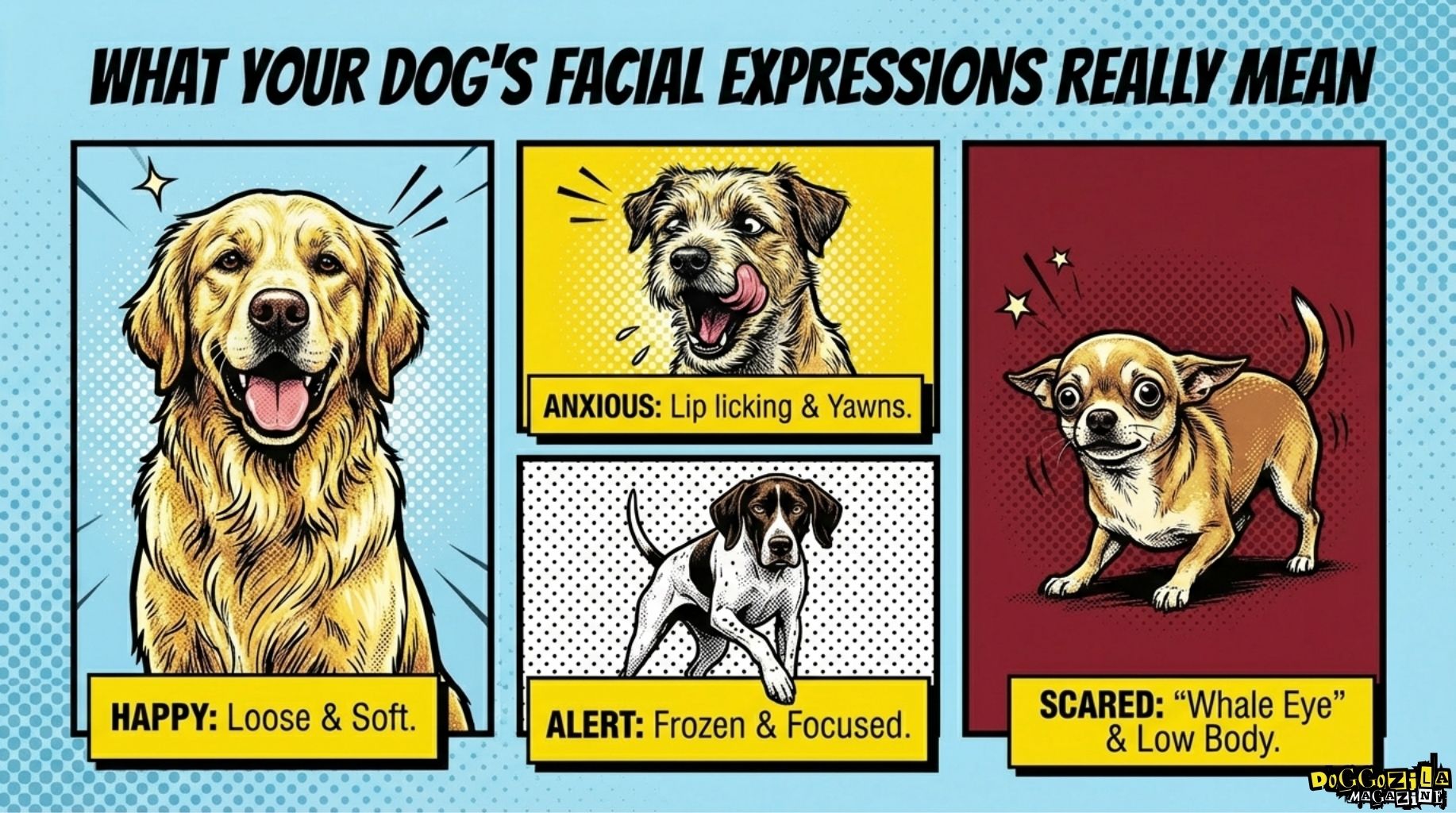
WHAT YOUR DOG’S FACIAL EXPRESSIONS REALLY MEAN?
Let us translate common looks. Dogs feel happiness, fear, worry, curiosity, and love. A happy dog’s face is loose. The muscles are relaxed. The eyes are soft. You might see a smile. A scared dog’s face is tight. The eye whites may show. The ears are glued down.
Anxiety shows as lots of yawning or lip licking. A curious dog has a bright face. Their ears are forward. Learning these meanings makes you a better friend. You can meet their needs and keep them safe.
The Happy and Relaxed Dog’s Facial Expressions
A truly happy dog’s facial expressions is easy to see. The whole face is “soft.” There are no tight lines. The eyes are normal or slightly squinty. They may blink slowly. The ears are in a natural, relaxed spot. The mouth is open in a gentle pant. The tongue hangs out. The mouth corners might turn up a bit. Some dogs even smile. This is often with a wiggly body and loose tail. This face says, “I am comfortable and I trust you.” It is the face we all love.
The Anxious and Stressed Dog’s Facial Expressions
Stress signs are subtle but important. Common signals are repeated yawning. Frequent lip licking with no food. Looking away from something upsetting. The ears may be low and to the side. The mouth is often closed tight. You might see muzzle tension. The eyes may be partly squinted. This group of signals means your dog is uncomfortable. They are trying to calm down. Seeing this face lets you help your dog. You can remove them from a stressful spot.
The Alert and Focused Dog’s Facial Expressions
This is the working face. You see it when your dog spots a bird. The dog’s facial expressions becomes still. The body freezes. The eyes are wide and locked on a target. The ears are fully forward. The mouth is firmly closed. The whole face shows deep focus. This is a neutral look. It is not good or bad. It means all attention is on one thing. What happens next depends. It could lead to play or a reaction. The next face will show their intent.
🔑 Key Points: Faces show clear emotions like happiness, fear, stress, and curiosity.
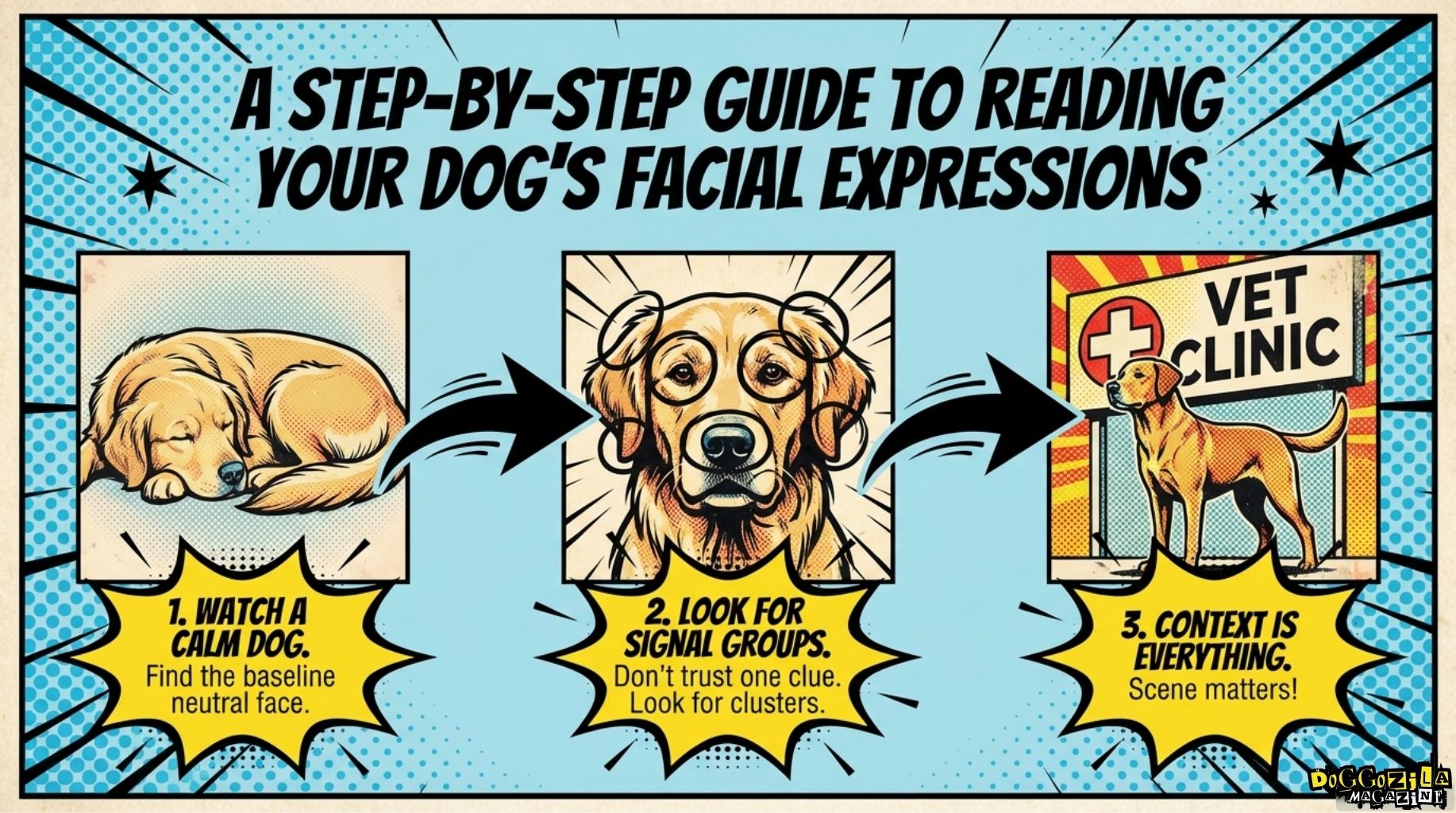
A STEP-BY-STEP GUIDE TO READING YOUR DOG’S FACIAL EXPRESSIONS
You can learn this with practice. Use a simple step-by-step method. First, look at your dog from their level. Second, see the three zones in order, eyes, ears, mouth. Note each one. Third, combine the signals for the full story. Fourth, check the rest of the body. Is the tail wagging? Is the body stiff? Finally, think about the context. What is happening?
A look at the vet is different from a look at the park. This method stops misreads of your dog’s facial expressions.
Step 1: Watch a Calm Dog
Start by watching your calm, relaxed dog. Learn their “neutral face.” Every dog’s neutral face is different. Know what their ears do when relaxed. See their sleepy eyes. This is your baseline. You cannot spot stress without knowing calm. Spend five minutes watching them rest. Take a photo. This is your reference. All changes in their dog’s facial expressions start from this neutral state. This first step is very important.
Step 2: Look for Signal Groups
Now, look for groups of signals. One lip lick might be nothing. But a lip lick with a yawn and pinned ears is a stress group. A hard stare with a wrinkled muzzle is an anger group. A soft gaze with a relaxed pant is a happiness group. Do not focus on one signal. Train your eye to scan the whole face fast. Look for matches. Do the eyes and ears agree? Does the mouth confirm it? When zones point to the same feeling, you can trust your read of your dog’s facial expressions. This stops mistakes.
Step 3: Context is Everything
The last step is all about context. A dog showing teeth at a fence is giving a warning. A dog showing teeth in a play bow is likely playing. The same look means different things. Ask yourself, Where are we? What just happened? Who is here? A scared face at fireworks is normal. A scared face in your quiet living room means trouble. Always read the dog’s facial expressions within the scene. This completes the picture. It turns observation into real understanding.
🔑 Key Points: Watch the face, check the body, and consider the situation in that order.
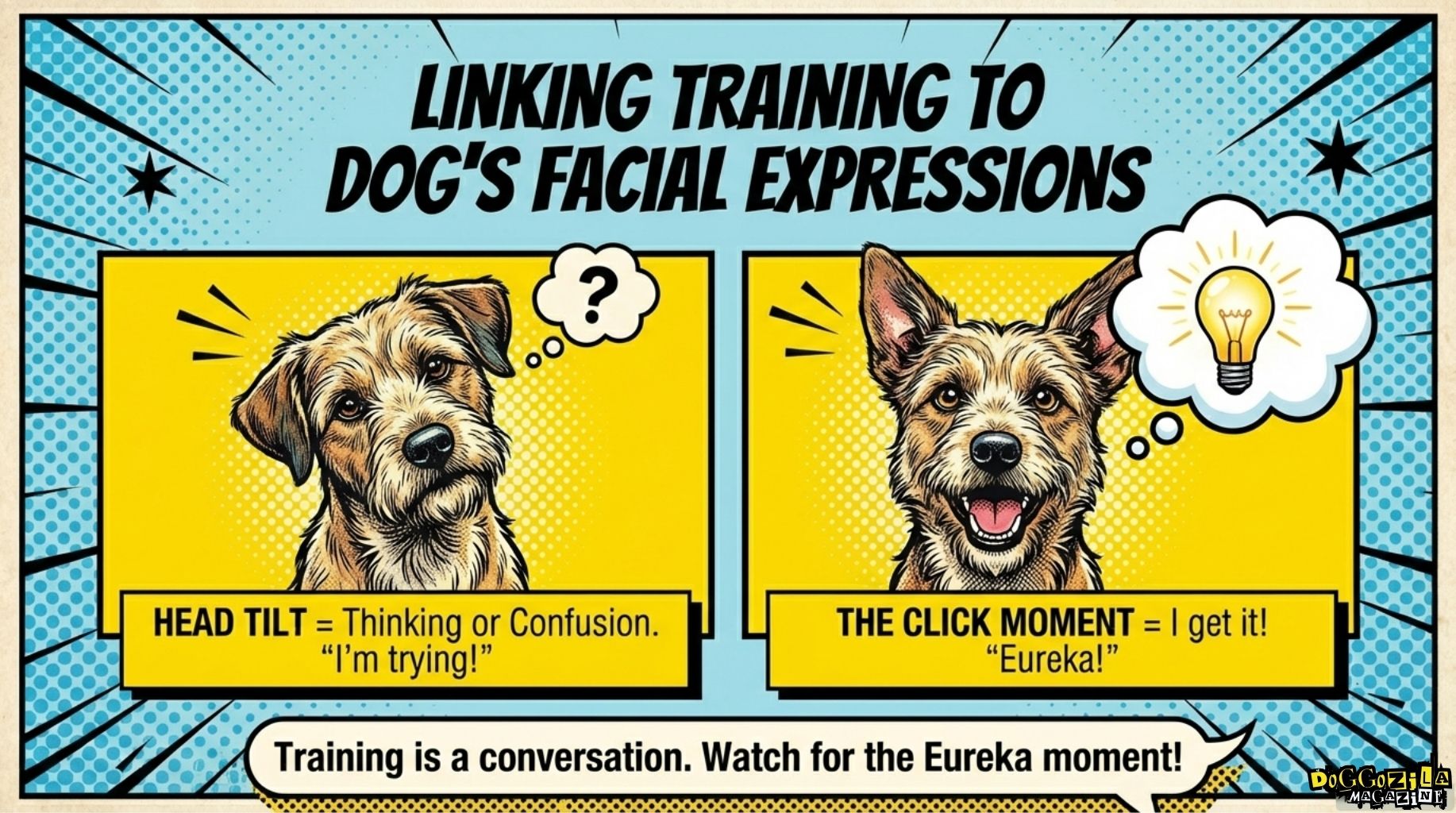
LINKING TRAINING TO DOG’S FACIAL EXPRESSIONS
Training is a conversation. Your dog’s face gives you feedback. Watching their dog’s facial expressions makes you a better trainer. A confused dog will often tilt its head or lick its lips. A frustrated dog might yawn or look away. A happy, engaged dog has a bright, soft face.
Seeing these signals lets you adjust. If you see stress, make the task easier. If you see focus, you are on track. This creates positive, trust-based training.
Seeing Confusion and Frustration
During training, watch for struggle signs. The head tilt means “I am thinking.” But if followed by a lip lick, it may be frustration. A dog that breaks eye contact is saying, “This is too hard.” Sudden ground sniffing can be stress. When you see these dog’s facial expressions, help your dog. Go back a step. Make the cue simpler. Give a clearer reward. Your dog’s face tells you the pace is wrong. A good trainer listens with their eyes.
Seeing the “Click” Moment
The best training moment is the “click.” This is when understanding lights up your dog’s facial expressions. Their eyes get bright. Than their ears perk up. Their body aims at you. They might try a behavior for a reward. This face says, “I get it! I love this game!” Reward this heavily. It encourages the joy of learning. Creating this happy, engaged look is the goal. It means your dog is a willing partner.
Building Trust by Understanding
When you respond to your dog’s face, you build attunement. Attunement is feeling deeply understood. If your dog looks worried and you help, they learn to trust you. Their face will show more relaxation over time. They will look to you for guidance. This bond, built on reading dog’s facial expressions, is strong. It is stronger than obedience alone. It changes the relationship from leader-follower to true partners.
🔑 Key Points: Your dog’s face gives instant feedback during training lessons.
COMMON MISTAKES IN READING DOG’S FACIAL EXPRESSIONS
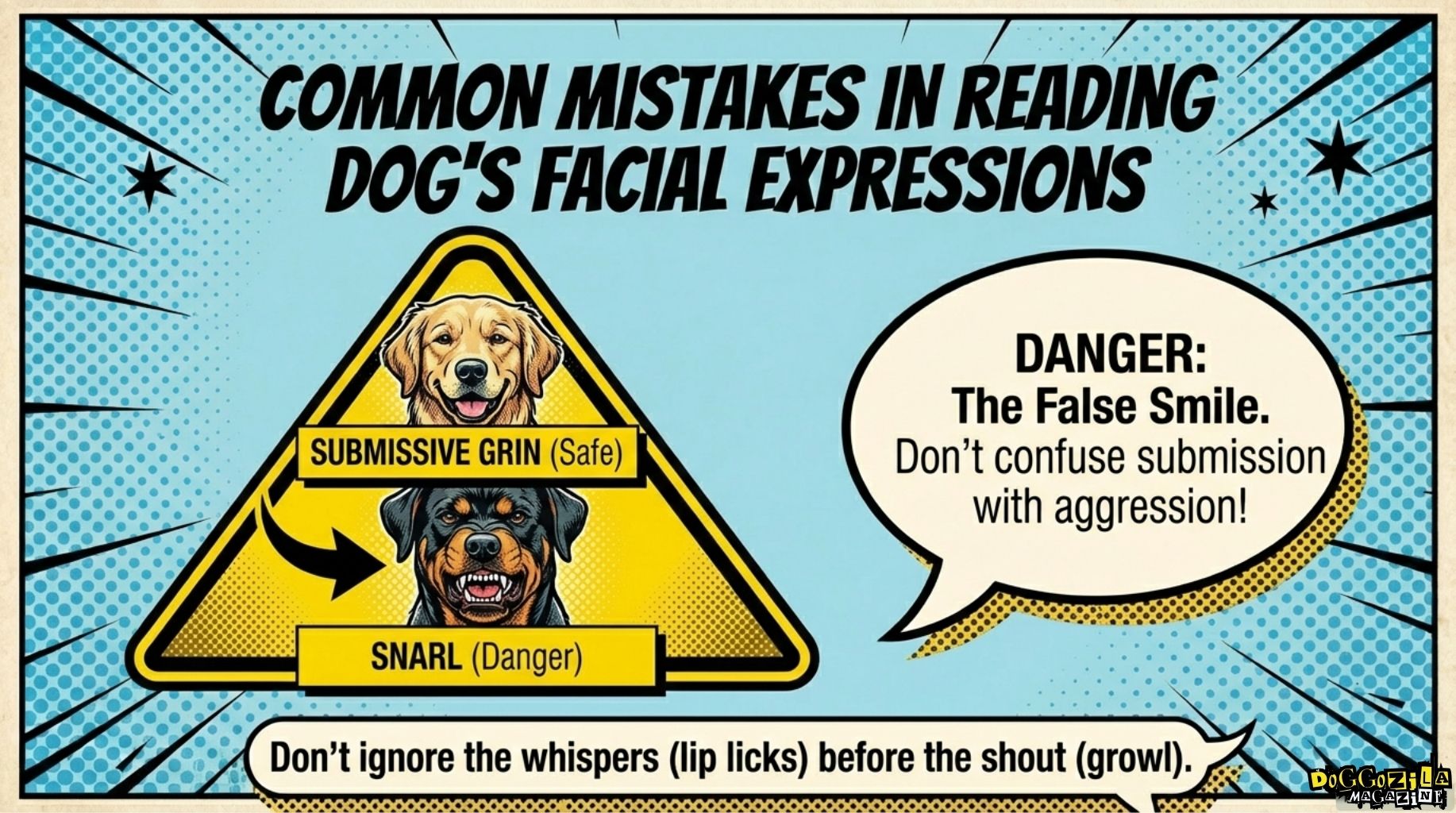
Many owners make simple errors. The biggest is humanizing dog expressions. We think a dog showing teeth is “smiling.” This can be dangerous. Another error is focusing only on the tail. A wagging tail can mean excitement, good or bad.
You must see the face. People also miss early stress signs. They only react to a growl. By then, the dog is upset. Learning these errors helps you avoid them. It keeps everyone safer.
Mistake 1: The “Smiling” Dog
This is the most common risk. Some dogs pull lips back in a “submissive grin.” It looks like a human smile. But a true snarl shows more teeth and has a wrinkled muzzle. Confusing them can lead to a bite. Always look at the whole face. A relaxed, happy dog’s mouth is usually open with no teeth. Any teeth showing needs careful check of eyes and ears. Know the true meaning of this dog’s facial expressions.
Mistake 2: Missing Small Stress Signs
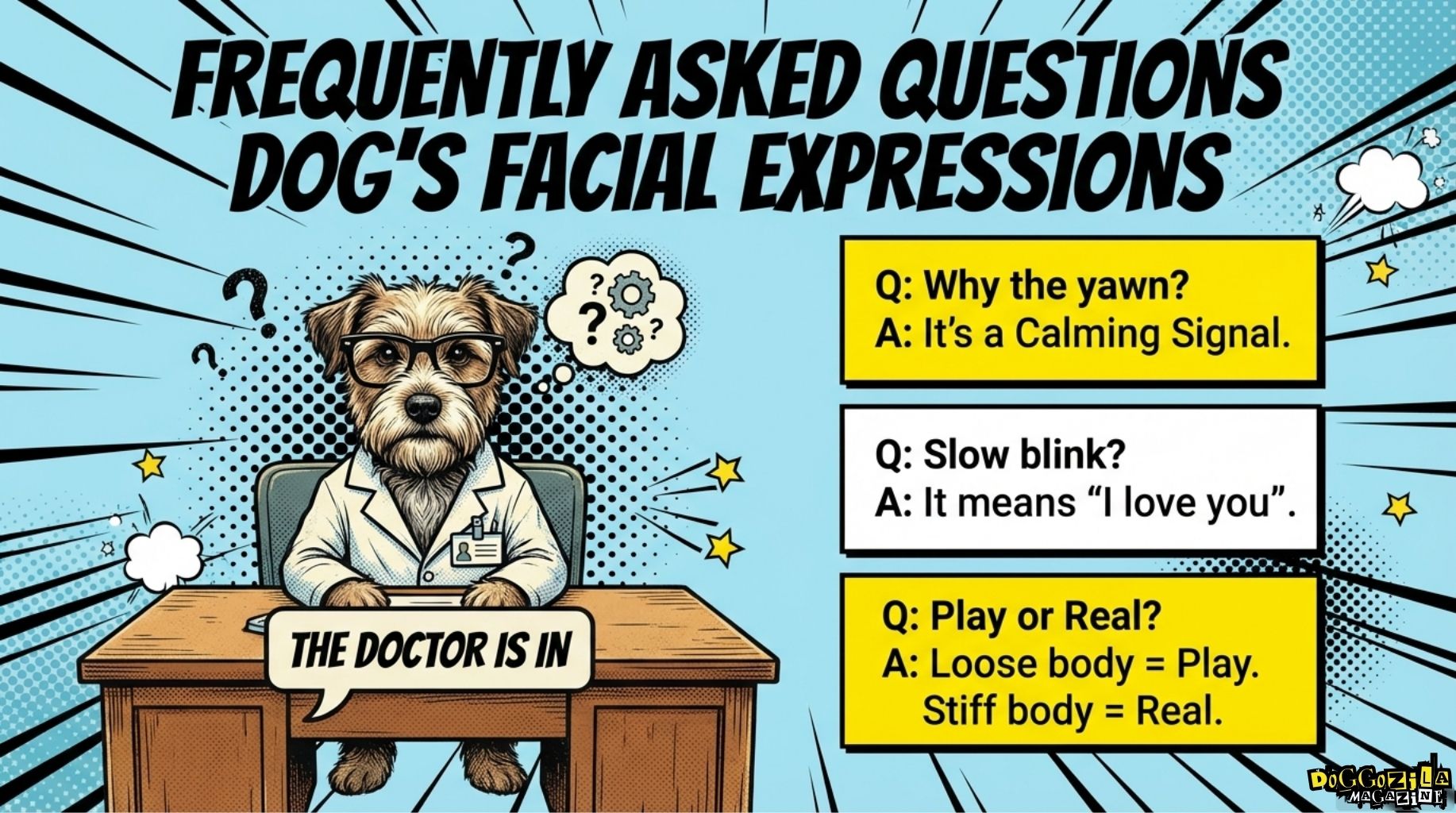
Dogs give small “calming signals” before they growl. These are the whispers of their dog’s facial expressions. Owners often miss them. The whispers include: looking away, slow blinking, nose licking, yawning, or sudden scratching. If ignored, the dog may growl to be heard. By seeing the tiny lip lick or ear flick, you can help. Give your dog space before they feel threatened.
Mistake 3: Ignoring the Whole Body
The face is just one part. A wagging tail with a stiff body and hard face is a threat. A loose, wiggly body with a soft face is play. A dog may have a relaxed face but a crouched, trembling body. That means fear. Do a full-body scan. Look from nose to tail. The dog’s facial expressions gives the emotion. The body posture tells the action. Together, they give the full message. Never judge by face or tail alone.
🔑 Key Points: Do not call a snarl a “smile.” Do not miss small stress signals like lip licks.
FUN FACTS ABOUT DOG’S FACIAL EXPRESSIONS
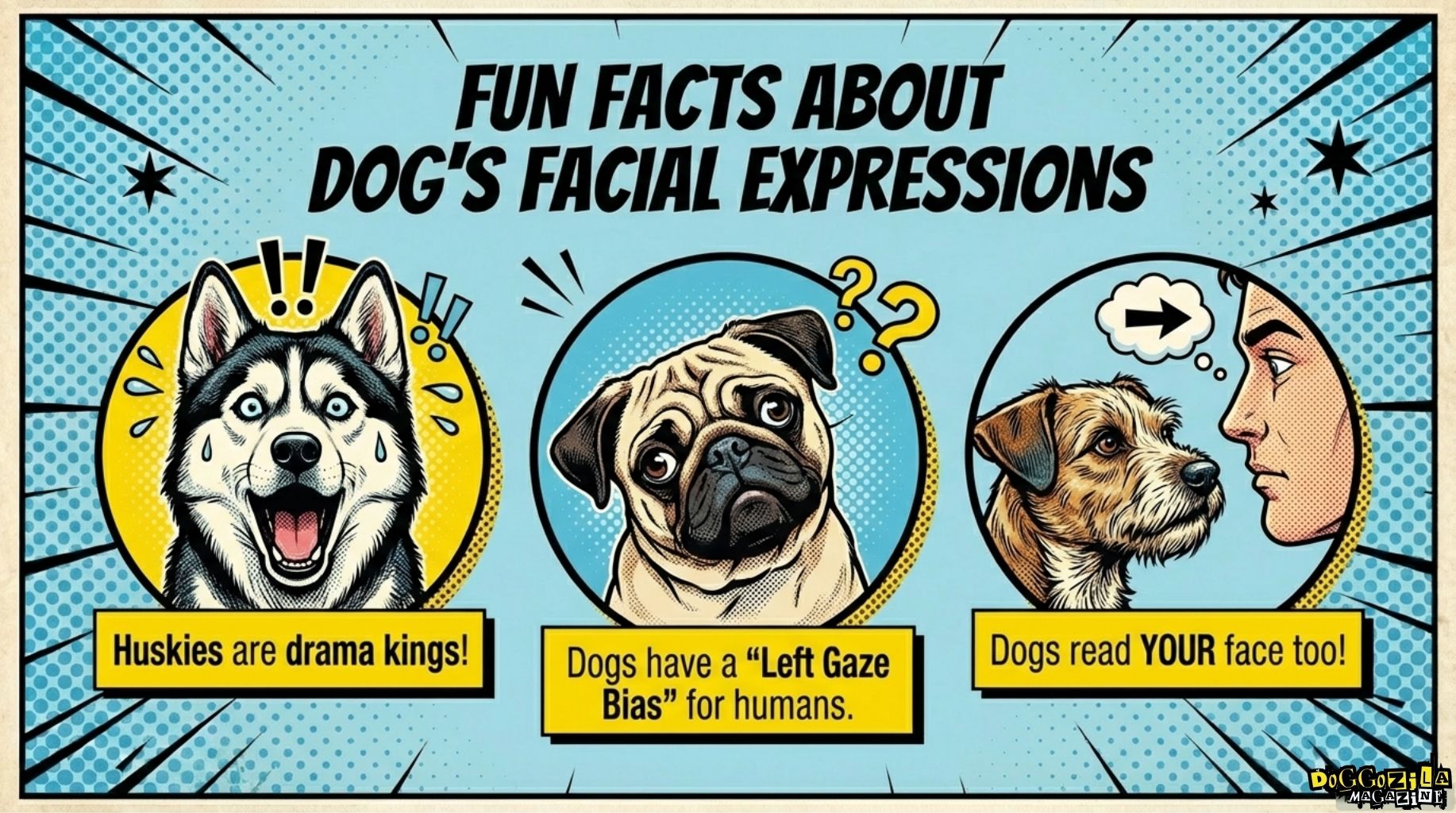
The world of dog’s facial expressions is wonderful. Did you know dogs understand human pointing? This links to reading our faces. Studies show dogs like happy human faces more than angry ones. They have a special brain part for human faces. Some breeds are “super-expressers.”
Siberian Huskies have dramatic, human-like faces. The “head tilt” may help dogs hear and see our faces better. These facts show how connected we are. Find out why do dogs tilt their head!
Dogs Read Our Faces Too
Research proves dogs read human facial expressions well. They tell a happy face from an angry face in photos. They follow our gaze and pointing. Even smart chimps are not great at this. Dogs watch our faces for info. When unsure, they look at our faces. This is “social referencing.” They ask, “Is this okay?” This two-way street is the core of our bond.
The “Left Gaze Bias”
Here is a cool science fact. Humans and dogs have a “left gaze bias.” When we look at a face, we look first at the right side. The right brain hemisphere processes emotions. Amazingly, dogs do this too with human faces! They look longer at the left side of our face to read our mood. This suggests their brains are tuned to our facial expressions. They understand us deeply.
Expressive Breeds and Their Quirks
Some breeds have funny, specific dog’s facial expressions. The Husky is the drama king. They sigh and grumble. Boxers “woowoo” talk with animated brows. Greyhounds have a strange “roach” smile. Shiba Inus have a famous scream and scowl. These breed quirks add to dog communication. All dogs speak the same basic language. But some have very colorful dialects!
🔑 Key Points: Dogs read our faces too. Some breeds have very dramatic expressions.
THE FUTURE OF UNDERSTANDING DOG’S FACIAL EXPRESSIONS
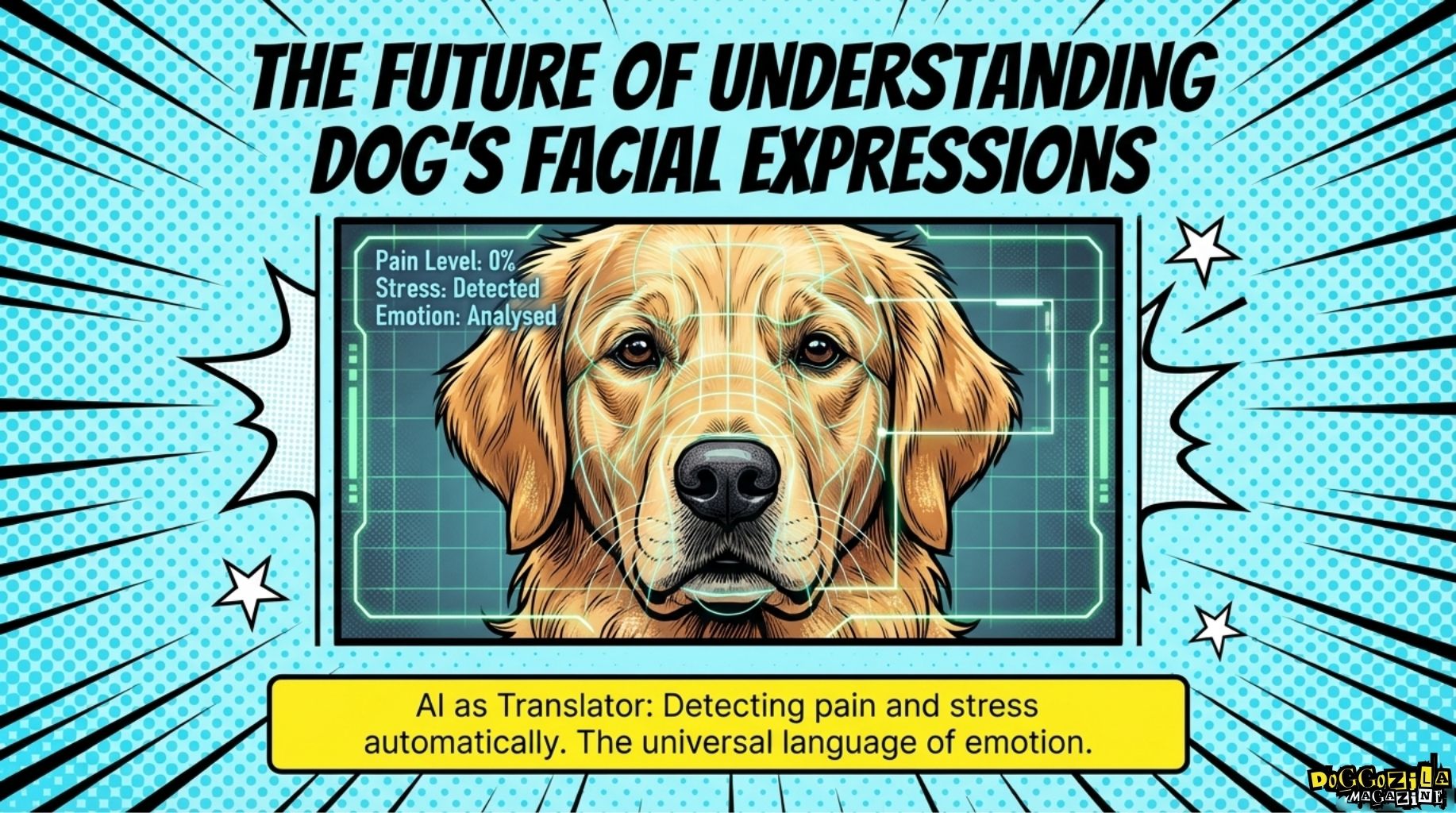
Science is just starting to unlock dog communication. The future is exciting. Researchers are making AI software. It can analyze dog’s facial expressions automatically. This could help vets spot pain. It could help shelters see stress.
Work is happening on a “Dog Facial Action Coding System.” It catalogs every facial movement. As we learn more, we can help anxious dogs better. We can improve animal therapy. The goal is a world where every dog is understood.
Technology as a Translator
Imagine a phone app. It scans your dog’s face. Than it tells you if they are in pain after surgery. It tells a trainer if a dog is stressed. This is real. Companies are working on it now. They use cameras and machine learning. AI sees tiny muscle movements we miss. This tech could change vet medicine and animal welfare. It gives dogs a “voice.” It translates their main language, their dog’s facial expressions into data we can use.
A Shared Language of Emotion
The big goal is universal understanding. The DogFACS system helps. It lets scientists use the same terms worldwide. This leads to better research. It helps trainers talk clearly. In the future, we might have a shared chart of dog’s facial expressions. It could be as common as a first-aid chart. This will help every dog owner. It will reduce fear and bites. It will strengthen the human-dog bond everywhere.
Your Personal Journey of Learning
The best part is this journey never ends. Every dog is unique. Your dog has its own special looks. The future of understanding dog’s facial expressions is not just in labs. It is in your living room. Maybe it is at the park. It is in quiet moments with your dog. By paying attention, you become a relationship pioneer. You learn your best friend’s personal dialect. That is the most rewarding work of all.
🔑 Key Points: New technology like AI will help us understand dog pain and stress from their face.
FREQUENTLY ASKED QUESTIONS DOG’S FACIAL EXPRESSIONS
Key Points and Takeaways
- Science: Dogs have special face muscles to communicate with us. Their expressions are a real language.
- Domestication: Living with people made dogs’ faces more expressive. This helped us bond.
- Anatomy: Learn the three key areas: eyes, ears, and mouth. Together they tell the true story.
- Meanings: Faces show clear emotions like happiness, fear, stress, and curiosity.
- Step-by-Step: Watch the face, check the body, and consider the situation in that order.
- Training: Your dog’s face gives instant feedback during training lessons.
- Mistakes: Do not call a snarl a “smile.” Do not miss small stress signals like lip licks.
- Fun Facts: Dogs read our faces too. Some breeds have very dramatic expressions.
- Future: New technology like AI will help us understand dog pain and stress from their face.
- Conclusion: Learning this language deepens your bond and makes you a better friend to your dog.