
Have you ever noticed your dog perk up when a stranger on the street starts crying, or walk right past someone who’s clearly upset? It’s not random. How dogs react to strangers in distress reveals that their emotional intelligence goes far beyond the family circle. Science shows that dogs can read unfamiliar people’s body language, vocal tones, and even their scent to sense when something is wrong. But do they always respond with sympathy? And what signals trigger a reaction, or a lack of one? Let’s dive into the three main cues dogs use to size up a stranger’s feelings: sight, sound, and smell.
“Can your dog tell the difference between a sad stranger and a happy one, and more importantly, does he actually care?”
Key Takeaways
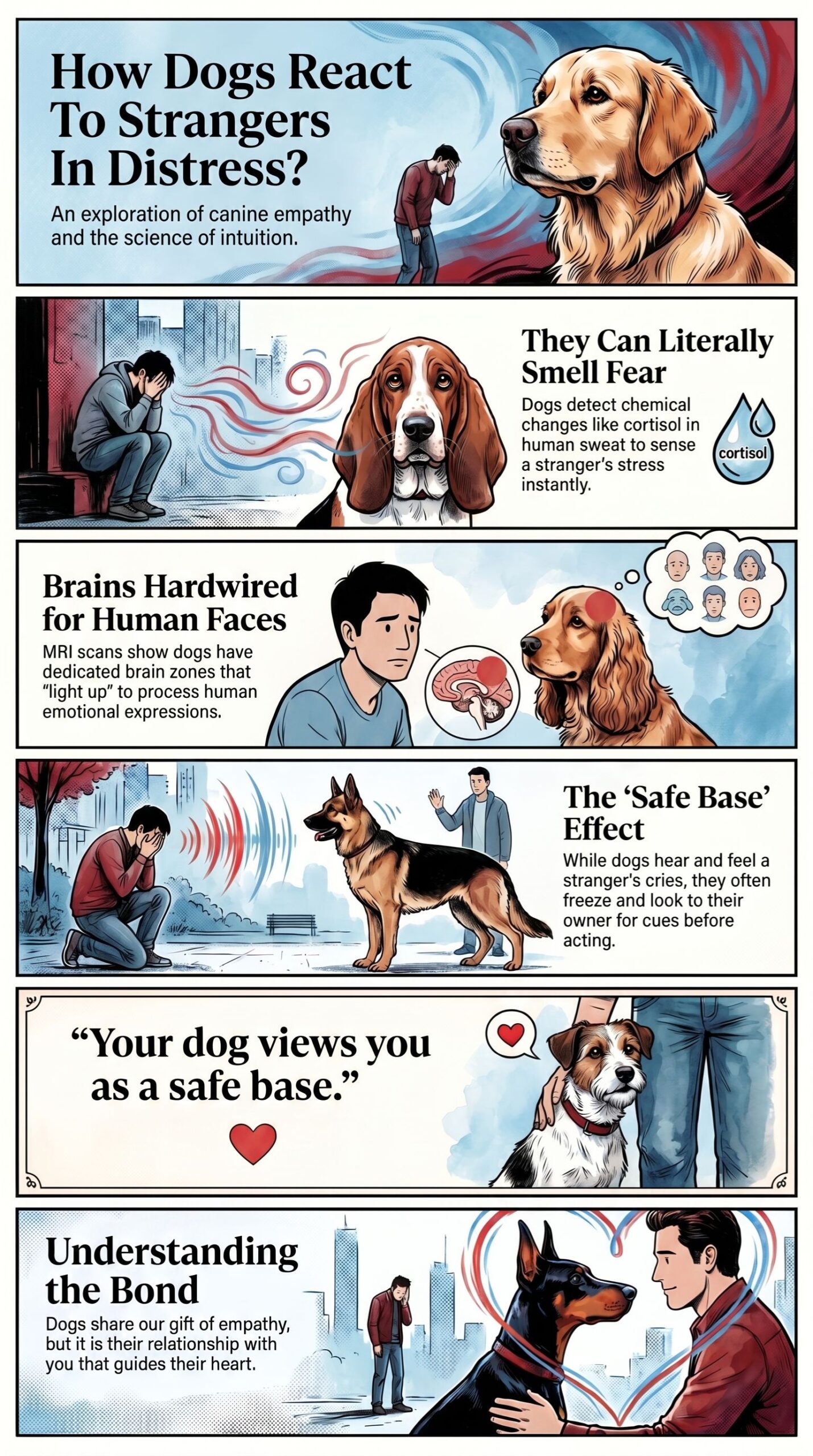
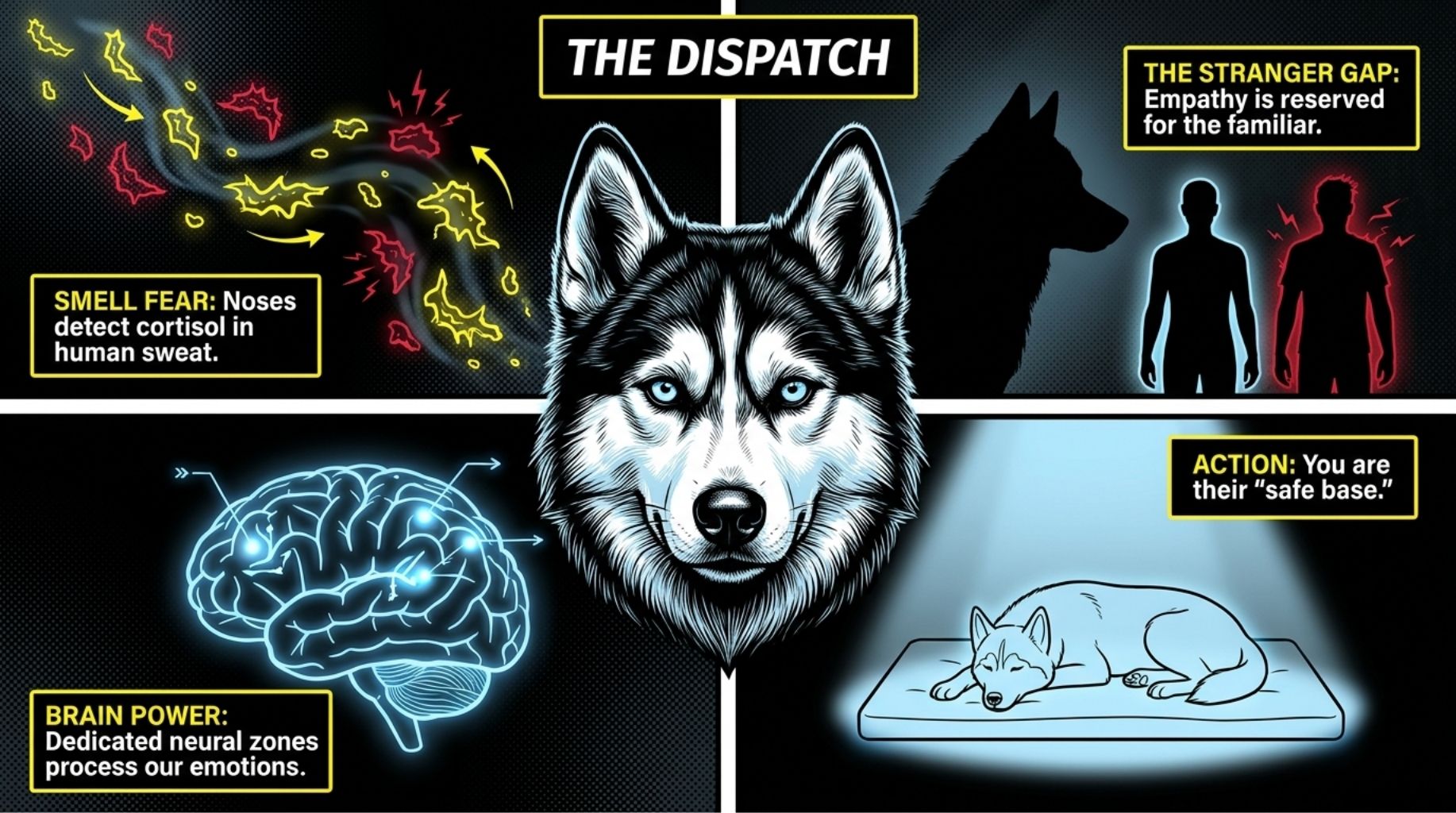
- They Smell Fear: Dogs can sniff chemical changes like cortisol in human sweat.
- Strangers are Tricky: Dogs show less empathy toward unfamiliar people versus their owners.
- Brain Power: MRI scans show dogs have dedicated brain zones for processing human emotions.
- Practical Tips: Learn how to be a “safe base” for your dog when visitors come over.
Quick Summary About How Dogs React To Strangers In Distress
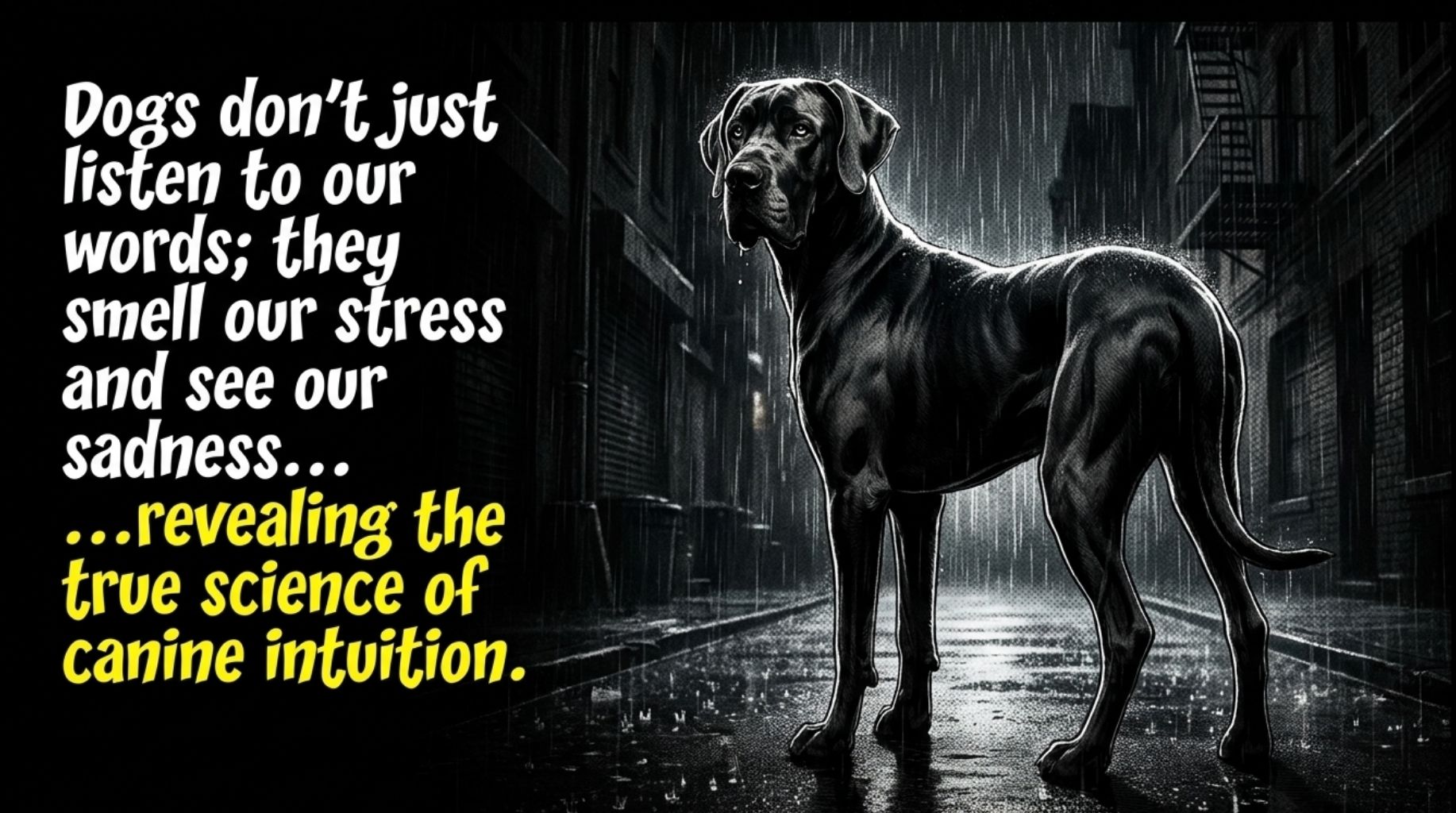
Dogs don’t just listen to our words, they smell our stress and see our sadness. This article breaks down the fascinating ways dogs react to strangers in distress, backed by recent 2025 studies. You’ll discover that dogs use their noses to detect human fear chemicals, and they have special brain areas just for reading our faces. We also explore why your dog seems to love some people immediately and dislike others, revealing the true science of dog intuition.
Listen the Episode by The Bark Brigade Podcast About How Dogs Can Sense The Stress in People and Choose to React!
THE SCIENCE BEHIND HOW DOGS REACT TO STRANGERS IN DISTRESS
Scientists used to think only humans could feel true empathy. Now, they know dogs share that gift. How dogs react to strangers in distress depends mostly on one thing, their relationship with the person. Your dog views you as a safe base. If a stranger is sad, your dog looks to you for cues before acting.
Explore How Dogs React to Strangers in Distress Through Scent
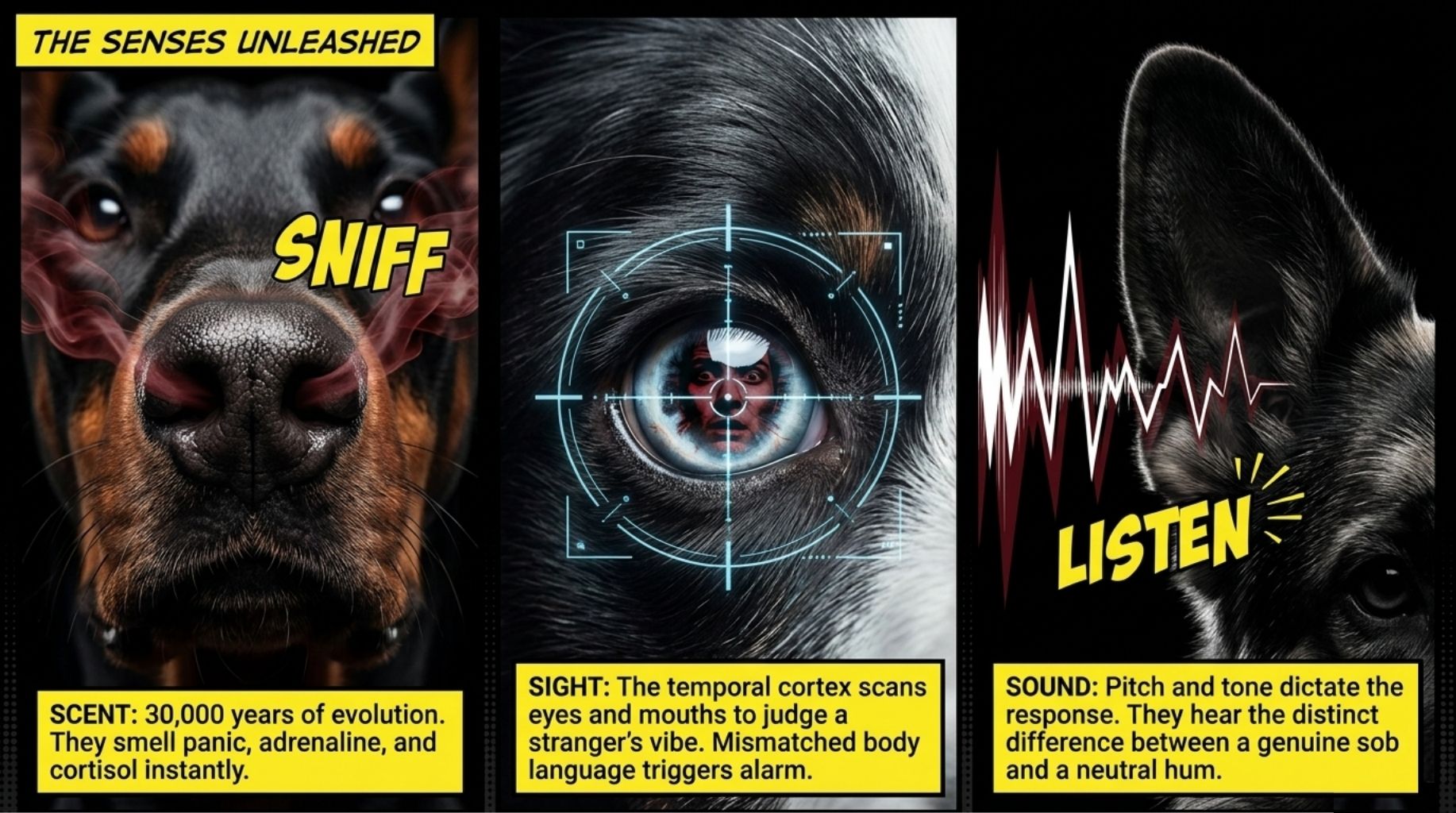
Your body talks to your dog without making a sound. When you panic, you release cortisol and adrenaline. Dogs smell these changes instantly. Their noses are powerful enough to detect the chemical signature of a stranger’s stress. This ability explains how dogs react to strangers in distress even before the stranger speaks a single word. Dogs have evolved alongside us for about 30,000 years.
A massive 2025 study showed that dogs can literally smell fear. Researchers placed human fear and neutral sweat on targets. Dogs that smelled the fear scent stayed longer with the experimenter. They also lowered their tails and moved more cautiously. This proves dogs react to the smell itself, not just a person’s actions.
Another recent test had dogs sniff stress sweat versus calm sweat. The stressed odor made dogs more pessimistic. They hesitated to approach a bowl that might have a treat. This suggests that smelling a distressed stranger actually puts dogs in a negative mood. Their emotional state changes just from a whiff of your armpit.
Discover How Dogs React to Strangers in Distress with Their Eyes
Dogs read your face like a book. They have a special brain area just for looking at humans. In MRI scans, a dog’s temporal cortex lights up when they see a happy face. But it reacts differently to anger or fear. How dogs react to strangers in distress often starts with a visual scan of the person’s eyes and mouth. They can tell if a stranger is smiling or grimacing.
In one fascinating brain study, dogs watched human faces showing happiness, anger, fear, or sadness. The dogs’ brains could actually predict which emotion they were seeing. Their caudate nucleus (the pleasure center) activated mainly for happy faces. This means dogs don’t just see a stranger, they judge that stranger’s vibe.
Furthermore, scientists found that dogs have separate brain spots for dog faces and human faces. This shows they evolved specifically to pay attention to us. When a stranger is in distress, a dog looks for mismatched signals. If the face says “cry” but the body is stiff, the dog notices the inconsistency. They use this visual data to decide whether to approach or hide.
Learn How Dogs React to Strangers in Distress by Hearing Cries
Sound is the third pillar of dog empathy. Dogs listen to the pitch and tone of human voices. A crying stranger sounds totally different from someone humming. How dogs react to strangers in distress often involves tilting the head and flattening the ears to hear better. Dogs can distinguish a genuine sob from a neutral sound.
In a home-based experiment, researchers had strangers cry or laugh in front of dogs. The dogs showed more person-oriented behaviors (like nudging and licking) toward the crying stranger. Interestingly, the dogs that got the most stressed by the crying were the ones that went to comfort the person. This suggests a mechanism for empathy, the dog feels sad, so it tries to help.
Another study confirmed that dogs communicate distress to humans more effectively than cats. Your dog whines when you are sad. They pick up on the urgency in a stranger’s voice. This auditory processing happens automatically. Even if the dog doesn’t know the person, the sound of distress triggers an internal alarm.
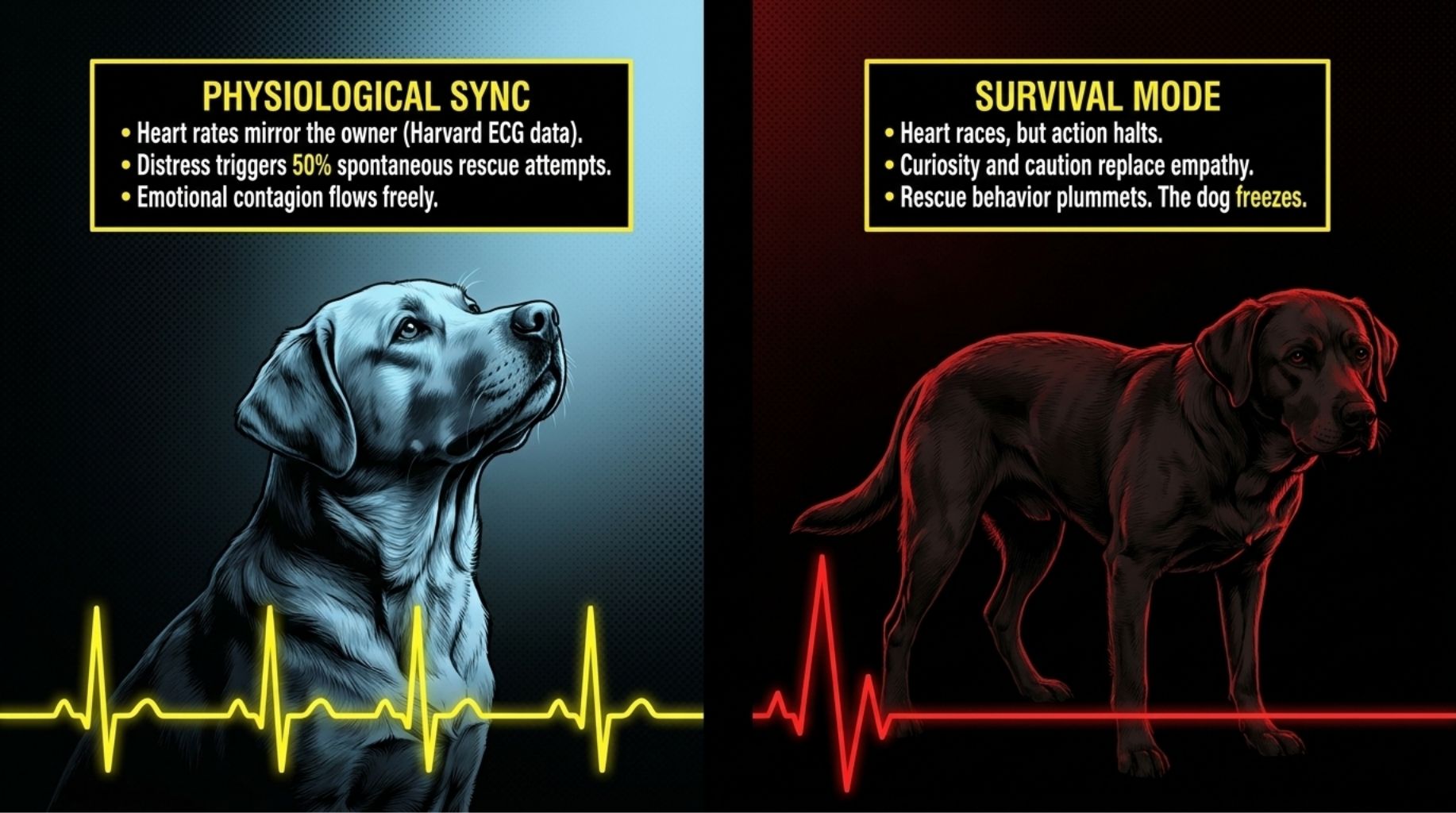
EMOTIONAL CONTAGION: DO DOGS COPY OUR FEELINGS?
Emotional contagion happens when one individual’s feelings trigger the same feelings in another. You laugh, your dog wags its tail. You cry, your dog whines. Dogs absolutely experience this with their owners. However, the story changes when the person is a stranger.
Physiological Matching: Heartbeats and Hormones
Your heart rate speaks to your dog. Harvard researchers hooked up owners and dogs to ECG monitors. They found that the heart rate variability of dogs and owners often mirror each other. When you relax, your dog relaxes. This matching happens regardless of the activity, whether cuddling or playing.
A 2025 thesis reviewed that dogs show physiological changes like increased heart rate when exposed to human stress. Their cortisol levels can sync with yours over long periods. Yet, when a stranger is the source of distress, the physiological link weakens. The dog’s body may show stress signs, but those signs don’t always lead to a rescue attempt. The dog gets stressed, but not necessarily helpful.
In rescue studies, dogs opened a box to save their trapped owner more often when the owner acted stressed. Their heart rate soared in the stressed condition. This shows emotional contagion works strongly in familiar relationships. But for a stranger, the dog’s heart might race, but it will freeze rather than act.
The Stranger Effect: Fear vs. Familiarity
Here is the big reveal from 2024 research. Scientists placed a stranger behind a clear door. The stranger either cried in distress or hummed a neutral tune. How did the dogs react? They did not open the door faster for the crying stranger. Their stress behaviors did not increase either.
The dogs that did open the door were described by owners as less fearful overall. This suggests that how dogs react to strangers in distress depends heavily on the dog’s personality. Anxious dogs shut down. Confident dogs investigate. But even the confident dogs didn’t seem to understand the “goal” of helping a crying stranger. They just approached the door out of curiosity, not empathy.
Researchers concluded that dogs may require the owner’s presence to moderate their stress. Without you there, a dog in a new place facing a sad stranger feels insecure. They worry about their own safety first. This is not cruelty, but it is a survival instinct.
Rescue Behavior: Trying to Help or Just Curious?
We all want to believe our dog would save us from a fire. Data shows about 50% of untrained dogs will spontaneously try to rescue a trapped owner. They push doors or pull levers. But when the distressed person is a stranger, rescue behavior plummets. How dogs react to strangers in distress rarely involves a deliberate rescue plan.
In one experiment, dogs had to push a heavy box to free their owner. Many dogs tried hard. They were not obeying a command, they were acting on emotional contagion. Yet, replicate that with a stranger, and the dog seems confused. They sniff the stranger but do not problem-solve.
This suggests that empathy in dogs is not automatic. It is a context-specific skill. Your dog is not being mean. It simply does not have the same attachment to a random person. The dog’s brain asks, “Is this person part of my pack?” If the answer is no, the empathy circuit dims.
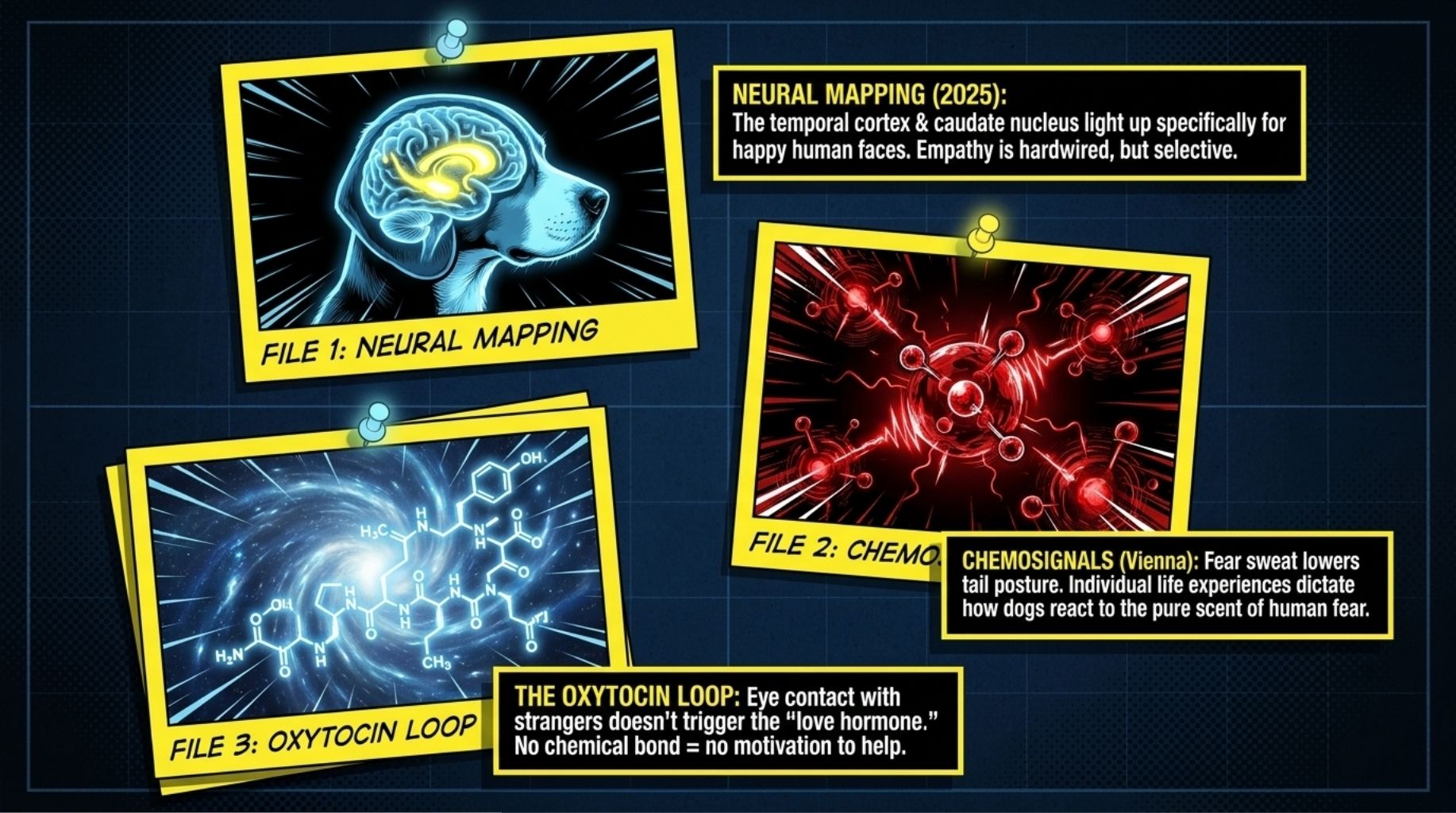
RESEARCH SUMMARY: WHAT SCIENCE SAYS ABOUT HOW DOGS REACT TO STRANGERS IN DISTRESS
Science has moved beyond anecdotes. We now have hard data from MRI machines, sweat samples, and heart rate monitors. How dogs react to strangers in distress is a complex mix of nature and nurture. Dogs have the hardware to feel empathy, but they use it selectively.
The Dog Brain Lights Up for Happy Faces (2025 fMRI Studies)
In 2025, neuroscientists trained dogs to lie still in MRI scanners. They showed the dogs pictures of human faces. The results were stunning. The dog’s temporal cortex and caudate nucleus activated significantly when viewing happy faces compared to neutral ones. This proves the dog brain specifically represents human emotions.
Another fMRI review confirmed that dogs share analogous brain structures for social cognition. They process body language and emotion perception in ways similar to humans. This explains how dogs react to strangers in distress when the distress is intense. The brain processes the visual signal immediately.
Furthermore, research indicates that part of the dog brain is associated with positive emotions and love. Your dog does feel affection for you and concern for your well-being. This neural foundation supports the empathy you see at home. However, those same circuits require activation through bonding, they don’t work on strangers by default.
Chemosignals: The Hidden Language of Fear (2025 University of Vienna)
The University of Vienna published a landmark study in 2025 on “chemosignals.” These are chemical substances humans excrete when afraid. The study shielded the human handler so the dogs only smelled the fear or neutral scent, without seeing a reaction. Dogs in the fear-smell group showed lower tail posture and stayed closer to the safe experimenter.
They did not necessarily avoid the fear smell, but they changed their behavior. This challenges the old idea that dogs innately avoid fear smells. Instead, it suggests individual life experience dictates the reaction. How dogs react to strangers in distress therefore varies by breed and past trauma.
The study also noted strong interindividual variation. Some dogs needed many commands to approach a fear smell, others did not care. This tells owners that if your dog is scared of strangers, it might be because of a bad experience with a specific smell. It is not just “being difficult.”
Oxytocin and the Bonding Loop (The “Love” Hormone)
Oxytocin is the hormone that makes you love your baby. It also flows when you pet your dog. Studies show that when dogs and owners lock eyes, oxytocin levels rise in both species. This creates a bonding loop. That loop is why how dogs react to strangers in distress looks different from how they react to you.
Strangers do not trigger the same oxytocin release. Without that chemical bond, the dog lacks the motivation to help. The dog may still feel distressed by the stranger’s crying, but it does not feel “responsible” for solving it.
Researchers measured oxytocin in dogs interacting with owners vs. strangers. The owner interactions skyrocketed oxytocin. The stranger interactions did nothing. So, if you want your dog to be a therapy dog, you must train that stranger-bond explicitly. It does not come for free.
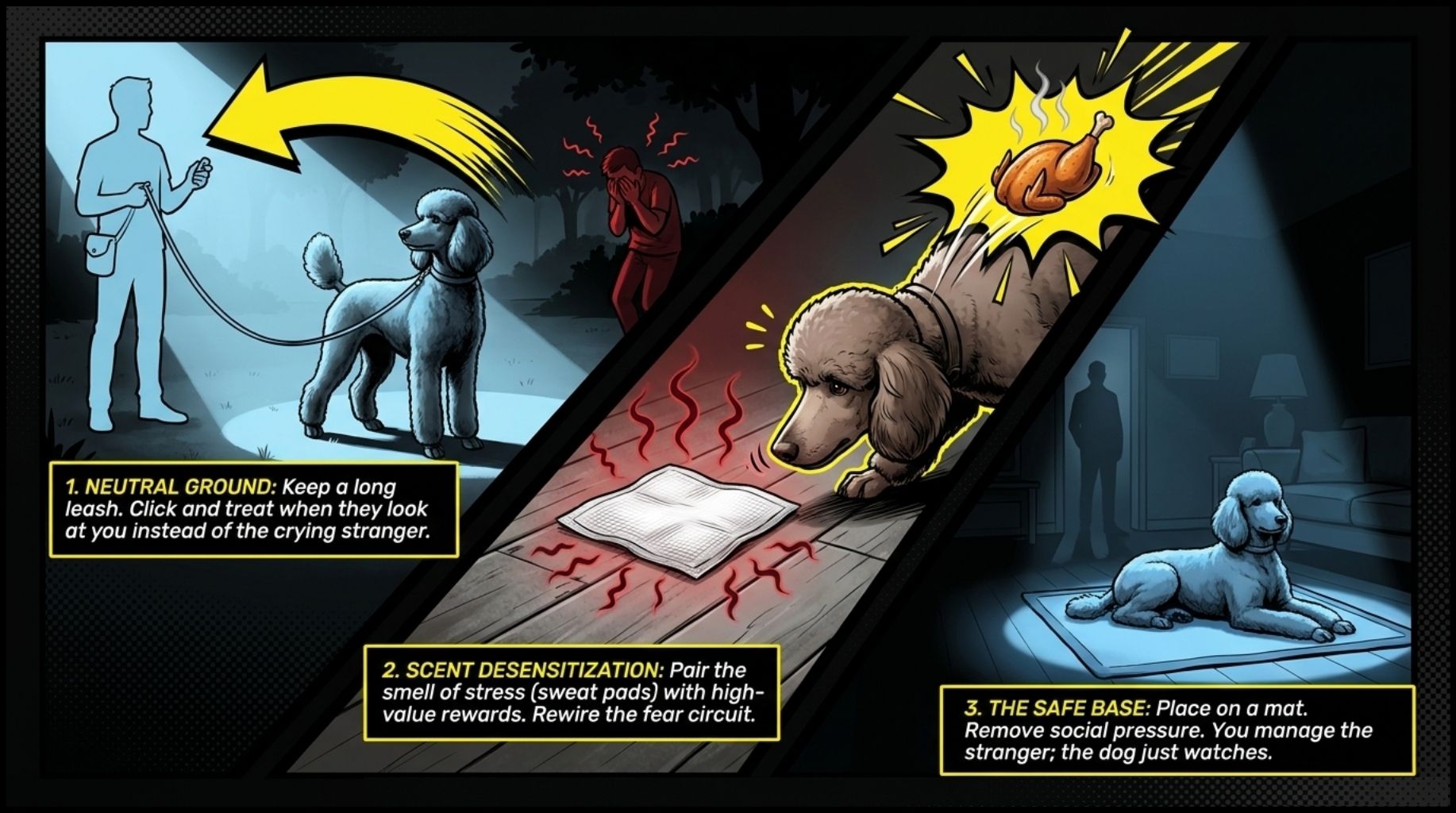
HOW TO TRAIN DOGS TO REACT CALM TO STRANGERS IN DISTRESS?
You want your dog to be polite when guests come over. You want them to sense a sad friend and lie down for a cuddle. Training this requires understanding how dogs react to strangers in distress. You must become a safety anchor for your dog.
Start with Neutral Ground
Never force a fearful dog to approach a crying stranger. This backfires. Instead, practice in a neutral park. Ask a friend to stand far away and act sad (pretend crying). How dogs react to strangers in distress in this setting, they usually look at you for guidance. When your dog looks at you, click and treat.
Reward calm looks, not barking. You want the dog to learn that a sad stranger means “check in with mom.” You do not want the dog to rush the stranger. Rushing can scare the stranger. Keep your dog on a long leash. Let them move back and forth at will.
Gradually move closer to the sad stranger over many days. If your dog stiffens or growls, you are moving too fast. Back up. The goal is neutrality, not forced friendship. A neutral dog that ignores a crying stranger is much safer than a dog that runs up to lick them.
Use Scent Desensitization
Since dogs smell stress, you can buy this. Ask a friend to wear a gauze pad under their arm while watching a scary movie. Collect that sweat pad. Bring it home. Do not shove it in your dog’s face. Place it on the floor across the room. How dogs react to strangers in distress via scent, they might sniff and look worried.
Let your dog choose to approach the sweat pad. Pair the pad appearance with high-value treats (cheese, chicken). You want the dog to form a new association, such as “Stressed human smell = chicken appears.” This counter-conditioning rewires the fear circuit.
Do this daily for two weeks. Eventually, your dog will see a stressed visitor and look to you for the cheese. They will predict a reward, not a threat. This technique works wonders for dogs that snap at anxious house guests.
The “Safe Base” Protocol
You are the safe base. When a stranger arrives, do not force greetings. Put your dog on a mat or in a crate with a chew. Ask the stranger to ignore the dog entirely. How dogs react to strangers in distress improves dramatically when you remove social pressure. The dog watches the stranger from a distance.
If the stranger pretends to cry, do not let your dog rush over. Calmly say, “Go to your mat.” Reward the dog for staying on the mat. The dog learns that the mat is the job. They do not need to manage the stranger’s emotions.
Only when the dog is completely relaxed (soft eyes, lying down) do you let the stranger toss a treat without looking at the dog. This process takes time. But it builds a resilient dog who can handle any visitor, sad or happy, without losing control.
Article Suggestion: Off-Leash Dog Training: How To Master The Freedom For All Dog Hikes?
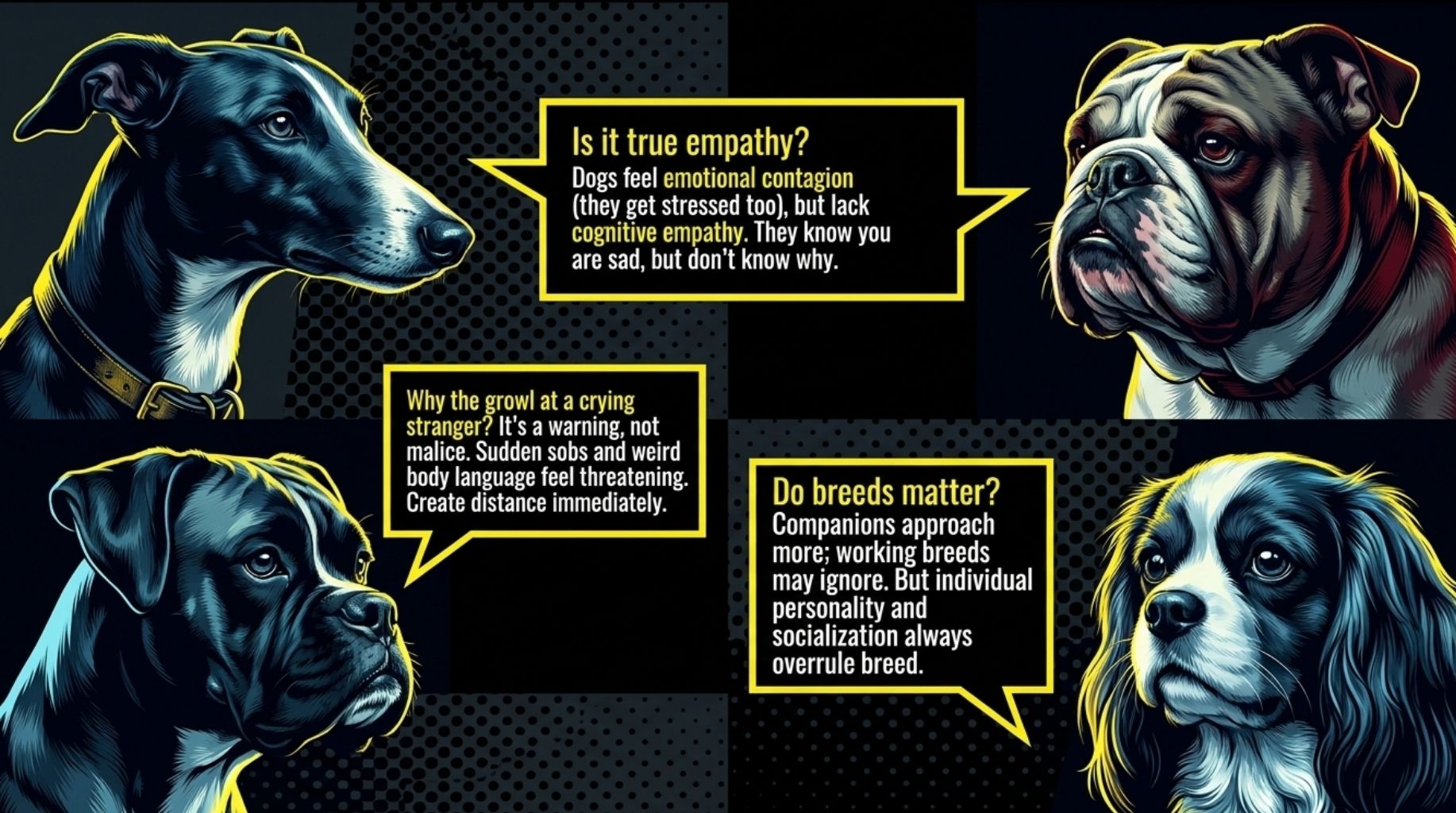
FREQUENTLY ASKED QUESTIONS (FAQs)