
Your dog isn’t just scared of thunderstorms. They shake for hours after the last boom, hide in closets, and pant uncontrollably at the first drop in barometric pressure. This isn’t ordinary fear, but it’s a profound, lasting reaction that makes many caring owners wonder, can dogs have PTSD?
The scientific answer is a resounding YES!
Post-Traumatic Stress Disorder (PTSD) is a well-documented condition in dogs, recognized by veterinary behaviorists worldwide. Once thought to be a uniquely human disorder, we now understand that the dog brain and nervous system can respond to trauma in almost identical ways.
This article delves into the neuroscience, symptoms, and pathways to healing, translating complex science into actionable knowledge for dog owners. Recognizing this condition is the first step toward providing your loyal friend with the compassionate support they need to heal.
“Dogs can carry the invisible scars of trauma, just like humans.”
Quick Summary About PTSD IN DOGS AND HOW TO OVERCOME THEIR TRAUMA
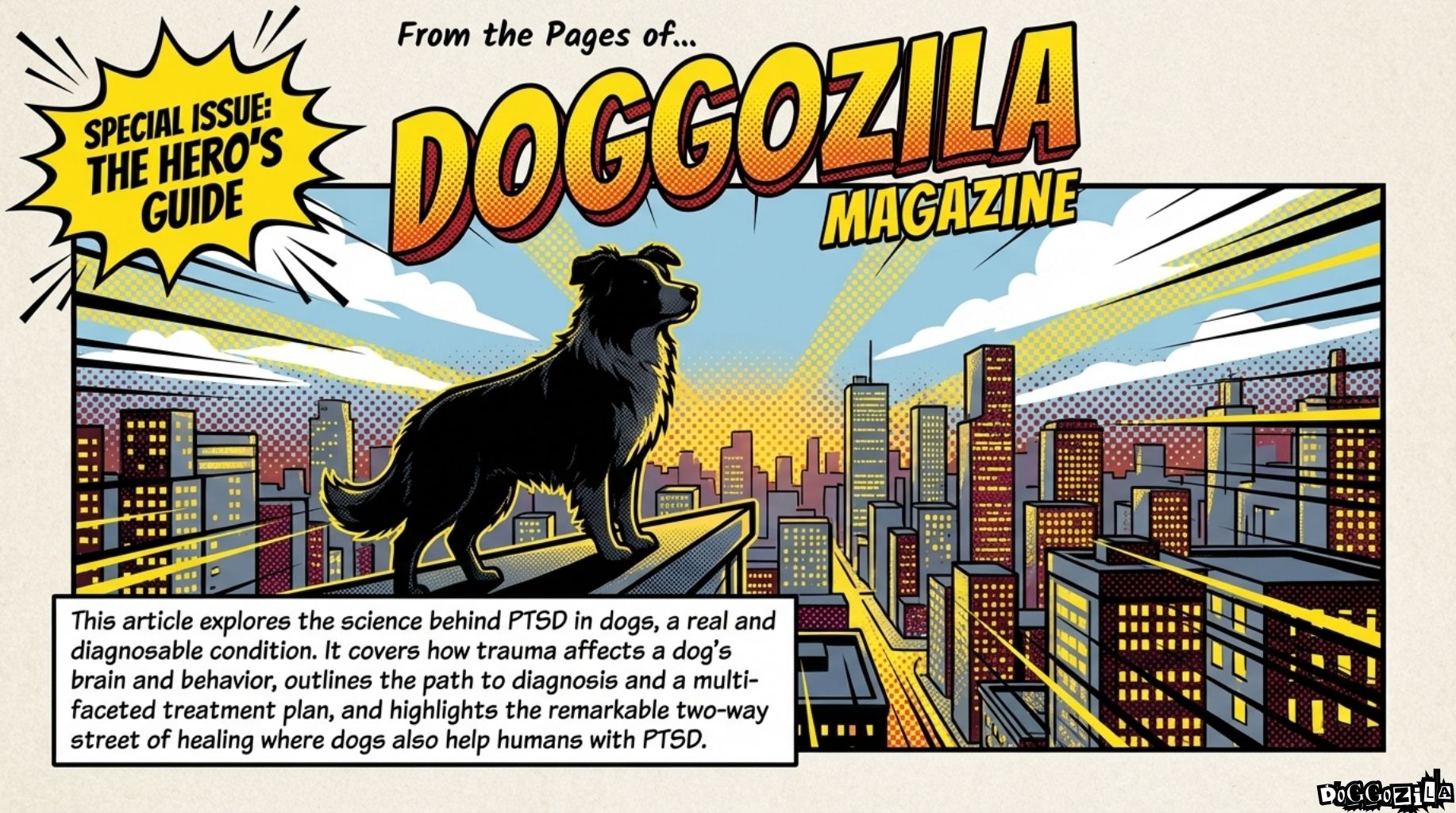
This article explores the science behind PTSD in Dogs, explaining that it is a real, diagnosable condition. It covers how trauma affects a dog’s brain and behavior, outlines the path to diagnosis and a multi-faceted treatment plan, and highlights the remarkable two-way street of healing where dogs also help humans with PTSD.
THE NEUROLOGICAL EVIDENCE PROVING CAN DOGS HAVE PTSD
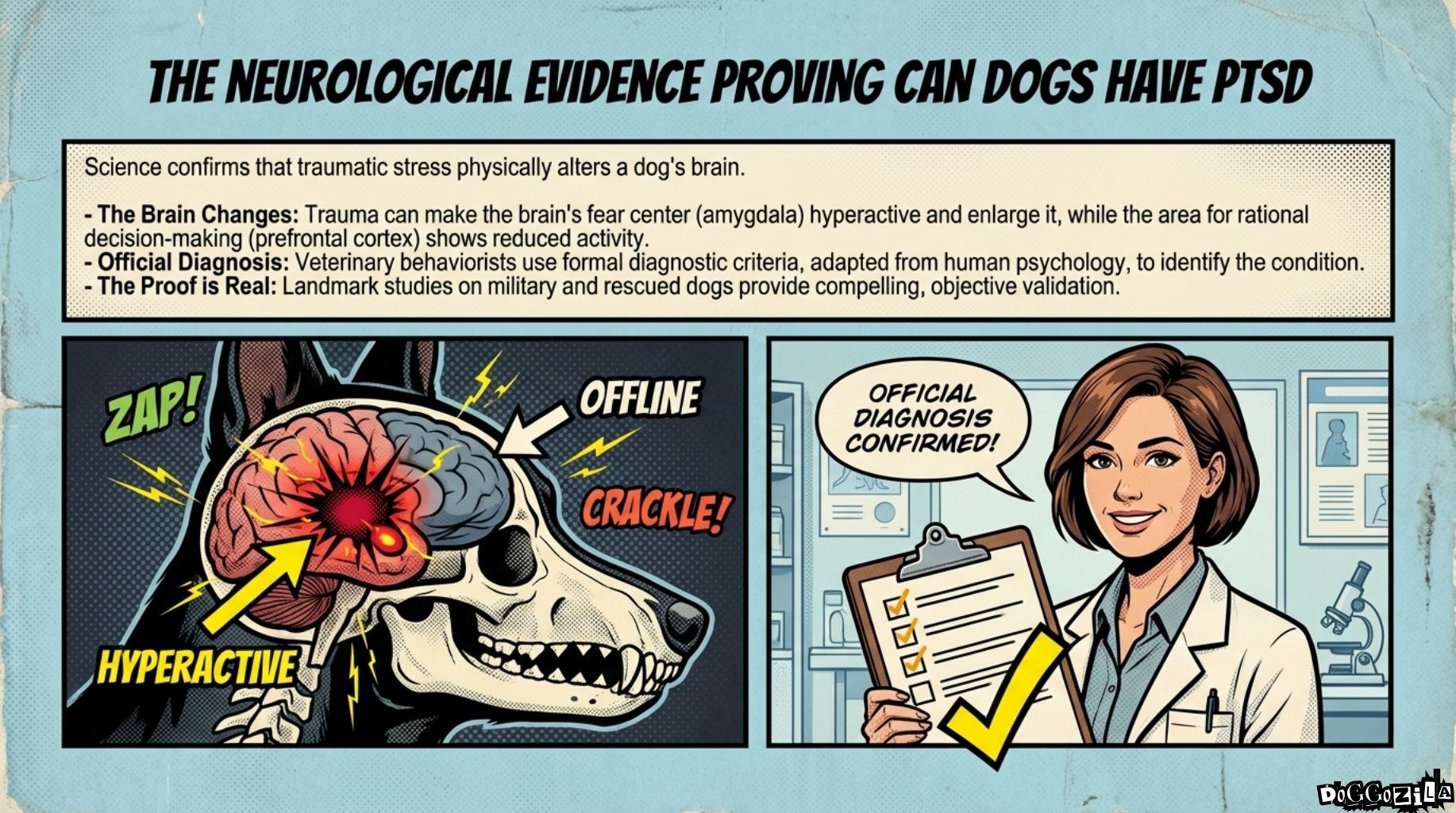
For decades, the concept of dog PTSD was met with skepticism. Today, advanced neurobiological research provides undeniable evidence. Scientific studies confirm that traumatic stress physically alters a dog’s brain, changing how they process fear and memory.
Veterinary behaviorists have adapted formal diagnostic criteria from human psychology to identify the condition in animals. This shift from anecdote to science validates the experiences of countless owners who see deep-seated fear in their dogs. The question is no longer if but how PTSD manifests in our furry friends. Understanding this evidence is fundamental to providing effective care and moving forward with empathy, directly answering the query can dogs have PTSD.
How Can Trauma Change the Brain in Dogs When They Have PTSD?
Traumatic events can rewire a dog’s brain on a structural level. The amygdala, the brain’s fear center, can become hyperactive and enlarged, while the prefrontal cortex, responsible for rational decision-making, may show reduced activity. This imbalance keeps the dog in a perpetual state of high alert, as their “alarm system” is stuck in the “on” position.
This neurological change is not a behavioral choice but a physiological reality, explaining why a dog cannot simply “get over” a past terror. These tangible brain alterations provide the definitive answer to the core question, if dogs can have PTSD. The proof is literally in their neural wiring, offering concrete proof that dogs can have PTSD is a neurological fact.
The Official Diagnostic Criteria Confirms How Dogs Can Have PTSD
Veterinary behaviorists have established clear criteria for diagnosing PTSD in dogs, mirroring the framework used for humans. Key indicators include exposure to a traumatic event, persistent re-experiencing (through flashbacks or nightmares), active avoidance of reminders, negative changes in mood and arousal, and heightened reactivity.
A diagnosis typically requires symptoms lasting over a month and causing significant distress or impairment. This formalized checklist moves the condition beyond vague anxiety, allowing for targeted treatment plans. It solidly confirms that dogs can have PTSD as a legitimate clinical inquiry, not just an anthropomorphic projection. The existence of this criteria settles the debate.
Landmark Studies Prove That Dogs Can Have PTSD
Compelling evidence comes from research on working dogs. Studies of military dogs deployed in combat zones found many returning with classic PTSD symptoms, hypervigilance, startling at loud noises, and uncharacteristic aggression. Similarly, research on dogs rescued from severe neglect or natural disasters documents long-term psychological scars.
These populations provide controlled observations because their trauma is often single-event and well-documented. The data from these dogs offers powerful, objective validation. It conclusively demonstrates that the query can dogs have PTSD is answered by documented cases in the field, leaving little room for doubt.
🔑 Key Points: Dogs absolutely can suffer from PTSD, a psychological condition recognized by science that is triggered by terrifying events and can cause lasting behavioral changes.
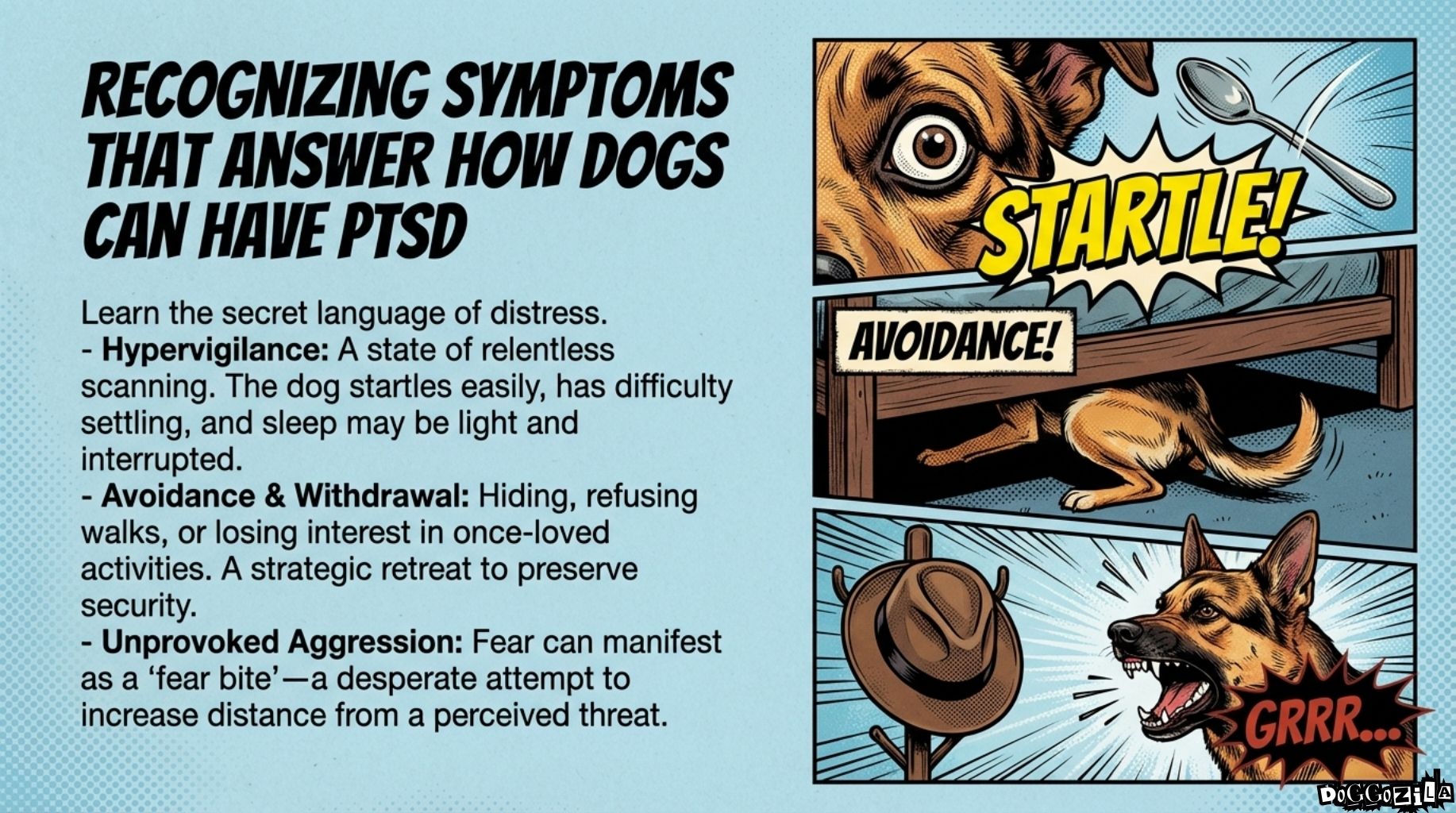
RECOGNIZING SYMPTOMS THAT ANSWER HOW DOGS CAN HAVE PTSD
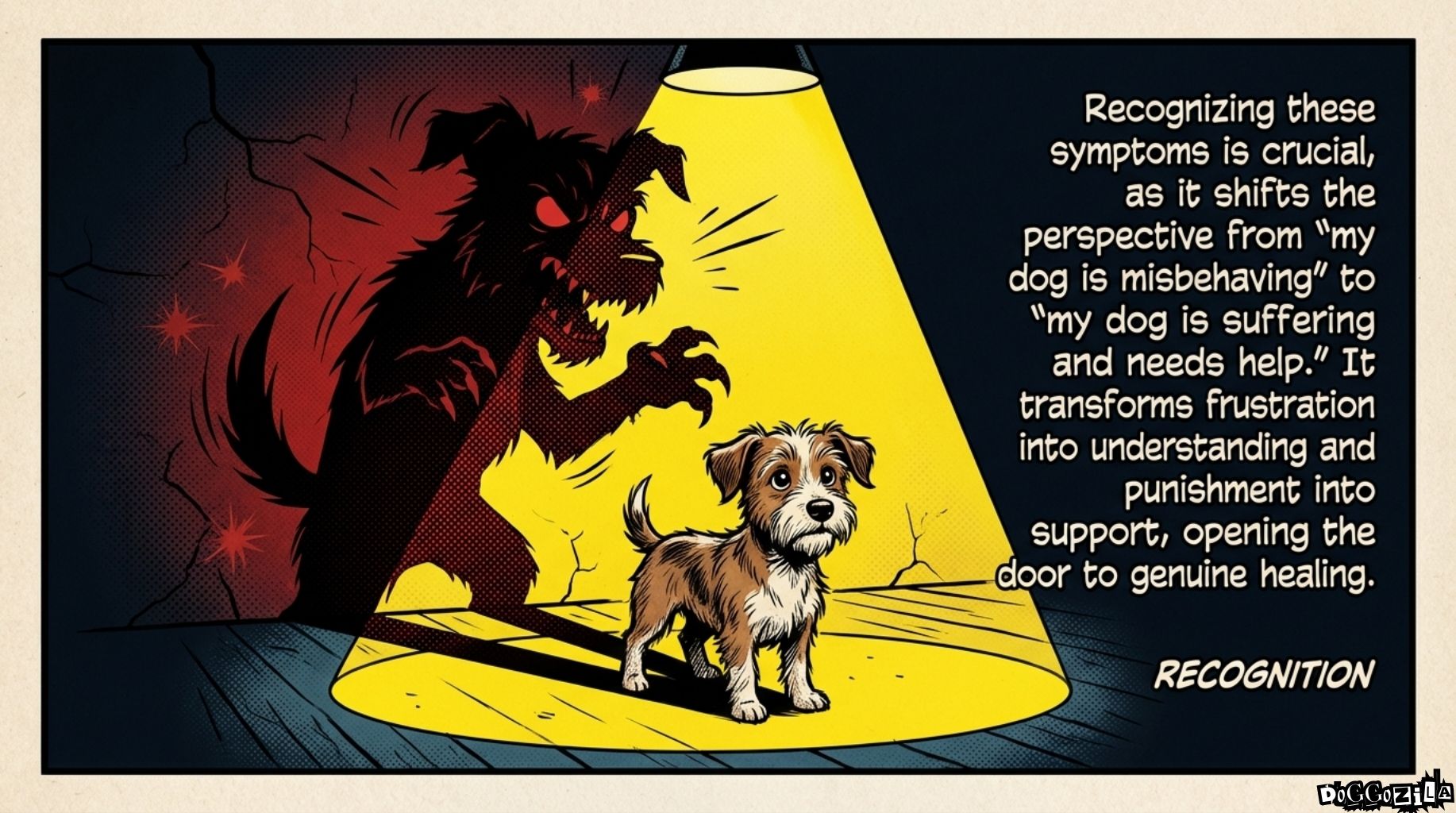
Dog PTSD often operates in silence, expressed through behaviors easily mistaken for stubbornness or disobedience. Owners may see a sudden, inexplicable change in their dog’s personality. Recognizing these symptoms is crucial, as it shifts the perspective from “my dog is misbehaving” to “my dog is suffering and needs help.”
The signs typically cluster into clear categories of hyperarousal, avoidance, and re-experiencing. Learning this language of distress allows you to become your dog’s greatest advocate. It transforms frustration into understanding and punishment into support, opening the door to genuine healing and providing a clear behavioral answer if dogs can have PTSD.
Hypervigilance: A Key Symptom That Shows Dogs Can Have PTSD
A dog with PTSD often lives in a state of relentless scanning. They may startle violently at mundane sounds, a dropping spoon, a door closing and have difficulty settling down. Their sleep might be light and interrupted, as if they’re always on guard duty. This isn’t normal alertness, it’s an exhausted nervous system unable to register safety.
The dog is physiologically primed for a threat that, in their mind, could return at any moment. This constant state of readiness is a primary symptom that makes experts ask, can dogs have PTSD, and observe this exhausting hyperarousal as a telltale sign.
Avoidance and Withdrawal Behaviors Show How Dogs Can Have PTSD
Active avoidance is a key coping mechanism. A traumatized dog may hide under furniture, refuse to walk down a certain street, or retreat from a person who resembles a past abuser. They might lose interest in activities they once loved, like play or walks, because the outside world feels too threatening.
This withdrawal is not a sign of a “bad” or “unfriendly” dog, it’s a strategic retreat to preserve their sense of security. Noting what your dog actively avoids provides critical clues to their internal world and their traumatic triggers, offering a clear window into the reality of how dogs can have PTSD.
Unprovoked Aggression and the Question of Can Dogs Have PTSD?
Fear can manifest as pre-emptive aggression. A dog may growl, snap, or bark at seemingly neutral stimuli, a man wearing a hat, a child running, the sight of a leash. This is often a “fear bite,” a desperate attempt to increase distance from a perceived threat before it can hurt them again.
This behavior is frequently misinterpreted as dominance or unpredictability, leading to further isolation and punishment. Understanding it as a trauma response is the first step toward de-escalation and rehabilitation, addressing the root fear rather than the surface behavior. This aggression forces us to seriously consider dog PTSD as the underlying cause.
🔑 Key Points: Diagnosing dog PTSD requires a veterinarian to first rule out medical causes, then assess behavioral history, with a veterinary behaviorist being the ideal specialist for creating a treatment plan.
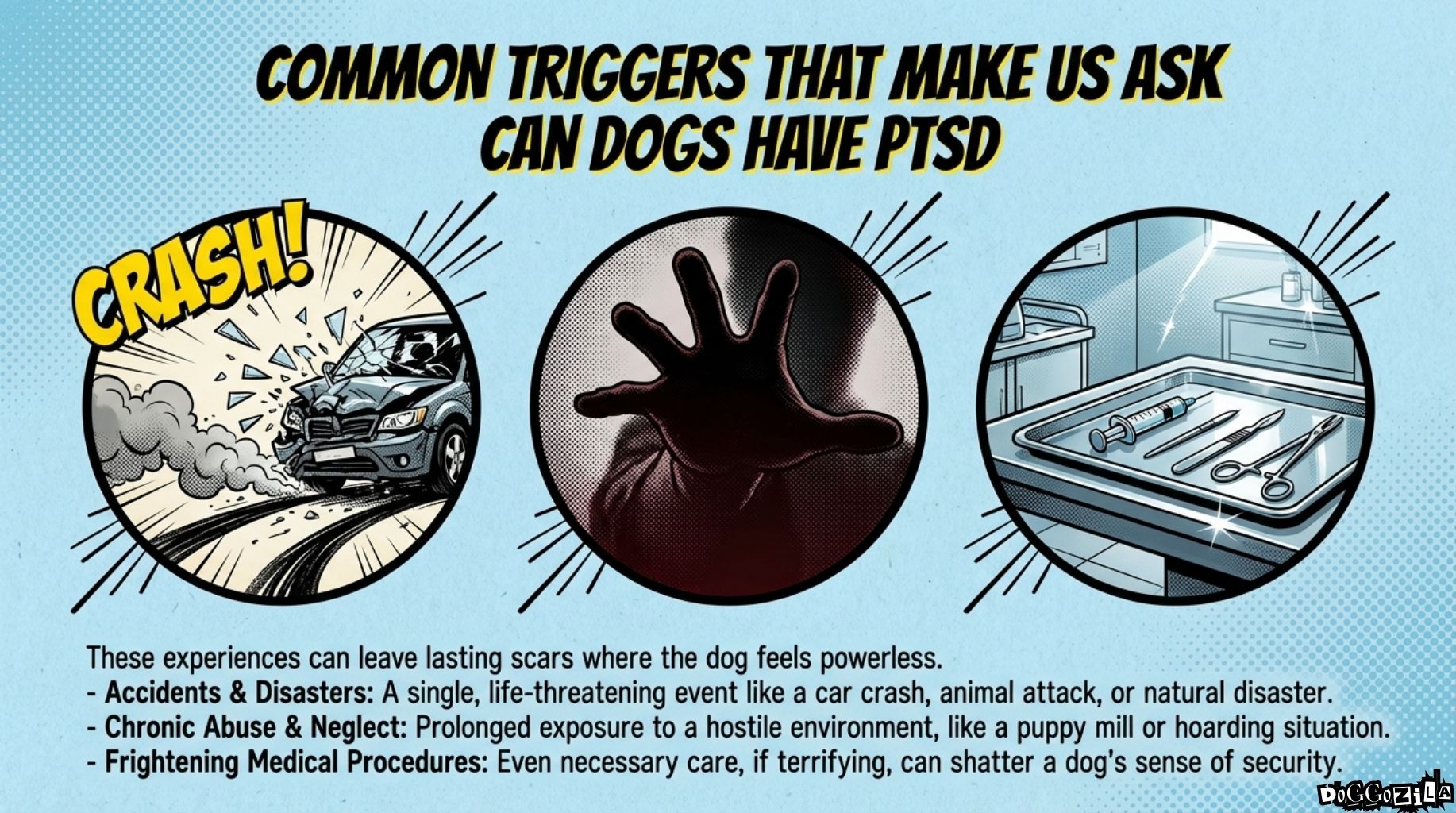
COMMON TRIGGERS THAT MAKE US ASK CAN DOGS HAVE PTSD
Trauma is subjective, what is manageable for one dog can be catastrophic for another. The common thread is an experience where the dog feels utterly powerless and overwhelmed by terror. These events are not always the dramatic stories we imagine. Often, they are incidents that happen in everyday life, leaving invisible scars that change a dog’s world.
Identifying potential triggers helps with both prevention and treatment, fostering a more trauma-informed approach to dog care. Knowing what can cause it deepens our understanding of the condition’s reality and directly influences the conversation around the question if dogs can have PTSD.
Surviving Accidents and Disasters: Events Can Lead Dogs to Have PTSD
Direct, life-threatening experiences are classic precursors to PTSD. A dog hit by a car, attacked by another animal, or caught in a fire or flood may develop lasting psychological wounds. The trauma is encoded alongside intense sensory details, like specific sounds, smells, or sights.
Afterwards, even related cues like the squeal of brakes, the sight of a large dog, or the smell of rain, can trigger a full panic attack. The memory is not a simple recall but a visceral, bodily re-living of the event, demonstrating how a single moment can have a lifelong impact and definitively show that dogs can have PTSD.
Chronic Abuse and Neglect Can Cause Dogs to Have PTSD
Prolonged exposure to a hostile environment creates complex trauma. Dogs rescued from hoarding situations, puppy mills, or abusive homes have never known safety or predictability. Their world was one of constant threat and scarce resources. This often results in symptoms like extreme fear of human hands, severe resource guarding, and a profound inability to trust.
Healing from this background requires immense patience, as the dog must learn that the fundamental rules of their existence have changed. This form of trauma asks for a deep commitment to recovery and is a tragic but clear answer to can dogs have PTSD.
Frightening Medical Procedures Can Cause Dogs to Have PTSD
Even necessary care can be traumatic if experienced as violent or terrifying. A painful veterinary procedure, forceful restraint during grooming, or a chaotic boarding kennel stay can shatter a dog’s sense of security. The very people and places meant to help them become associated with pain and fear.
This can create a heartbreaking conflict for owners, as their dog’s healthcare becomes a source of re-traumatization. It underscores the importance of fear-free, low-stress handling practices in all animal care professions to prevent iatrogenic trauma, a key consideration when evaluating can dogs have PTSD.
🔑 Key Points: Effective treatment combines behavior modification (like desensitization), possible veterinarian-prescribed medication, and lifestyle enrichment to manage anxiety and build new positive associations.
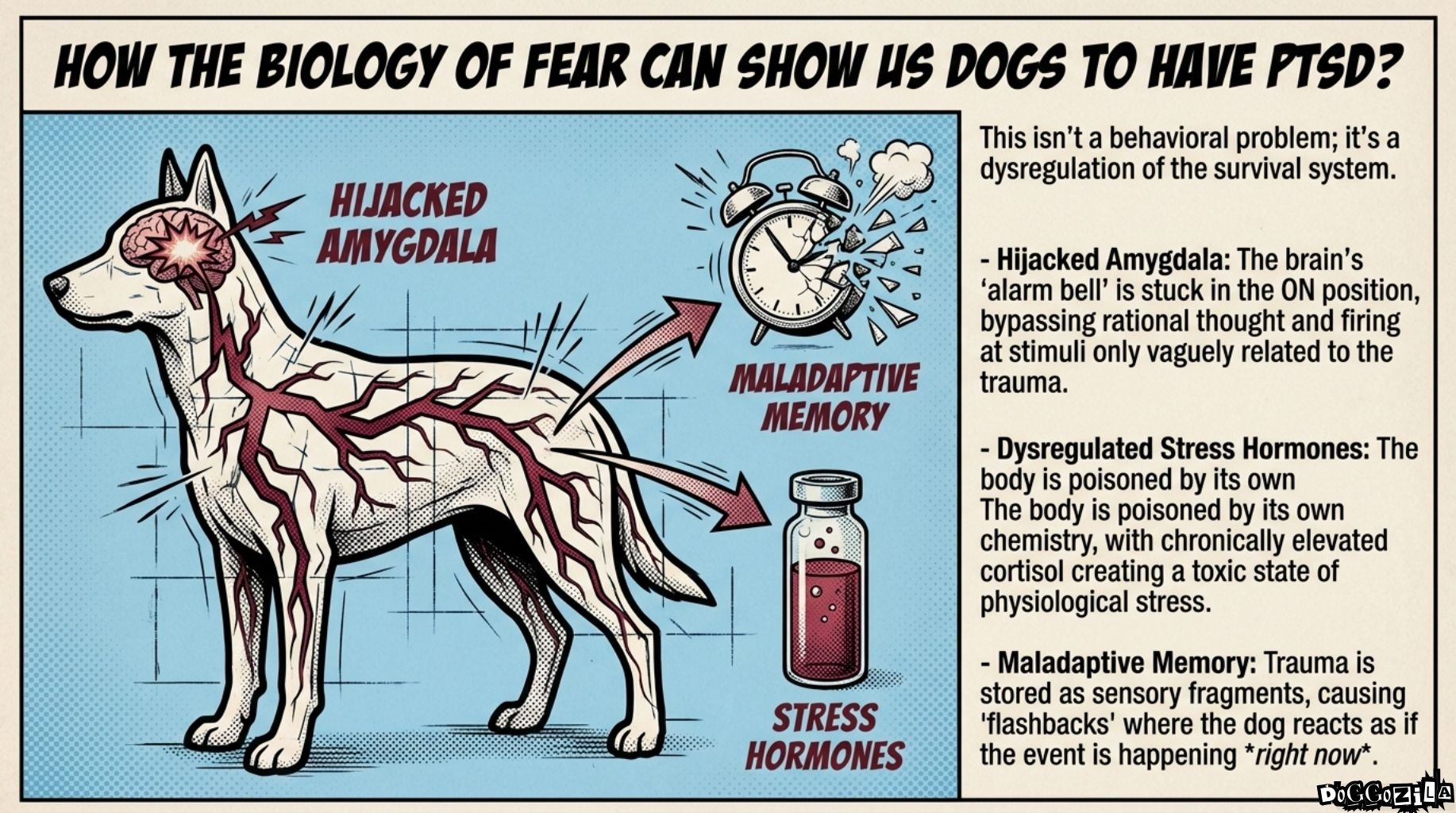
HOW THE BIOLOGY OF FEAR CAN SHOW US DOGS TO HAVE PTSD?
To move beyond labels and into effective solutions, we must understand the biology of fear. PTSD is not a behavioral problem but a dysregulation of the survival system. When a dog encounters extreme fear, a cascade of hormonal and neurological events occurs. In PTSD, this system malfunctions, failing to return to baseline after the danger passes. The dog becomes trapped in a past moment of terror.
This biological perspective removes blame and illuminates the path to treatment, focusing on calming the nervous system rather than just modifying behavior. It provides the mechanistic explanation for the question if dogs can have PTSD.
The Hijacked Amygdala and the Reality of Dogs Developing PTSD
The amygdala, the brain’s alarm bell, becomes hyper-reactive. It begins to fire at stimuli only vaguely related to the original trauma, generalizing the fear. A dog traumatized by a gunshot might later react to any loud, sharp noise, a book dropping, a car backfiring. This “trigger stacking” means minor stresses can accumulate until the dog has a disproportionate reaction.
The logical, thinking part of the brain is effectively bypassed. This is why reasoning with or scolding a terrified dog is futile; their higher brain functions are offline, overruled by a primal survival command. This hijacking is central to understanding how dogs can have PTSD.
Dysregulated Stress Hormones Affirming That Dogs Can Have PTSD
During trauma, the body floods with cortisol and adrenaline. In a healthy system, levels subside afterward. In PTSD, this hormonal system can become dysregulated. Cortisol may remain chronically elevated, or the feedback loop that shuts off production may break.
This creates a toxic, sustained state of physiological stress, leading to symptoms like weight loss, a weakened immune system, gastrointestinal issues, and relentless anxiety. The dog’s body is literally poisoned by its own stress chemistry, creating a vicious cycle where fear begets more fear. This hormonal dysregulation is a biological testament to dogs with PTSD.
Maladaptive Memory Consolidation Proves That Dogs Can Have PTSD
Traumatic memories are processed differently. They are stored in fragmented, sensory-rich forms (smells, sounds, sensations) rather than as coherent narratives. These fragments are easily triggered, causing “flashbacks” where the dog reacts as if the trauma is happening now.
When your dog hears a firework and cowers as if back in that terrifying storm from years ago, they are experiencing a flashback. Their memory system is malfunctioning, unable to properly file the event as a completed past experience. This is the cruel heart of PTSD, the past feels eternally present, offering a clear-cut answer to can dogs have or develop PTSD.
🔑 Key Points: An owner’s patience, consistency, and commitment to becoming their dog’s safe haven are the most critical components for successful long-term recovery.
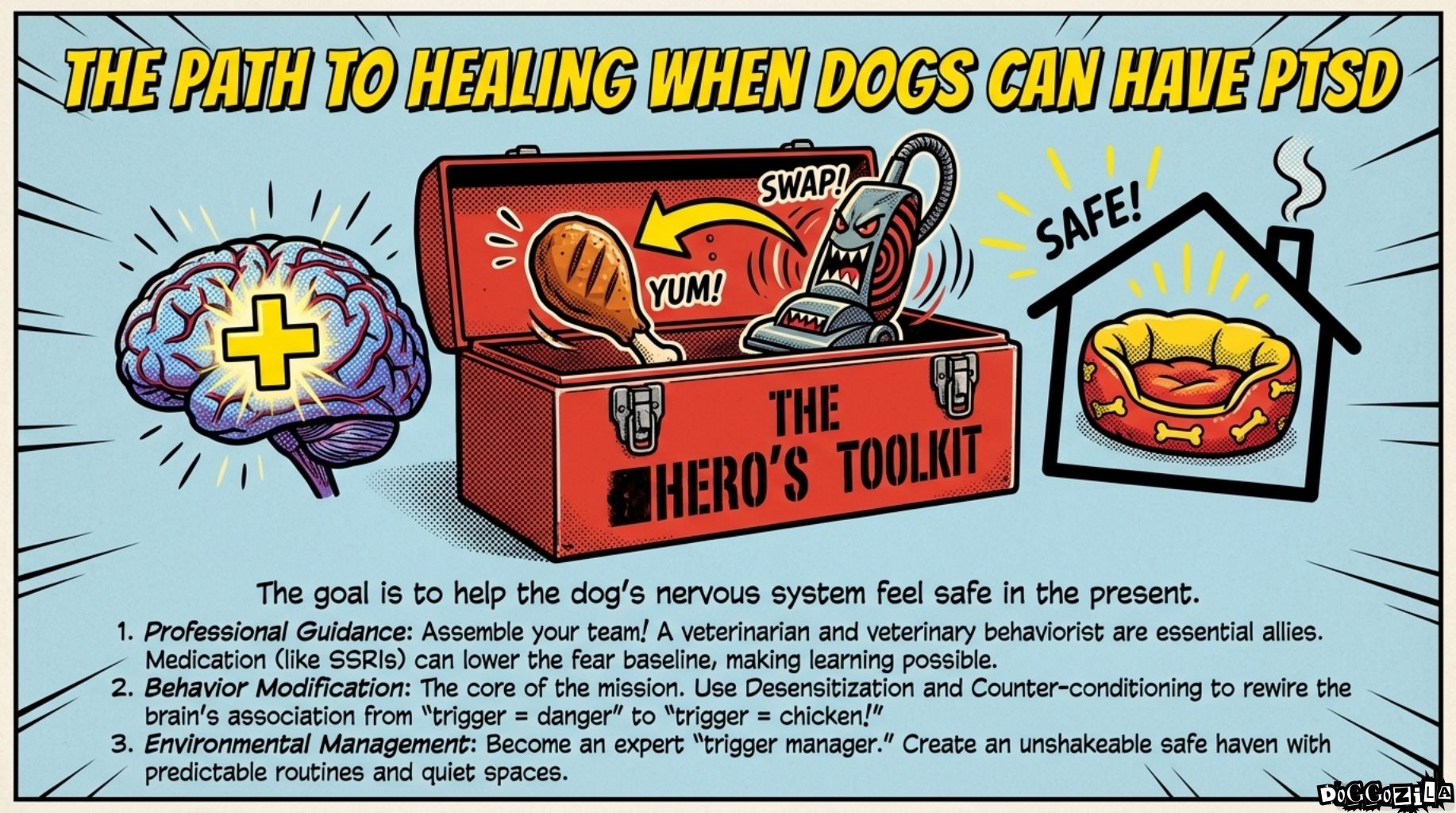
THE PATH TO HEALING WHEN DOGS CAN HAVE PTSD
A diagnosis of PTSD can feel overwhelming, but it is the beginning of a roadmap to recovery. Effective treatment is multi-modal, combining management, behavior modification, and sometimes medication. The goal is not to erase the past but to help the dog’s nervous system learn to feel safe in the present.
Success is measured in small victories, a calmer moment, a wider “buffer zone” around a trigger, a spark of regained joy. With commitment and the right help, significant improvement is not just possible, but it’s probable. Changing the narrative from simply asking can dogs have PTSD to actively treating it.
Professional Guidance Can Help Dogs That Have PTSD
The cornerstone of treatment is a proper medical evaluation. A veterinarian can rule out underlying pain or illness that may exacerbate anxiety. A referral to a Diplomate of the American College of Veterinary Behaviorists is ideal. These specialists can design a comprehensive plan, which may include psychoactive medication like SSRIs (e.g., fluoxetine).
Medication is not a sedative, but it works by lowering the dog’s overall anxiety baseline, making them more receptive to behavioral therapy. Think of it as turning down the volume of their fear so they can learn new, quieter songs, a vital step after confirming that dogs have PTSD.
Behavior Modification Can Address Problems to Dogs That Have PTSD
This evidence-based technique is the core of behavioral rehab. Desensitization involves exposing the dog to a minimized version of their trigger (e.g., a recording of thunder at barely audible volume). Counter-conditioning pairs that trigger with something the dog loves (e.g., high-value chicken).
The process rewires the brain’s association from “trigger = danger” to “trigger = chicken!” It must be done with exquisite care, progressing at the dog’s pace to avoid causing more fear. This slow, positive work directly challenges the maladaptive learning of PTSD and is the primary behavioral tool once we accept that dogs can have PTSD.
Environmental Management Can Help Dogs That Have PTSD
Healing cannot occur in a chaotic environment. Owners must become expert “trigger managers,” predicting and avoiding known stressors whenever possible. Creating an unshakeable safe space is critical, a sound-muffled crate in a quiet room, a “safe haven” bed where the dog is never disturbed.
Using white noise machines, pheromone diffusers (like Adaptil), and structured routines provides a predictable, calm world. This management isn’t “giving in” to fear, it’s providing the essential foundation of security from which all other healing can grow, a non-negotiable need for cases where dogs do have PTSD.
🔑 Key Points: Specially trained PTSD service dogs perform life-changing tasks for humans, such as interrupting anxiety attacks and providing grounding, showcasing a powerful two-way healing bond.
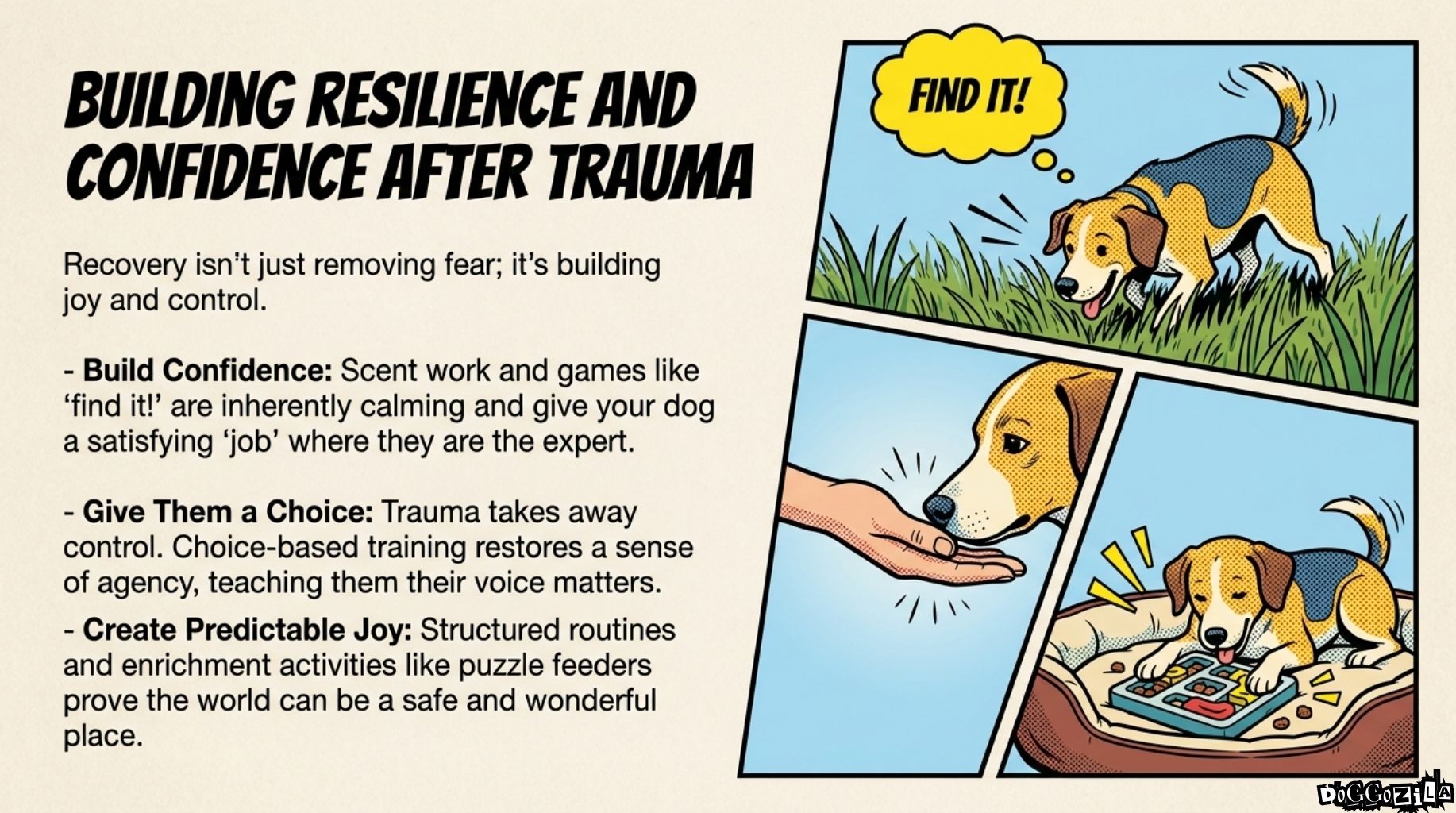
BUILDING RESILIENCE AND CONFIDENCE AFTER TRAUMA
Activities that foster confidence and allow the dog to make choices are profoundly therapeutic. They help overwrite the helplessness of trauma with experiences of success and control. This phase focuses on joy, engagement, and rebuilding a positive relationship with the world. One small success at a time, moving beyond the diagnosis of dogs with PTSD toward a fuller life.
True recovery extends beyond symptom reduction. It involves actively building a new self-concept for the dog, one of competence and agency.
Confidence-Building Through Nosework and Games
Scent work is a uniquely powerful tool. A dog’s sense of smell is directly linked to the emotional and memory centers of the brain. The act of searching for a hidden treat or a target odor is inherently calming and rewarding. Simple games like “find it!” or more structured nosework sports give the dog a satisfying job where they are the expert.
Each successful find floods their system with dopamine, building new, positive neural pathways. This work literally helps rebuild a brain focused on seeking rewards, not scanning for threats, which is crucial for healing after establishing that dogs can have PTSD.
Implementing Choice-Based Training and Consent
Trauma often involves a devastating loss of control. Rehabilitation must actively restore a sense of agency. Choice-based training lets the dog communicate, offering a chin rest for petting, using “start buttons” to initiate interactions, or choosing which direction to walk.
Respecting a “no“, when a dog walks away, is as important as rewarding a “yes.” This empowerment rebuilds trust from the ground up, teaching the dog that their actions have predictable, positive consequences and that their boundaries will be honored. This is especially important when addressing the powerlessness inherent in dogs that have PTSD.
Structured Routine and Predictable Enrichment
For an anxious brain, predictability is safety. A consistent daily schedule for feeding, walks, and quiet time reduces the stress of uncertainty. Pair this routine with predictable enrichment, puzzle feeders for meals, a daily frozen Kong, or a calm decompression walk in a familiar, quiet area.
These activities provide mental stimulation within a framework the dog can trust. They fill the dog’s life with small, guaranteed pleasures, creating a new narrative where good things happen regularly and the world is not a place of constant peril, directly countering the chaos that causes us to ask can dogs have PTSD.
🔑 Key Points: Training a PTSD service dog is a rigorous, years-long process focused on reliable task work and public manners, often built through positive reinforcement and a strong partnership.
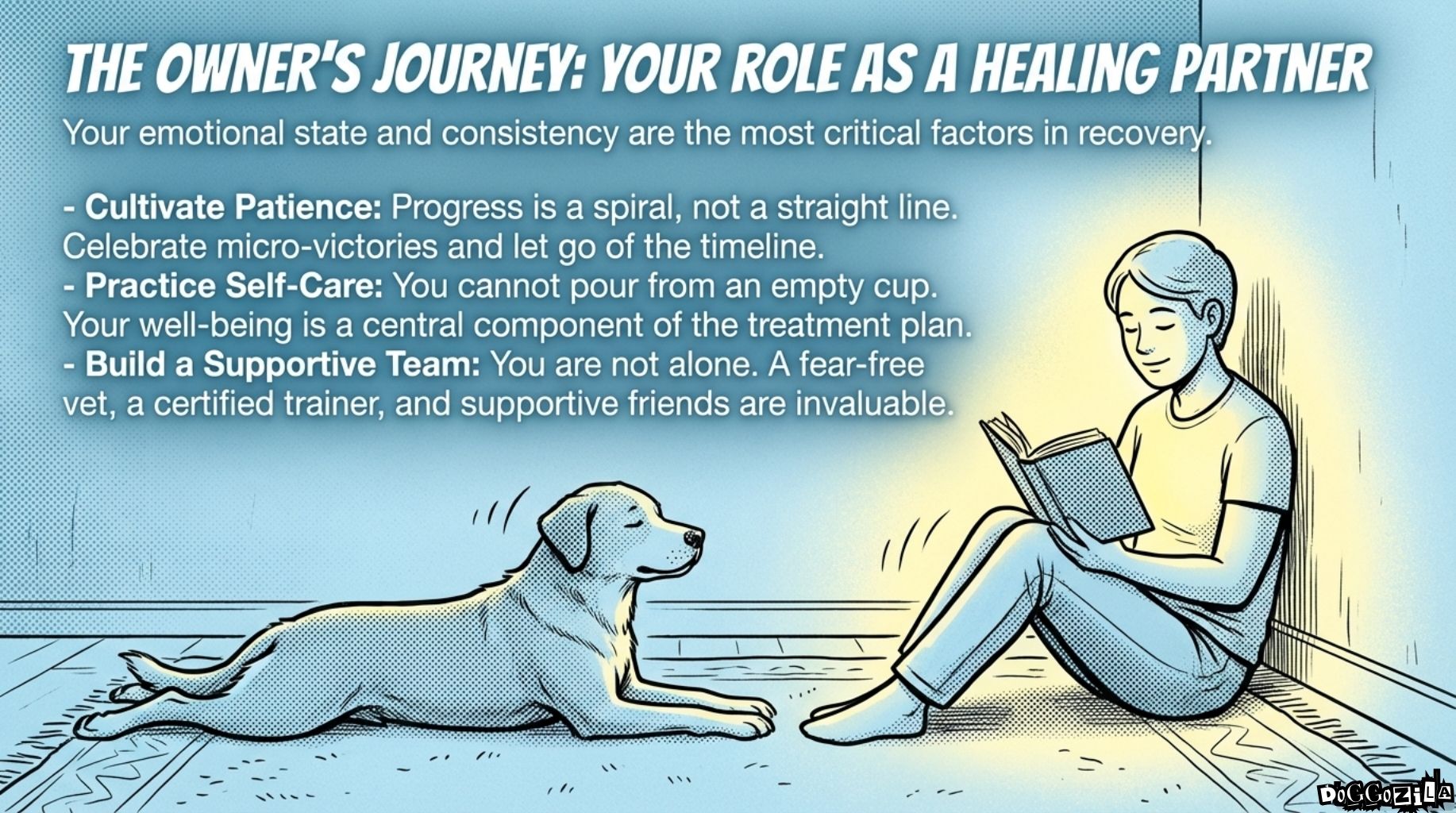
THE OWNER’S JOURNEY: YOUR ROLE AS A HEALING PARTNER
Supporting a dog with PTSD is a profound commitment that demands patience, education, and self-care. Your emotional state and consistency are the most critical environmental factors in your dog’s recovery. You are not just a trainer, you are a safe harbor, a steady anchor, and an interpreter of the world.
This journey will challenge you but can also deepen the bond with your dog in unimaginable ways. Your resilience fuels theirs, and your understanding of dog PTSD shapes the recovery environment.
Cultivating Patience and Managing Expectations
Progress in trauma recovery is rarely a straight line. It is a spiral, with periods of great leaps forward and frustrating regressions. Owners must learn to celebrate micro-victories, a softer eye, a deeper sigh, a moment of curiosity. Letting go of a timeline or an idealized version of a “normal dog” is essential.
Your patience, showing up calmly, day after day, without frustration, communicates unconditional safety to your dog’s nervous system. This steadfast presence is the most powerful medicine you can provide, a daily practice after learning that dogs can have PTSD.
Self-Care and Emotional Regulation for the Handler
Dogs are exquisitely sensitive to our emotional states. If you approach a training session with anxiety or frustration, your dog will absorb that tension, undermining the work. It is imperative to manage your own stress. Practice deep breathing, seek support from understanding communities, and give yourself permission to take a break.
Your well-being is not separate from your dog’s treatment plan, it is a central component. You cannot pour from an empty cup, and you cannot model calmness from a state of burnout, which is vital when managing a condition where dogs do have PTSD.
Building a Supportive Care Team
You do not have to be the sole therapist. A strong care team is invaluable. This may include your fear-free veterinarian, a certified professional dog trainer (CPDT-KA) specializing in fear, a veterinary behaviorist, and supportive friends or family. Educate everyone who interacts with your dog on their needs.
Use tools like “Do Not Pet” patches on harnesses to advocate for your dog’s space in public. This network protects your energy and ensures you have experts to turn to, making the path forward feel less solitary and more manageable on the journey after accepting that dogs can have PTSD.
A Future of Understanding: Advocacy and Awareness
By learning about dog PTSD, you are already part of a growing movement of awareness and advocacy. You can help other dog owners by sharing information and reducing the stigma around mental health issues in pets. Support ethical organizations that train service dogs or rescue and rehabilitate traumatized animals.
Advocate for force-free training methods in your community. The more we understand that dogs can have PTSD, the more we can push for better resources, more veterinary behaviorists, and more compassionate care standards. Your experience, whether personal or as an ally, contributes to a future where every dog who has known fear can find the safety and healing they deserve.
🔑 Key Points: The first action step for a concerned owner is to consult a veterinarian, avoid punishing fearful behavior, and begin managing the dog’s environment to reduce triggers while seeking professional guidance.
FREQUENTLY ASKED QUESTIONS (FAQ)