
For thousands of years, our story has been tangled with the story of dogs. We shaped them, and they shaped us. Today, many scientists believe this shared journey is taking a dramatic new turn. We are witnessing what some call a third wave of domestication, pushing our dogs into a new phase of evolution suited for modern couch cushions, not ancient campfires.
This shift asks profound questions about what we want from our furry friends and how they are changing to meet the demands of 21st-century life. Are dogs in a new phase of evolution? The evidence is wagging right in front of us.
„Imagine your dog’s fascination with the delivery person isn’t just mischief, but a ancient wolf instinct crashing into modern life, this clash is fueling the most profound change in our best friends since they first approached our campfires.“
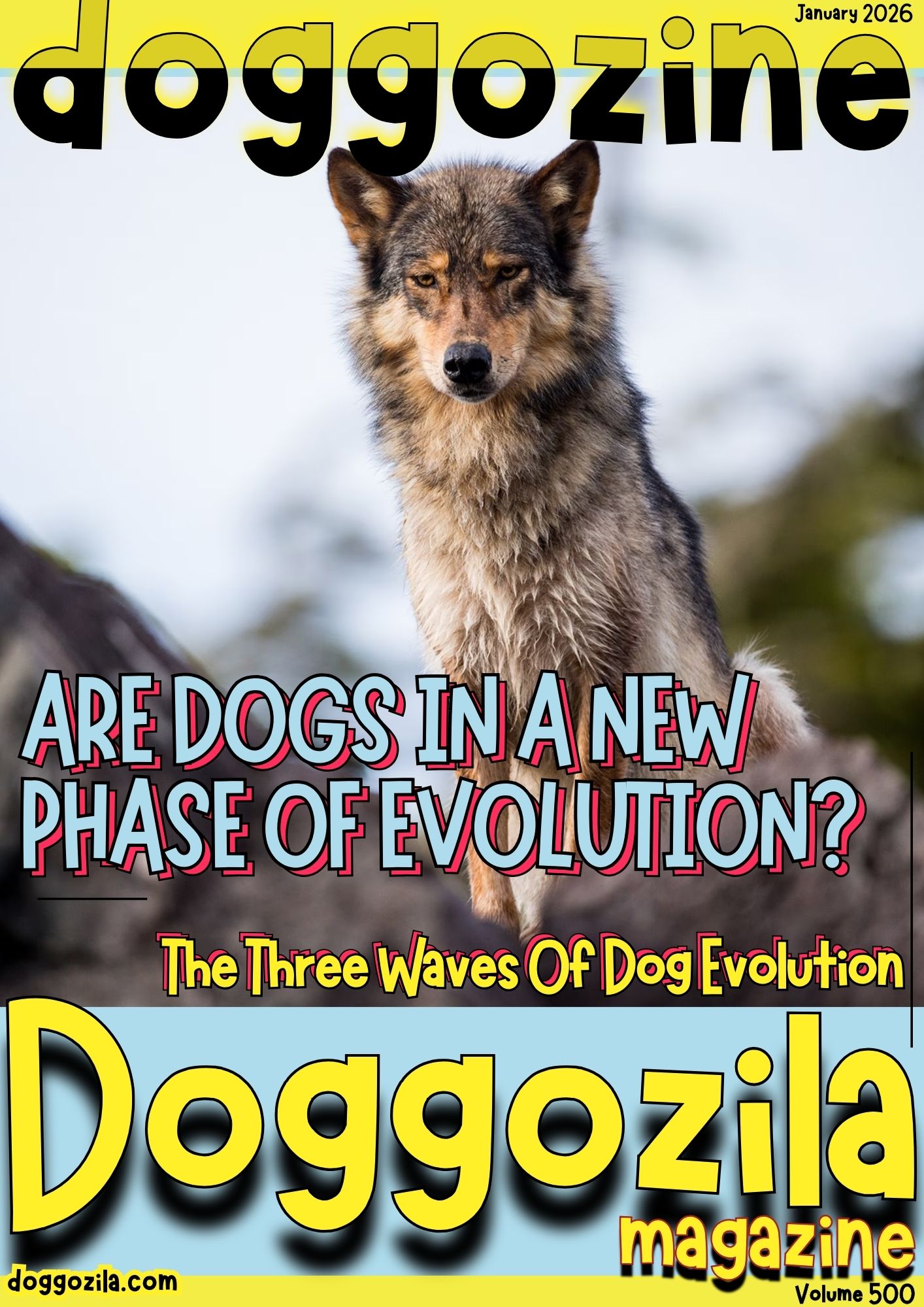
Quick Summary About THE NEW PHASE OF DOG’S EVOLUTION
This article explores the compelling idea that dogs are experiencing a “third wave” of domestication. We’ll journey from their ancient origins as wolves to their transformation into Victorian status symbols, and finally to today’s modern companions who are being shaped by the pressures of urban living. The central question we unpack is whether these new demands for calm, adaptable temperaments mean dogs are in a new phase of evolution, actively guided by our 21st-century needs.
THE ANCIENT PACT WITH WOLVES: ARE DOGS IN A NEW PHASE OF EVOLUTION?
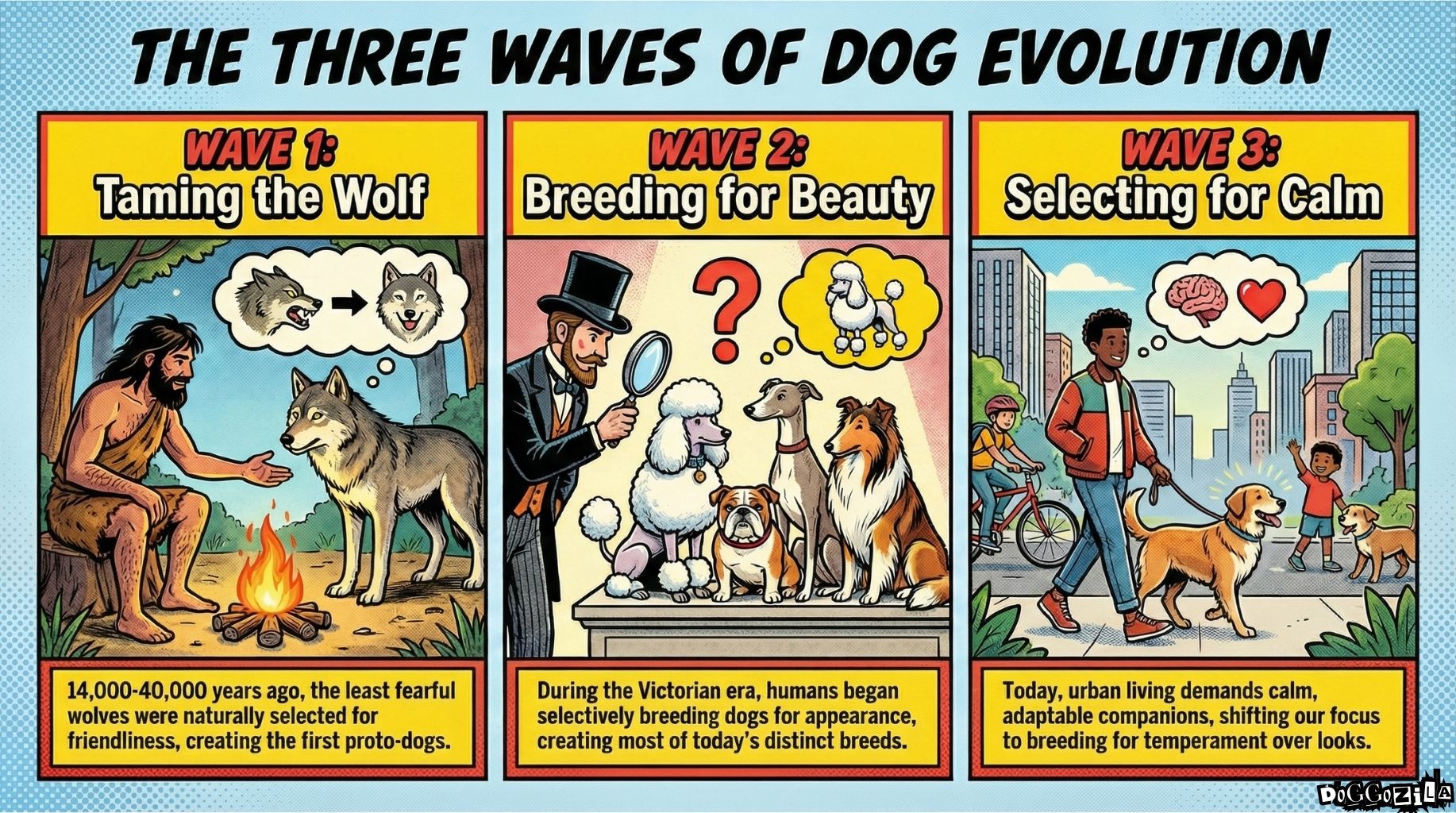
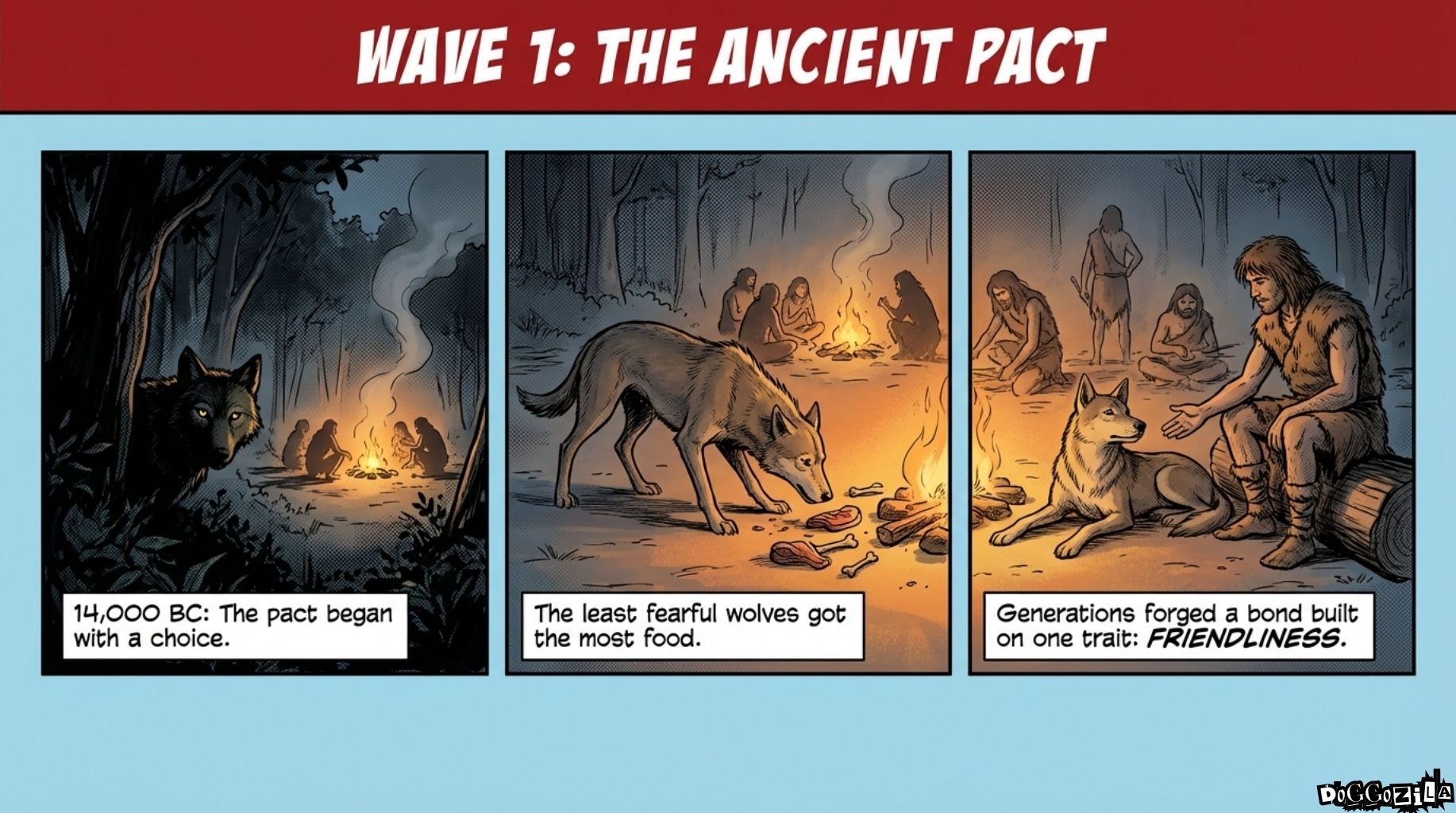
Our incredible journey with dogs began not with a leash, but with a wary glance. Between 14,000 and 40,000 years ago, bold wolves started lurking around the edges of human camps. They were drawn by the scraps and garbage our ancestors discarded. This was the spark of a world-changing partnership.
The wolves that were least afraid of humans got the most food! So, over generations, this natural selection for friendliness fundamentally changed them. They began their transformation from wild predators into proto-dogs, forging the first unbreakable bond between our species. This first, slow wave of change set a precedent for the idea that dogs are in a new phase of evolution today, as they continue to adapt to us.
The First Wave: Where the Question If Dogs Are in a New Phase of Evolution Began
This first wave of domestication was a slow, natural process. The tamer wolves that thrived around humans gradually took on new roles. They cleaned up waste and likely warned our ancestors of approaching predators or strangers. In return, they received a steady food supply and protection. This mutual benefit cemented the relationship.
It was not about looks or specific jobs yet, but about a fundamental shift in temperament. Fear and aggression were replaced by tolerance and then attraction to humans. This foundational change in personality set the stage for everything that followed, including the modern pressures that lead us to ask if dogs are in a new phase of evolution.
The Second Wave: Breeding Before We Asked if Dogs Are in a New Phase of Evolution
You might think the wild variety of dogs is a modern invention, but you would be wrong. New research studying ancient skulls reveals a stunning fact. By about 10,000 years ago, nearly half of the physical diversity we see in modern dogs was already present. Scientists found skulls with shorter snouts and wider heads alongside more wolf-like shapes from this ancient period.
This explosion of form happened incredibly early in our relationship. It shows that once dogs split from wolves, they immediately began adapting to different human societies, environments, and roles. Their evolution was rapid and diverse from the very start, proving that canine change is a constant.
The Third Wave Dawns: Recognizing That Dogs Are in a New Phase of Evolution
This early diversity was no accident. As humans migrated and explored, dogs came with us as crucial “biocultural packages“. They were living tools and companions who moved alongside hunter-gatherers, farmers, and pastoralists. Their genetics show they traveled the ancient world with us.
Where we went, they went. This shared migration meant dogs adapted to every corner of the human world. They were not just pets, they were integral partners in human survival and expansion, their evolution tightly woven into our own history. This deep partnership is the bedrock upon which today’s potential new chapter is built.
🔑 Key Points: The first bond was built on mutual benefit, less fearful wolves got food from humans, and humans gained early warning and cleaner camps. This natural selection for friendliness, not looks, was the original evolutionary leap.
THE VICTORIAN REVOLUTION: BREEDING DOGS FOR BEAUTY BEFORE A NEW PHASE OF EVOLUTION
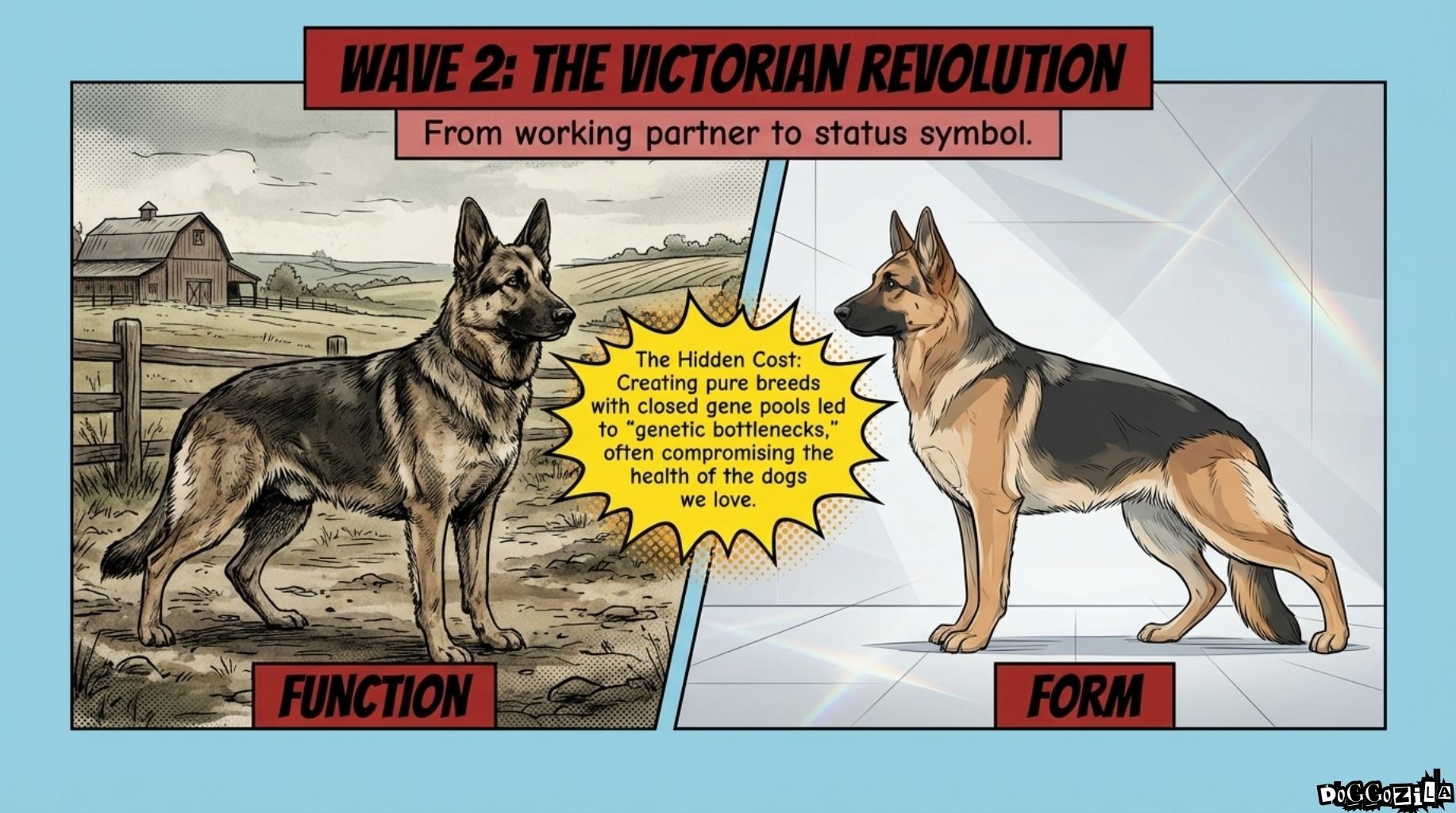
The second great wave of dog domestication crashed ashore with the Industrial Revolution. As a new middle class emerged, dogs transformed from working partners into status symbols. People began to prize appearance above all else. Armed with a budding understanding of genetics and a passion for pedigree, Victorian enthusiasts started controlling reproduction with unprecedented precision.
This era gave us most of the over 200 dog breeds recognized by kennel clubs today. The goal shifted from utility to aesthetics, creating the distinct breeds we know and love, a trend that would later set the stage for a different kind of selection.
When Form Overshadowed Function
In this second wave, a dog’s value became linked to its looks. Breeding focused on coat color, tail shape, ear carriage, and snout length. Think of the elaborate standards for Poodles or the distinct silhouette of a Scottish Terrier. While some breeds retained echoes of their original jobs, the primary driver was human taste.
This created the spectacular variety of shapes we see today, from the tiny Chihuahua to the massive Saint Bernard. However, this intense focus on appearance often came with a cost, overlooking the behavioral and health needs of the animals confined by these new beauty standards. This created challenges that the next evolutionary phase must solve.
The Hidden Cost of the Purebred
Closing gene pools to create pure breeds had serious genetic consequences. A landmark study on German Shepherds tells a cautionary tale. Researchers compared genomes from historical museum specimens with modern dogs. They found a massive drop in genetic diversity during the 20th century, driven by population crashes during war and the overuse of a few popular sires.
This “popular sire effect” created genetic bottlenecks. The result was less robust health and a higher prevalence of inherited disorders. The quest for perfect form sometimes compromised the fundamental fitness of our best friends, a lesson that must guide future decisions if dogs are in a new phase of evolution.
Beyond the Kennel Club
It is crucial to remember that the Victorian purebred is just one part of the dog story. For every breed with a pedigree, there are countless “village dogs” around the world. These free-ranging, adaptable dogs are not under intense human selection for looks. They represent a more ancient and genetically diverse canine population.
Their existence reminds us that the dog’s evolutionary path has many branches. The story of domestication is not just about the breeds in show rings, it is also about the scruffy, intelligent survivors thriving in villages and cities globally, and their genes may be key to future resilience.
🔑 Key Points: The shift to breeding dogs primarily for looks and pedigree standards created stunning breed diversity but often at the cost of genetic health and behavioral fitness, setting the stage for future problems.
NAVIGATING THE URBAN CHALLENGE: ARE DOGS IN A NEW PHASE OF EVOLUTION?
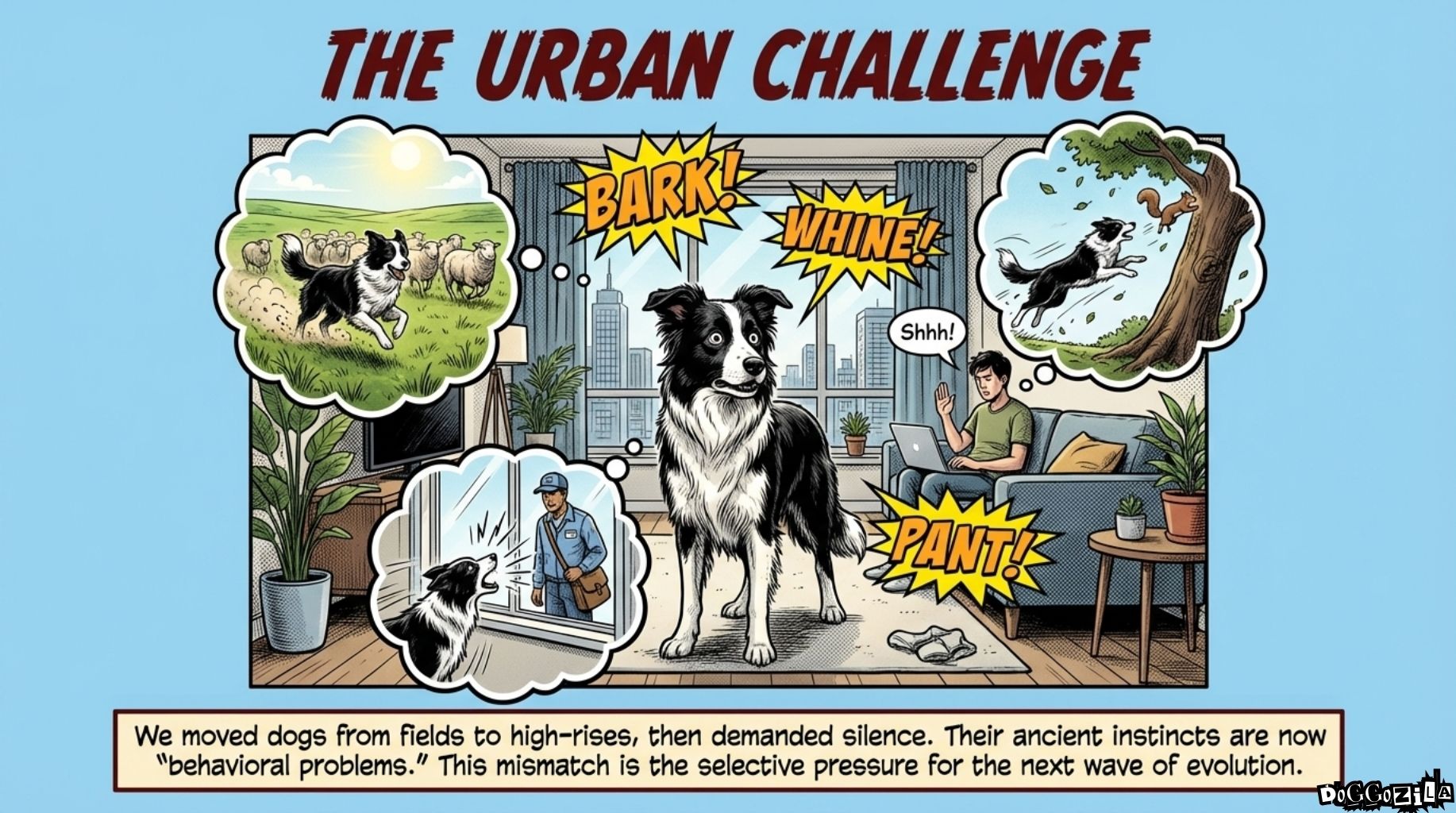
Our world has changed faster than ever, and our dogs are struggling to keep up. We took them from farms and fields and placed them in apartments and suburbs. The modern dog is expected to be a perfect, polite family member. They must stay calm during a work Zoom call, walk politely past strangers, and befriend the cat.
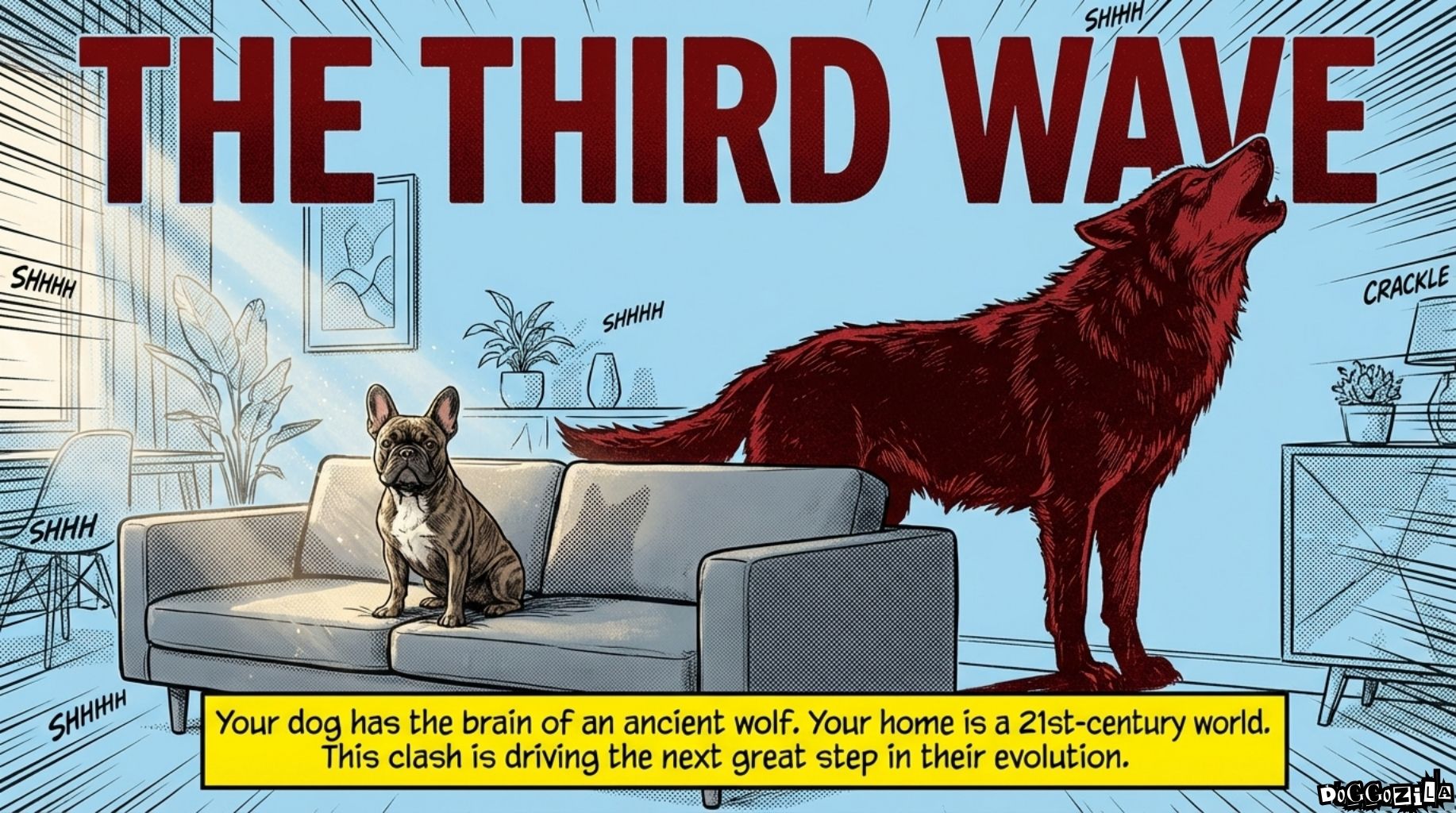
Now we arrive at today’s pressing question. This is a monumental ask for an animal whose ancestors were selected for vigilance, energy, and prey drive. This dramatic mismatch is the engine forcing us to ask if dogs are in a new phase of evolution.
The Clash of Instinct and Expectation
A dog’s natural behaviors are now often problems. Guarding against strangers makes walks stressful. High energy without a job leads to anxiety in a small apartment. Barking at noises disturbs close neighbors. These instincts, perfect for ancient or rural life, are maladaptive in dense urban settings.
The result is a crisis of surrender in shelters, where dogs deemed “too difficult” often end up. Our modern lifestyle demands a new kind of canine citizen, one that is inherently friendly, flexible, and calm. This demand is the selective pressure for the third wave, directly prompting the question, are dogs in a new phase of evolution driven by city life?
The Service Dog Blueprint Show Us That Dogs Are in a New Phase of Evolution
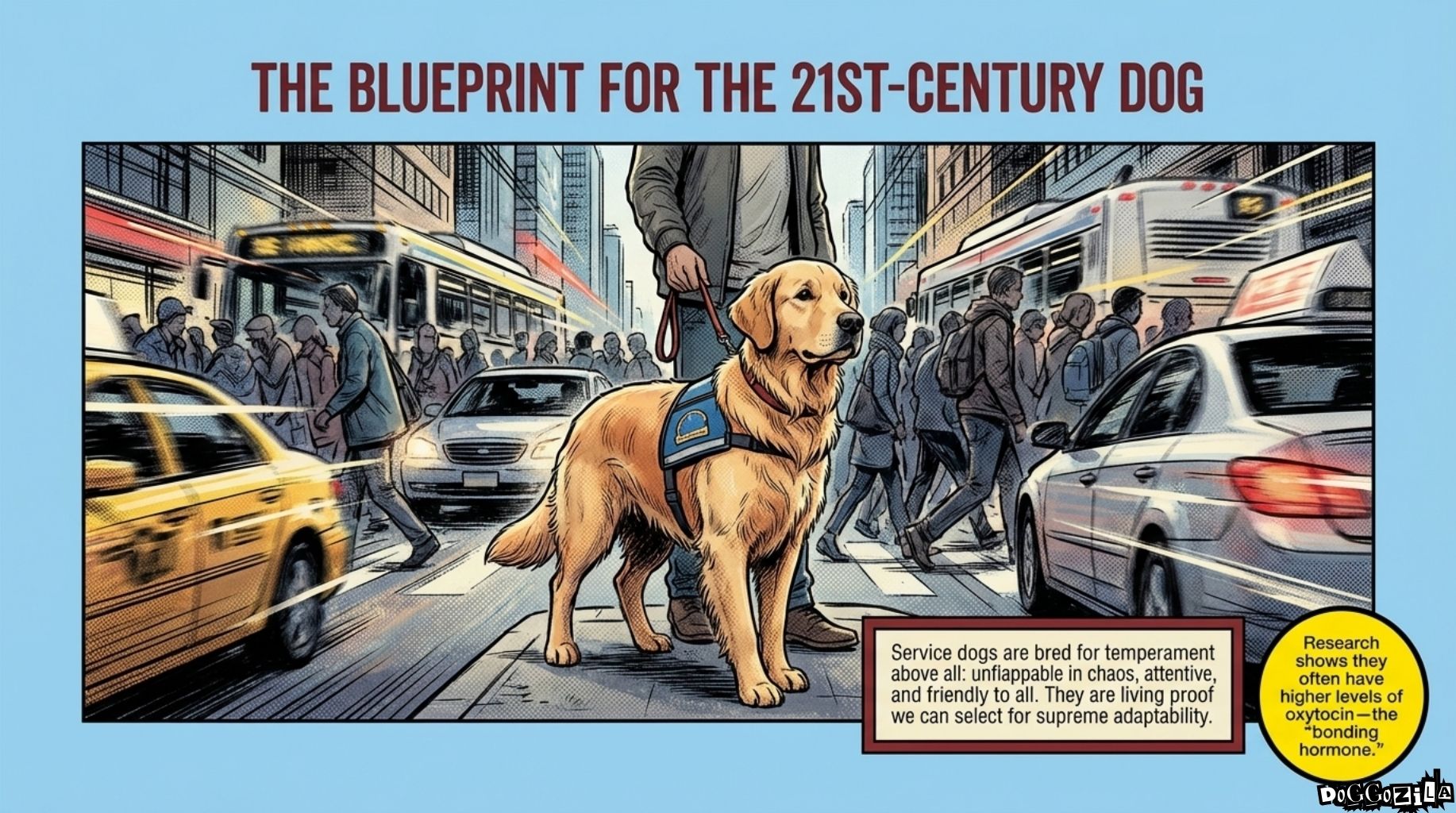
Where can we find the model for this 21st-century dog? Look no further than the professional service dog. Organizations like Canine Companions have spent decades perfecting this model. These dogs are not just trained, they are bred for specific temperaments. They need to be unflappable in noisy cities, gently attentive to human needs, and friendly to all.
Research shows these dogs often have higher levels of oxytocin, the “bonding hormone,” than the average pet. They represent a tangible genetic and behavioral shift. They are living proof that we can selectively breed for supreme adaptability and sociability, offering a clear “yes” to the question of a new evolutionary phase.
Selecting for the “Settle” Gene in This New Phase
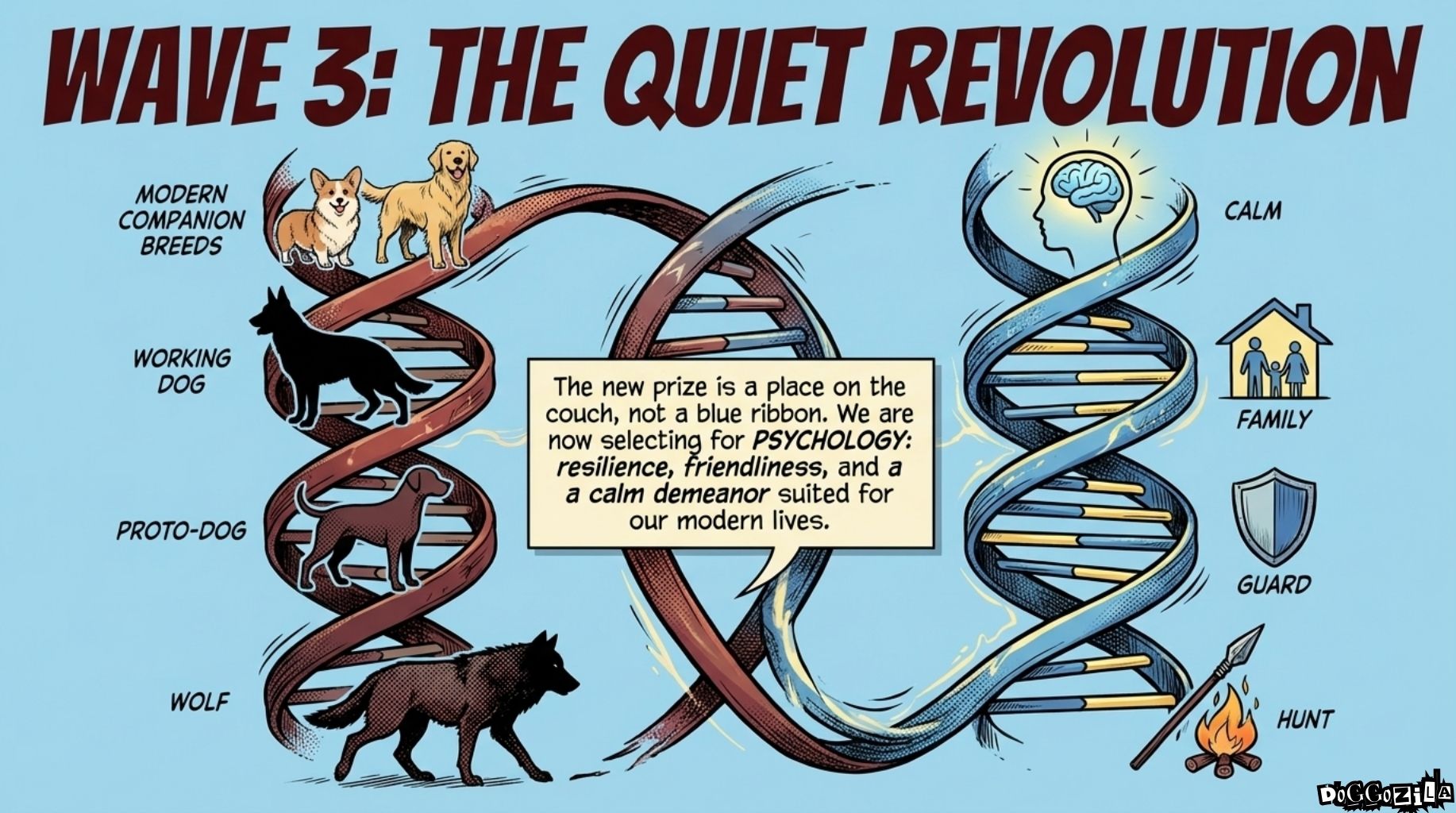
The third wave of domestication is less about how a dog looks and all about how a dog behaves. The most desirable traits are now psychological, resilience, friendliness, and a calm demeanor. Imagine breeders prioritizing a puppy’s ability to “settle” quickly after play or its comfort with novel sounds. This is a fundamental redefinition of what makes a “good” dog.
The question of whether dogs are in a new phase of evolution finds its answer here. We are shifting from selecting for physical form to selecting for internal temperament suited for shared urban living spaces and quieter home lives. This is evolution in real-time.
🔑 Key Points: The modern demand for dogs to be calm, polite companions in apartments and cities creates a mismatch with their ancient instincts, acting as the primary selective pressure that forces us to ask if dogs are in a new phase of evolution.
THE GENETICS OF CALM: EVIDENCE FOR A NEW EVOLUTIONARY PHASE
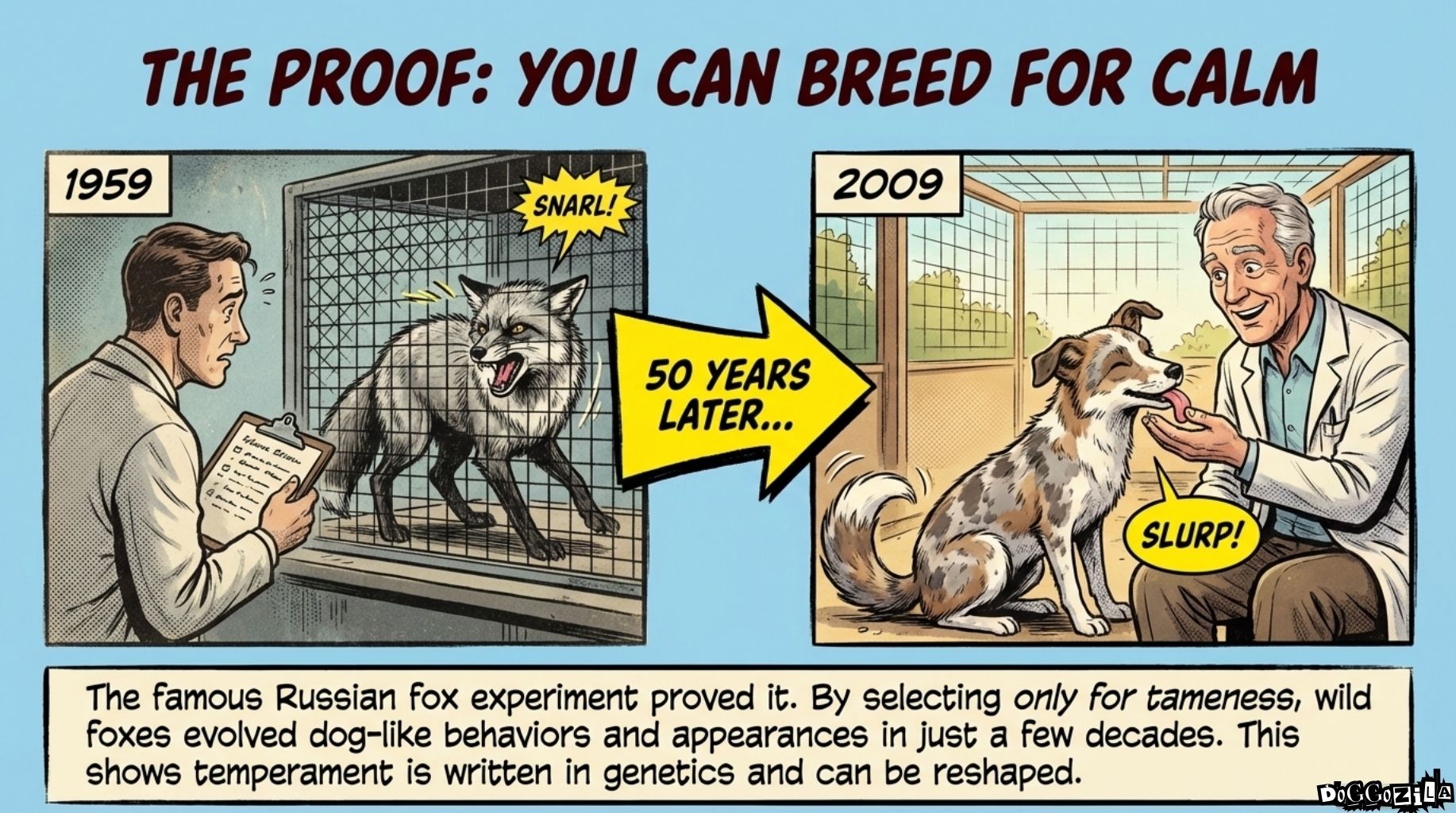
Deliberately breeding for personality is not science fiction. We have a powerful historical example, the famous Russian fox experiment. Starting in the 1950s, scientists selectively bred silver foxes solely for tameness and friendliness toward humans.
Astonishingly, within just a few decades, the foxes began to behave like dogs. They wagged their tails, sought human contact, and even developed floppy ears and spotted coats, physical changes linked to their behavioral evolution. This experiment proves that selecting for temperament can rapidly reshape an animal, both in mind and body, providing a perfect model for understanding if dogs are in a new phase of evolution.
Are Dogs in a New Phase of Evolution? Real-World Canine Changes
This genetic shift is already happening in real-time with dogs. The comparison between service dog lineages and typical pet lines shows measurable differences in a short time-frame. By consistently choosing the gentlest, most biddable dogs for breeding, organizations have created populations that are “almost a different breed” from their lookalike pet cousins.
This demonstrates that significant evolutionary change can occur in less than 50 years. The genetics of calm are being mapped and understood, providing a roadmap for those who wish to follow this path in broader dog breeding. This is concrete evidence that a new evolutionary phase is not just theory, but practice.
The Village Dog’s Advantage in Modern Evolution
Interestingly, the unsung heroes of canine genetics, global village dogs, might hold key genetic diversity for this new phase. These dogs, which have survived for millennia without human-controlled breeding, are masters of adaptation. They are typically less fearful and more resourceful than some purebreds.
As we look to create more resilient, easygoing dogs, their deep and varied gene pool could be invaluable. Incorporating this robust genetic material could help create the next generation of family companions without the health problems linked to closed purebred studbooks, helping to safely guide dogs in a new phase of evolution.
How Epigenetics Plays a Role?
Beyond pure genetics, the science of epigenetics shows how environment can turn genes “on” or “off.” A puppy’s early experiences in a stimulating, positive home can shape its adult temperament. This means our modern urban environment isn’t just a selective pressure for breeding, it directly influences how dogs develop.
So, the question “are dogs in a new phase of evolution“ includes not just their DNA, but how their life experiences from birth shape their behavior to fit our world. It’s evolution happening within a single lifetime, not just over generations.
🔑 Key Points: Scientific evidence, like the Russian fox experiment, proves selecting for temperament can rapidly change animals. Real-world service dog breeding programs show this evolutionary shift toward calmness is already happening.
WHAT IT MEANS FOR YOUR HOME IF DOGS ARE IN A NEW PHASE OF EVOLUTION?
So, what does this grand evolutionary theory mean for you and your goofy, sock-stealing pup? It provides a powerful lens to understand their behavior and your shared life. It explains why your dog might bark at the delivery driver or get overly excited at the park. They are not being “bad“, they are expressing ancient instincts in a modern context.
Knowing this can foster patience and guide you toward better training solutions. It helps us see our dogs not as flawed, but as amazing creatures caught between their deep past and our fast-paced present, actively navigating what seems like a new phase of evolution.
Choosing a Dog for This Brave New World
If you are looking for a new dog, this framework changes the game. Instead of focusing solely on breed stereotypes (“Labs are friendly,” “Border Collies are smart“), look for individual temperament. Meet the puppy’s parents if you can. Reputable shelters and breeders now prioritize temperament testing.
Ask about a dog’s comfort with handling, noise sensitivity, and social attraction to strangers. Finding a dog whose natural personality matches your lifestyle, a calm homebody versus an adventurous partner, is the single most important thing you can do. This alignment is the heart of the new domestication and a direct result of the pressures that make us wonder if dogs are in a new phase of evolution.
Are Dogs in a New Phase of Evolution? Training with the Answer in Mind
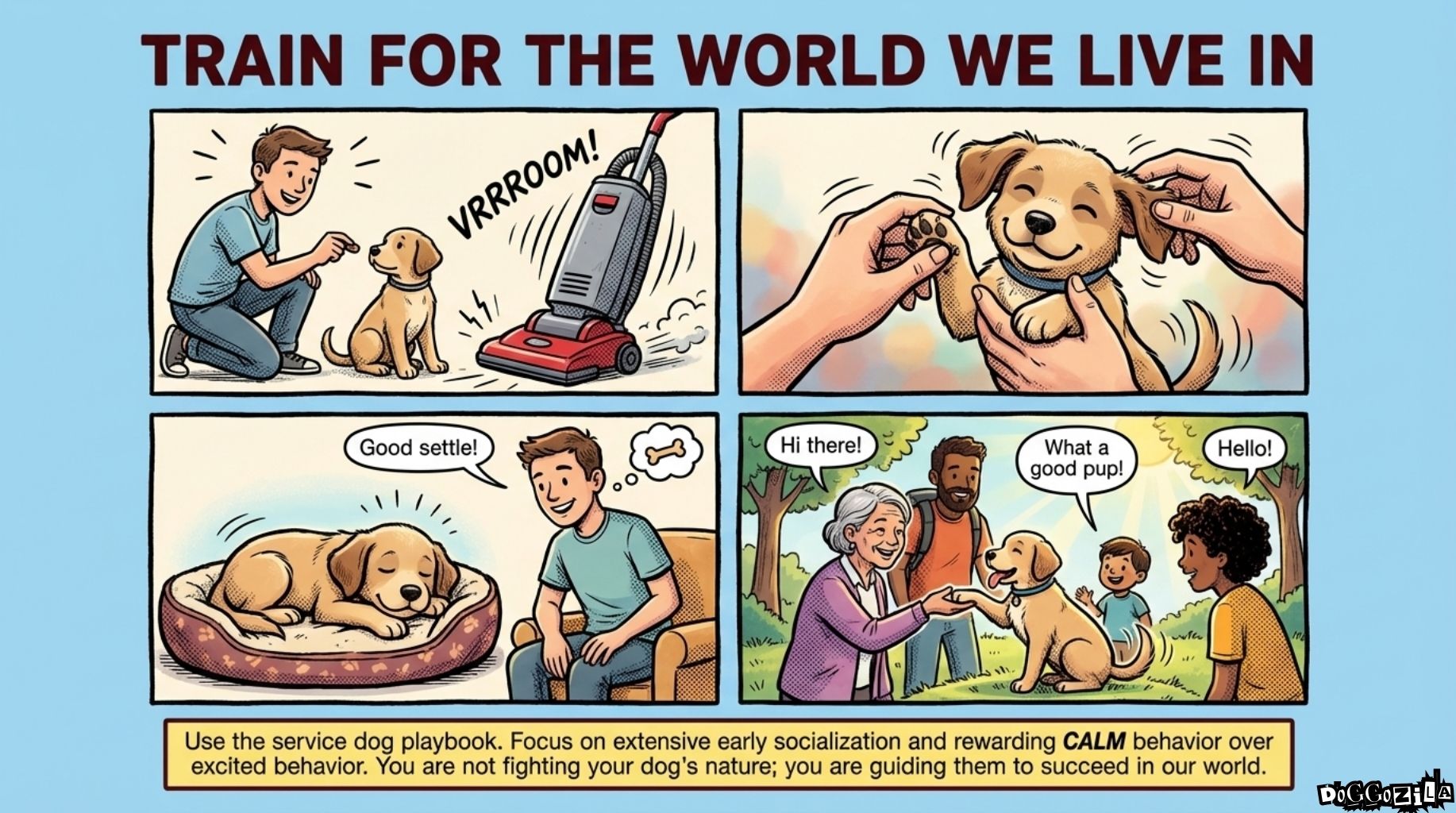
You can apply the principles of this third wave right now through enlightened training. Service dog organizations show us the way, extensive early socialization, positive reinforcement, and teaching calmness as a default behavior. Socialize your puppy to a hundred different sounds, surfaces, and people. Reward calm behavior more than excited behavior.
Teach an “off-switch” with mat training. You are not fighting your dog’s nature, you are gently guiding their evolution to help them succeed in our world. This proactive approach builds confidence and prevents problems, and it’s how you participate in this modern evolutionary story.
The Lifelong Bond Through Changing Times
For the dog already by your side, this perspective encourages compassion. Your dog may never be a café-patronizing social butterfly, and that is okay. The goal is not to force them into an impossible mold but to help them live their best, most secure life within their capabilities. Celebrate their unique spirit.
Maybe their “job” is to make you laugh or to be a cozy couch companion. The timeless skills dogs offer, unconditional love, joyful greetings, and living in the moment, are more valuable than ever. They remain our bridge to a simpler, more authentic way of being, even as the question of dogs in a new phase of evolution swirls around us.
🔑 Key Points: You can participate in this shift by prioritizing a dog’s individual temperament over its breed and using positive, socialization-focused training to help your dog adapt successfully to the modern world.
ARE DOGS IN A NEW PHASE OF EVOLUTION? IMAGINING THE DOG OF 2100
Let us gaze into a speculative, fun future. If the third wave of domestication continues, what might the dog of 2100 look like? Physically, they may not be wildly different. The extreme brachycephalic dogs (flat-faced) or giant breeds might become less common due to health concerns.
We may see a resurgence of moderate, healthy, “wolfy” builds. The real change will be under the fur. The ideal dog may possess a default “calm” setting, a remarkable ability to read human emotional cues, and a robust resilience to stress. They will be born ready for a world of bustling streets and quiet home offices, the ultimate product of this new phase.
A Healthier, Heartier Companion from Evolution
With a growing awareness of genetic health, the future likely holds a move away from closed breeding. We may see more “hybrid” or “designer” breeds not for looks, but for hybrid vigor and temperament blending. Breeders might responsibly outcross to improve genetic diversity and health.
The dog of the future could be, on average, healthier and longer-lived. The focus will finally align well-being with beauty, creating animals that are as sound in body as they are in mind. This is a hopeful and necessary direction for canine evolution, and a positive outcome if dogs are in a new phase of evolution.
Are Dogs in a New Phase of Evolution? The Redefined “Working” Dog
The very concept of a “working dog” will evolve. While traditional herding and hunting will persist, new jobs will emerge. We already have dogs trained to detect low blood sugar, impending seizures, and even certain cancers. Future dogs might be bio-engineered (ethically, one hopes) for even more sensitive detection roles. Their primary “work,” however, will be socio-emotional.
In an increasingly disconnected digital world, their evolved ability to provide companionship, reduce stress, and prompt social interaction will be their most vital job. They will be therapeutic partners by design, a direct answer to the modern needs driving a new evolutionary phase.
The Role of Technology and AI
Future tech will also shape this evolution. Imagine wearable devices that monitor a dog’s stress levels in real-time, giving owners insights. Genetic testing could become standard to match puppies perfectly to families. AI might even analyze puppy behavior videos to predict adult temperament with stunning accuracy.
This technology doesn’t replace natural evolution, but it guides our understanding of it, helping us make better, kinder selection choices. It accelerates our ability to ask and answer whether dogs are in a new phase of evolution with data, not just guesswork.
🔑 Key Points: The dog of the future may be defined by psychological resilience and a default “calm” setting, with health and temperament becoming the main breeding goals over extreme physical looks.
THE FINAL VERDICT: ARE DOGS IN A NEW PHASE OF EVOLUTION?
After this journey from ancient campfires to futuristic cities, the evidence is compelling. Yes, dogs are entering a new phase of evolution. This third wave of domestication is driven not by our need for hunting help or status symbols, but by our deep need for compatible, stress-free companionship in a challenging world.
The selective pressure is the modern urban environment, and the selected trait is a malleable, friendly temperament. It is a quieter revolution than those that came before, but it is just as profound. We are actively shaping the minds of our best friends for life in the 21st century. So, the central question, are dogs in a new phase of evolution, receives a confident, evidence-based “yes.”
Our Responsibility as Evolutionary Partners
With this great power comes great responsibility. We must guide this evolution with ethics and compassion. It means prioritizing health and happiness over fashion. Also means embracing shelter dogs who are already wonderfully adapted. It means being patient with the dogs we have, who are doing their best.
We are not just pet owners, we are the stewards of a species we helped create. The story of dog domestication is our shared story. As we turn this new page, we must write it with care, love, and a deep respect for the incredible animal that chose to walk beside us so long ago, especially now that we understand dogs are in a new phase of evolution.
The Evolving Role of Dogs in Human Society and Ethical Stewardship
Dogs’ roles are diversifying far beyond hunting and herding. They now serve as medical alert dogs, psychiatric support animals, and high-tech conservation detectors. This expansion of roles creates new selective pressures for specific, sophisticated sensitivities and cognitive abilities, guiding a new path for how do dogs evolve today to meet human needs.
With great knowledge comes great responsibility. The Third Wave grants humans unprecedented power to shape canine evolution. This demands a strong ethical framework focused on welfare, consent, and the preservation of canine essence. Our goal should be to evolve with dogs as partners, not to design them as products.
The Unbroken Bond Through All Phases
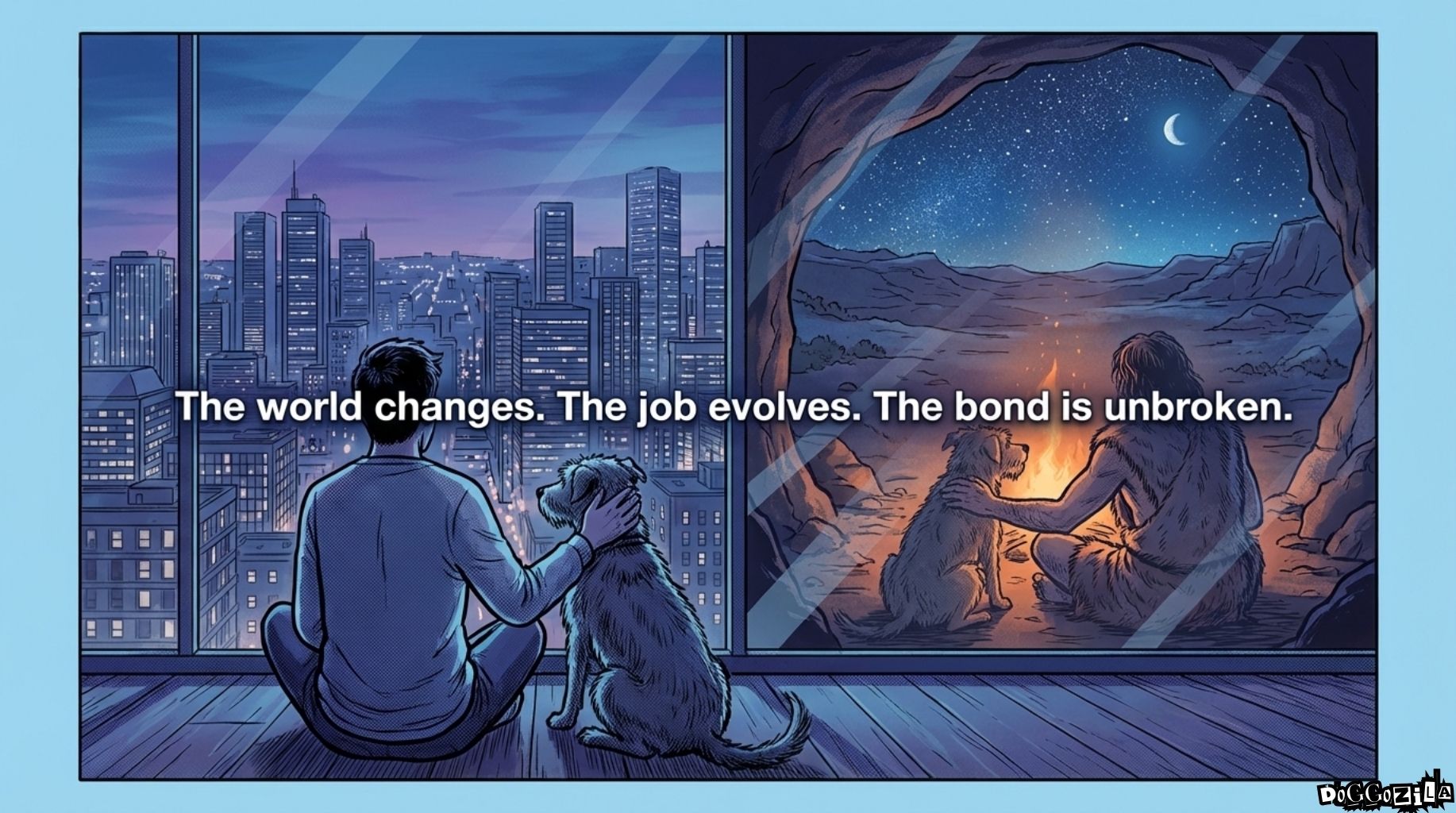
Ultimately, the core of our relationship remains unchanged. Dogs still look to us for guidance, food, and love. We still look to them for loyalty, comfort, and a connection to something pure. The third wave is simply the latest chapter in the longest and most successful inter-species partnership on Earth.
Whether your dog is a purebred champion, a street-smart rescue, or a service dog hero, they are a testament to this ongoing, beautiful evolution. So, give your dog a pat. You are both living participants in a grand, ancient, and still-unfolding story, a story that is clearly entering an exciting new chapter.
🔑 Key Points: The evidence strongly suggests yes, dogs are in a new phase of evolution. This third wave is a quiet revolution selecting for compatible temperament, and we have an ethical responsibility to guide it with compassion.
THE FUTURE FAMILY DOG: ENVISIONING DOGS IN A NEW PHASE OF EVOLUTION
Looking ahead, the future family dog will likely be defined by resilience and companionship. We can expect a continued emphasis on stable, friendly, and adaptable temperaments. The popularity of “designer mixes“, the designer dog breeds like the Labradoodle often stems from a desire for these hybrid vigor and predictable personalities.
Technology, like genetic temperament testing, will help breeders and owners make better matches. The ideal will be a dog that is as comfortable in a busy cafe as it is hiking a trail. This dog will be a true partner, emotionally in tune and physically robust. By making conscious choices today, we guide this future. We ensure the next chapter of our shared journey is happy and healthy for all dogs.
Advocating For Your Dog’s Needs
Finally, be your dog’s advocate. Recognize that they are a species with ancient instincts living in a very new world. If your dog is overwhelmed at a busy farmer’s market, it’s okay to leave. If they need more quiet time than another dog, honor that. Don’t force them into situations that cause chronic stress.
The third wave is about fit and harmony, not forcing a square peg into a round hole. By respecting your dog’s individual limits and providing them with a tailored, understanding environment, you are not just a pet owner, you are a partner in their successful adaptation, actively shaping the positive answer to whether are dogs in a new phase of evolution.
Predicting the Physical and Behavioral Traits of Tomorrow
Future dogs may be shaped less by breed standards and more by adaptations to human technological and social environments. We might see a continued trend toward moderate-sized, highly adaptable family companions with robust health and stable, biddable temperaments. The extreme physical forms of the Second Wave may give way to a “neo-moderate” conformation optimized for health and function.
Looking Ahead: The Future of Our Shared Journey
The story of dogs and humans is an unparalleled evolutionary partnership. We have shaped each other for millennia. Today, as we become more aware of our influence, we have a choice. We can continue to shape dogs based on fleeting aesthetics, or we can guide them thoughtfully toward a future where they are both physically healthy and mentally well-equipped to be our companions.
The evidence suggests a new phase is already underway, driven by the silent pressures of apartment living, busy schedules, and our deep need for connection. By embracing breeding for health and temperament, committing to positive training and socialization, and advocating for our dogs’ well-being, we can ensure this third wave leads to a brighter future for all dogs. The next chapter of this incredible journey is being written in our homes, and we all have a pen.
🔑 Key Points: The story of how do dogs evolve today is still being written, and we are its co-authors. From ancient partnerships to the genetic and epigenetic complexities of the modern era, dog evolution reflects our own history, values, and scientific understanding.
FREQUENTLY ASKED QUESTIONS