
Imagine the sound of panting breaths and the soft crunch of paws on snow. Picture a team of powerful dogs, working as one, pulling across a frozen landscape under the northern lights. This scene is ancient, yet it still lives today. The story of sled dog breeds is an incredible tale of partnership. It spans from the very survival of human cultures to the thrilling world of modern dog sport. These dogs are more than just animals, they are heroes, athletes, and living history. Let’s dive into their amazing journey together.
„Bred in the frozen cradle of civilization, sled dogs did more than pull weights, they pulled entire cultures across impossible landscapes, from the edge of survival to the finish line of modern sport.“
Quick Summary About THE JOURNEY OF SLED DOG BREEDS
From their ancient origins over 9,000 years ago as vital partners for Indigenous Arctic survival to their legendary roles in gold rushes, heroic serum runs, and global exploration, sled dog breeds have been foundational to human history in the north. This article traces their journey from indispensable working animals to modern dog athletes, exploring the key breeds, their specialized team roles, and the contemporary challenges that shape their future.
HOW THE ANCIENT JOURNEY OF SLED DOG BREEDS BEGINS?
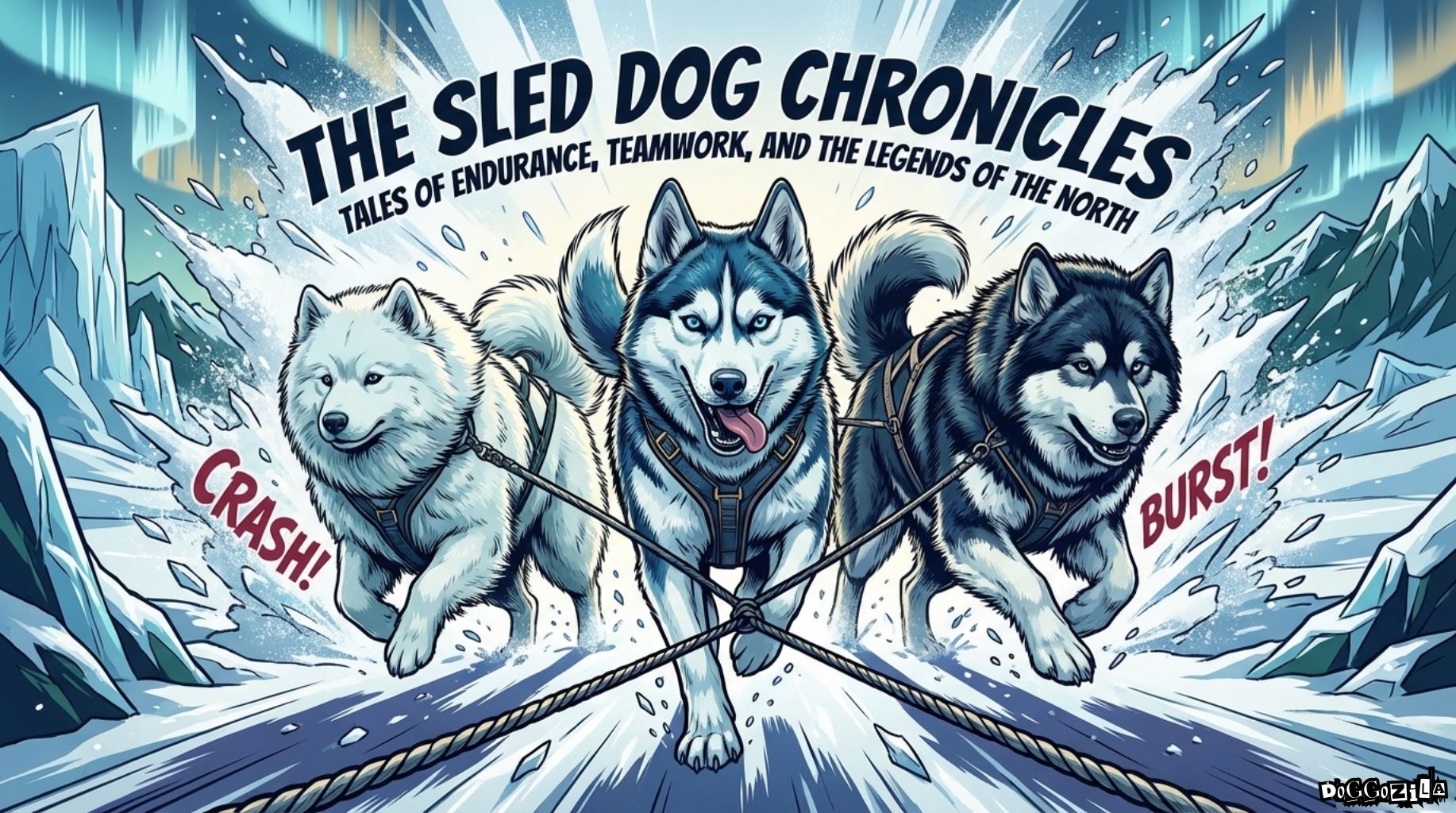
Our story starts not hundreds, but thousands of years ago. Long before written records, humans and dogs formed a bond in the coldest places on Earth. This partnership was not for fun, but for pure survival. People needed to travel and hunt across vast, frozen lands. The ancestors of modern sled dog breeds made that possible. They pulled sleds loaded with food, supplies, and people across impossible terrain. This ancient teamwork built the foundation for everything that followed. It truly was the dawn of a legendary alliance.
The strategic use of dogs for transport has a long and deep history, fundamentally shaping human life in the Arctic. Early peoples relied on them to move vital goods across formidable terrain, a practice that enabled the establishment and continuation of communities in the circumpolar north.
Tracing the Paw Prints Back in Time
Archaeologists have found clues to this deep history. A sleigh runner discovered in Finland is about 9,000 years old. While we do not know if dogs pulled it, it shows early sled technology. More concrete evidence points to the Inuit and other Indigenous peoples of the Arctic.
By at least 1,000 A.D., they were masters of dog-powered travel. They did not just use dogs, they shaped them. They carefully bred dogs for strength, endurance, and thick coats. This created the first true sled dog breeds tailored for a frozen world.
How Indigenous Cultures Shaped Sled Dog Breeds We Know Today?
For the Chukchi people of Siberia, their dogs were family. These dogs, the ancestors of the Siberian Husky, hauled loads over huge distances. They were treated with respect and care. Similarly, the Inuit in Greenland depended on strong, durable dogs for hunting on sea ice.
These cultures did not see their dogs as mere tools. They were essential partners in a harsh environment. Their selective breeding created the resilient, cooperative temperaments we still see in these breeds today. This respectful partnership was key to their mutual survival.
The Evolution From Simple Sleds to Strong Teams
Early sledding looked different than the teams we know. At first, a single dog might pull a small load. But people soon made a brilliant discovery. They realized that multiple dogs could share the weight. This allowed them to move heavier goods farther and faster.
So, they developed bigger sleds and organized teams. This innovation changed everything. It turned a simple helping paw into a powerful transportation system. This system would one day build nations and save lives.
🔑 Key Points: Sled dog breeds originated from an essential survival partnership between humans and dogs in the Arctic thousands of years ago, with Indigenous peoples shaping the first specialized breeds for transportation across frozen landscapes.
MEET THE FOUNDATIONAL SLED DOG BREEDS
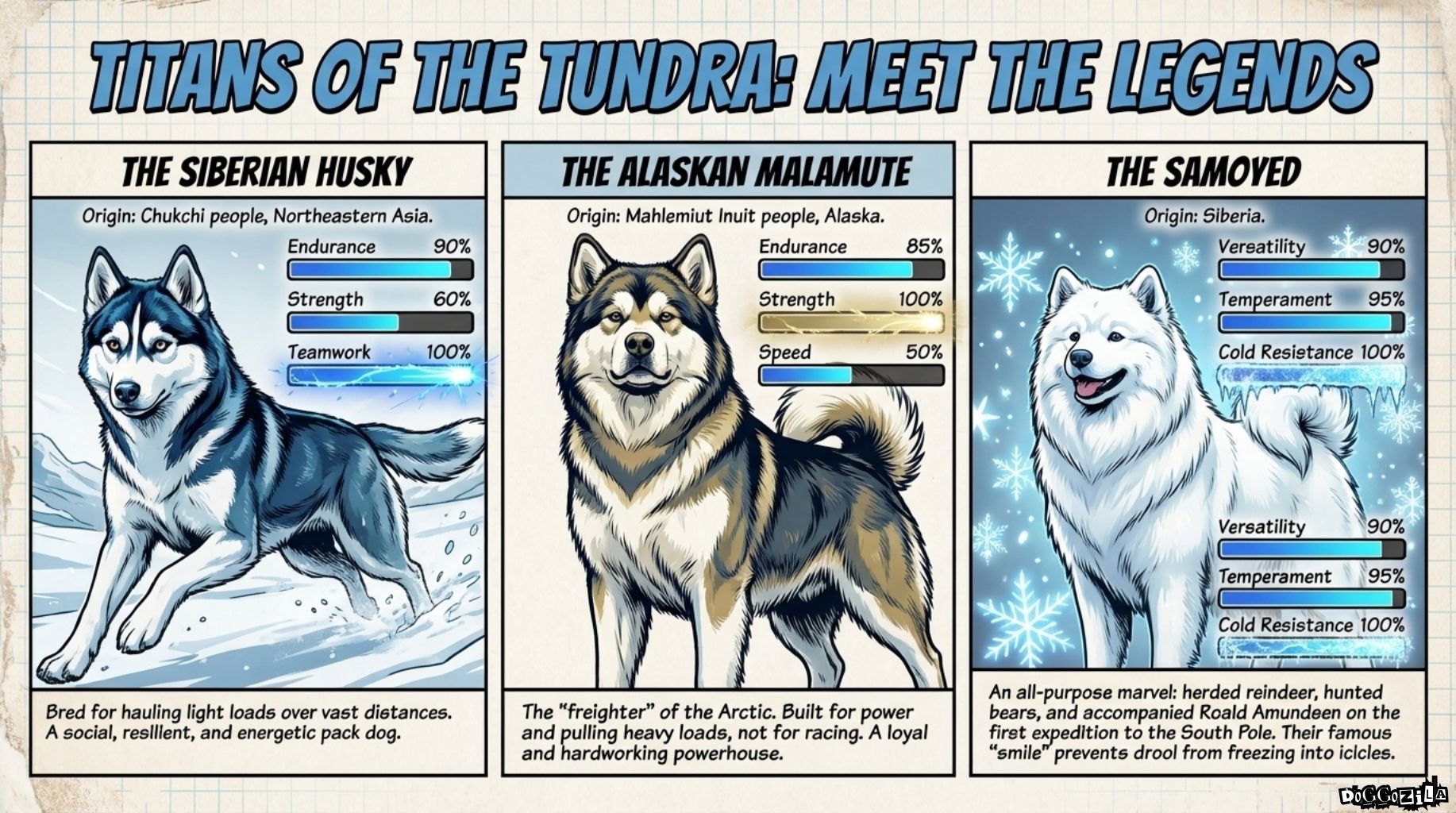
When you think of a sled dog, a few classic faces come to mind. These are the purebred heroes with stories etched in snow. Each of these foundational sled dog breeds was perfected for a specific job. Some were built for sheer power, while others were made for incredible endurance. Understanding them helps us appreciate the full spectrum of dog athletes. They are the original stars of the north, each with a unique role in history.
Arctic cultures strategically developed specialized breeds for sledding by selecting for specific traits such as strength, endurance, and profound adaptation to extreme cold. These purpose-bred dogs became essential partners in survival and transport, forming the genetic bedrock of the sled dog world.
The Siberian Husky: The Iconic Endurance Runner
The Siberian Husky is likely the most famous of all sled dog breeds. Bred by the Chukchi people, they are the marathon runners of the snow. They are not the biggest or the strongest, but they can run for incredible distances. Their history as gentle family dogs for the Chukchi gives them a friendly, social nature. Of course, their fame skyrocketed after the 1925 serum run to Nome. This breed proves that heart and stamina can be just as important as raw power.
The Alaskan Malamute: The Powerful Freight Hauler
If the Husky is the runner, the Malamute is the weightlifter. This breed is among the most powerful of all sled dog breeds. Bred by the Mahlemiut Inuit, they were designed to pull massive loads slowly and steadily. They are the freight trucks of the Arctic. Their strength was vital for moving entire camps and heavy supplies. Today, that strength comes with a loyal but independent personality. They are affectionate giants who take their jobs very seriously.
The Samoyed and Other Frosty Specialists
Do not forget the smiling Samoyed! This fluffy, white breed is another Siberian expert. They herded reindeer, hunted, and kept their people warm at night. Their upturned “smile” actually stops drool from freezing. Then you have hardy breeds like the Greenland Dog. This rare breed is a fierce hunter and protector, even from polar bears. Each of these sled dog breeds brings a special skill to the table. Together, they showcase the brilliant diversity of northern dogs.
🔑 Key Points: Classic purebreds like the Siberian Husky (endurance), Alaskan Malamute (power), and Samoyed (versatility) were each perfected for specific tasks, forming the historic backbone of dog-powered travel.
MORE UNIQUE PUREBRED SLED DOG BREEDS
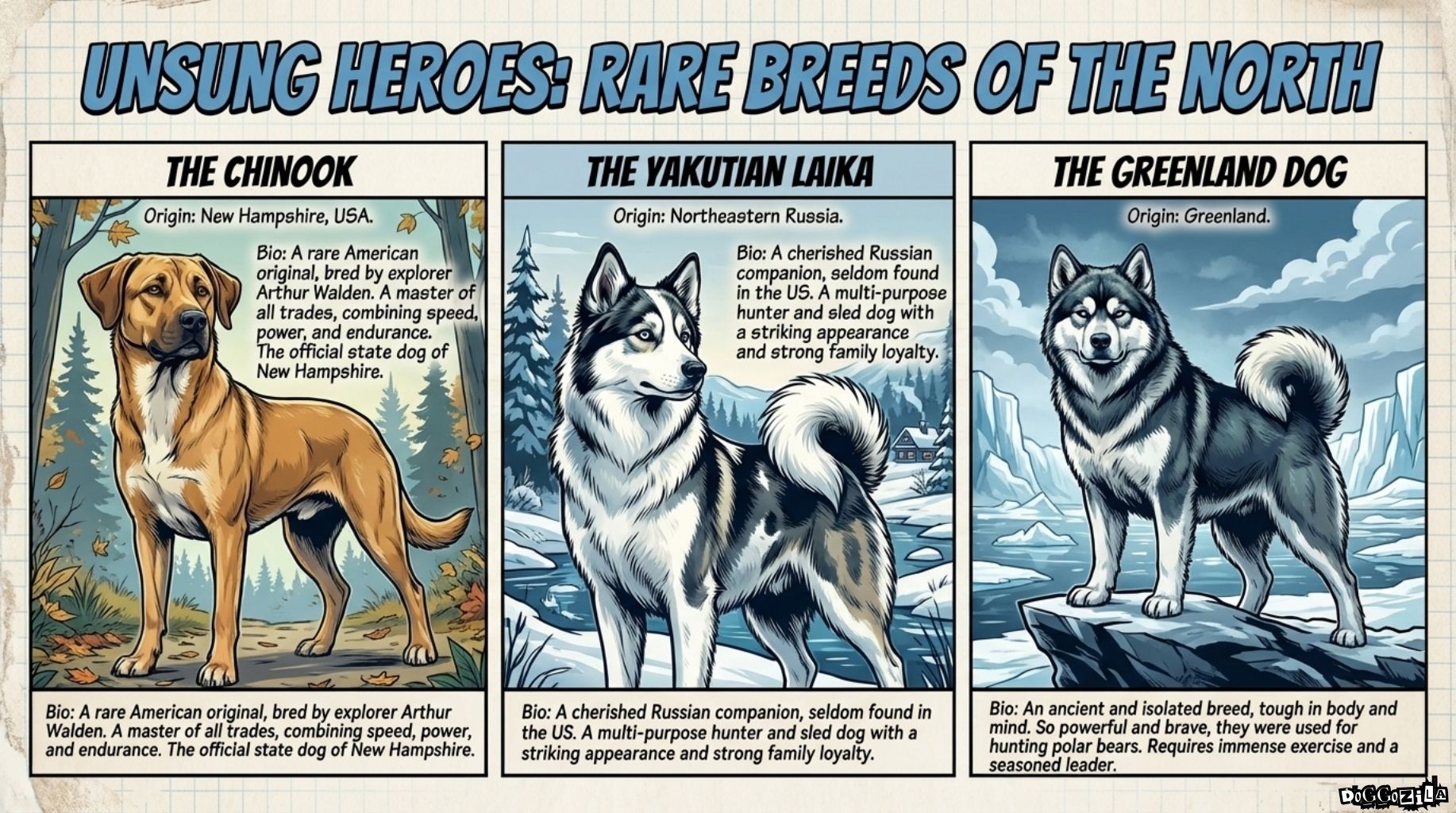
Beyond the iconic Siberian Husky and Alaskan Malamute, the world of purebred sled dogs encompasses several other remarkable but less common breeds. These “hidden gems” of the mushing world each possess a unique history and specialized set of traits, forged by the specific demands of their native lands.
From American foundations to ancient Arctic lineages, these breeds highlight the diverse genetic tapestry and adaptive brilliance of dogs bred for winter transport, offering a deeper look into the specialized canines that have powered human life across the snow.
The Versatile Chinook
The Chinook is a rare American sled dog breed with a unique history. It was founded in 1917 by explorer Arthur Walden in New Hampshire, who sought to create the ideal sled dog with a combination of speed, power, and endurance. The breed nearly went extinct in the late 20th century, but dedicated breeding efforts have helped its population recover.
Today, the Chinook is the official state dog of New Hampshire. Known for its gentle and good-natured temperament, the Chinook is one of the most versatile types of sled dogs. They can haul hefty loads but are also accomplished sled racers. Their excellent physical and social abilities also make them strong candidates for other work, such as search and rescue dogs.
The Hardy Greenland Dog
It is a challenge to find a Greenland Dog outside of its namesake island, as centuries of isolation have kept the breed largely apart from the rest of the world. They have worked alongside Greenland natives for generations, developing into fast sled dogs with incredible hunting prowess.
These muscular and brave dogs have even been reported to provide protection from polar bears. The Greenland Dog is a demanding breed with an independent mind and extremely high exercise needs, requiring up to two hours of activity per day to stay physically and mentally fit. Their tough, survivalist nature means that training must begin at a young age.
The Ancient Norwegian Elkhound
With a history dating back as early as 5,000 B.C., the Norwegian Elkhound is an ancient breed that has braved the Scandinavian climate for millennia. They are so integral to the region’s history that they sailed with the Vikings and have appeared in Norse art. In addition to pulling sleds, they were employed for hunting large game like bears, wolves, moose, and even elks.
With their pointed snout and ears, Norwegian Elkhounds have a fox-like appearance and an alert, agile nature. While they may look intimidating, they are often shy around strangers at first but become friendlier once they get to know you. The rigorous standards of purebred lineage contrast sharply with another category of sled dog, one defined not by ancestry, but by unparalleled performance.
🔑 Key Points: Beyond the well-known breeds, rare and ancient types like the Chinook, Greenland Dog, and Norwegian Elkhound showcase the wider genetic diversity and specialized adaptations of sled-pulling dogs.
SLED DOG BREEDS BECOME HEROES IN HISTORY
These dogs did much more than just pull sleds for daily life. They stepped onto the stage of world history at critical moments. Sled dog breeds became engines of expansion and agents of rescue. They helped shape nations during frenzied gold rushes. They also performed acts of heroism that are still celebrated today. Their paws are prints on the pages of our past.
Beyond sport and daily survival, sled dog breeds have played indispensable roles in major historical events. They have served as engines of exploration, settlement, and commerce, and have even performed lifesaving missions that have become the stuff of legend.
The Klondike Gold Rush Lifeline
Imagine Alaska in the late 1800s. Prospectors flooded north seeking gold, but winter stopped everything. Trains could not run, and boats were frozen. The only transport left was dog power. Sled dog breeds became the absolute lifeline of the Gold Rush. They moved mail, medicine, food, and people. The demand for dogs was so huge that strays were reportedly rounded up from Seattle streets. A good team could cost a fortune. This era proved their irreplaceable value.
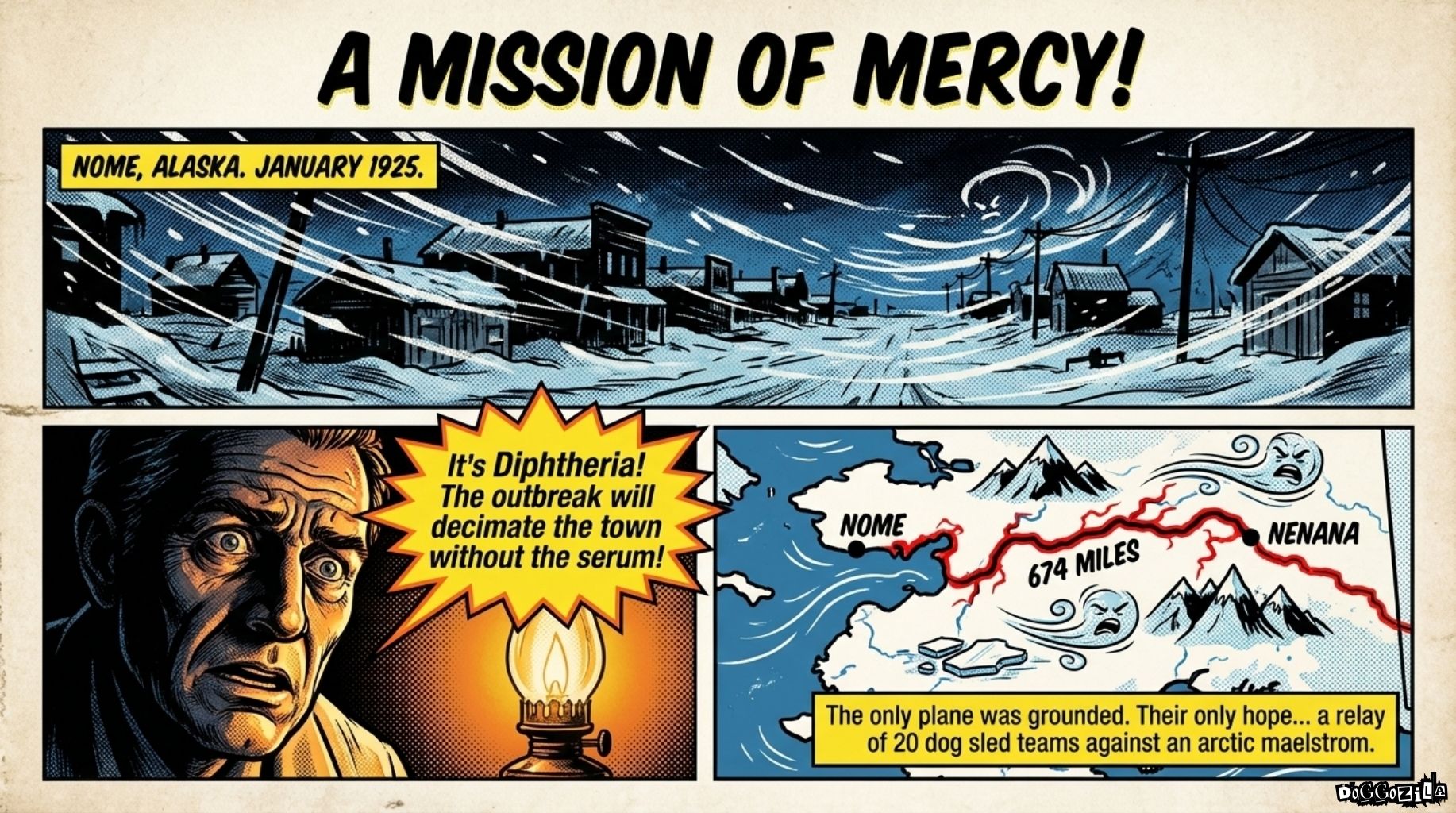
The Legendary 1925 Serum Run to Nome
This is one of the most thrilling stories about sled dog breeds. A deadly diphtheria outbreak hit Nome, Alaska. The nearest medicine was over 600 miles away in awful winter conditions. Planes could not fly.
So, a relay of 20 musher and dog teams raced the serum across Alaska. Balto is famous for leading the final team into Nome. But the true marathon hero was Togo, a Siberian Husky. At 12 years old, he led his team through the longest, most dangerous leg. These dogs saved a town.
Polar Explorers and Wartime Warriors
Sled dogs helped humans conquer the poles. Explorer Roald Amundsen used teams of Samoyeds to reach the South Pole first in 1911. Their speed and reliability gave him the win. Later, during both World Wars, these dogs served bravely.
They pulled supplies over mountain passes, laid communication wires, and rescued downed pilots. The French army even awarded three dogs a high military honor, the Croix de Guerre. Their service in global conflict is a proud, often overlooked chapter.
🔑 Key Points: Sled dog breeds played pivotal roles in history, serving as the lifeline of the Klondike Gold Rush and executing lifesaving feats like the 1925 serum run, proving their irreplaceable value.
THE MODERN ATHLETE: RACING SLED DOG BREEDS
The world changed. Snowmobiles and planes took over transport. But the story of sled dog breeds did not end, it evolved. Their incredible drive and athleticism found a new outlet in sport. Today, they are elite athletes competing in exciting events. This shift from essential worker to competitor has kept their spirit alive. It has also led to the development of some of the fastest canine athletes on the planet.
After World War II, technology rendered sled dogs largely obsolete for transport. However, the tradition was preserved and transformed through recreational mushing and competitive racing. This shift from essential workers to modern athletes ensured the continuation of their legacy.
The Rise of the Iditarod and Modern Racing
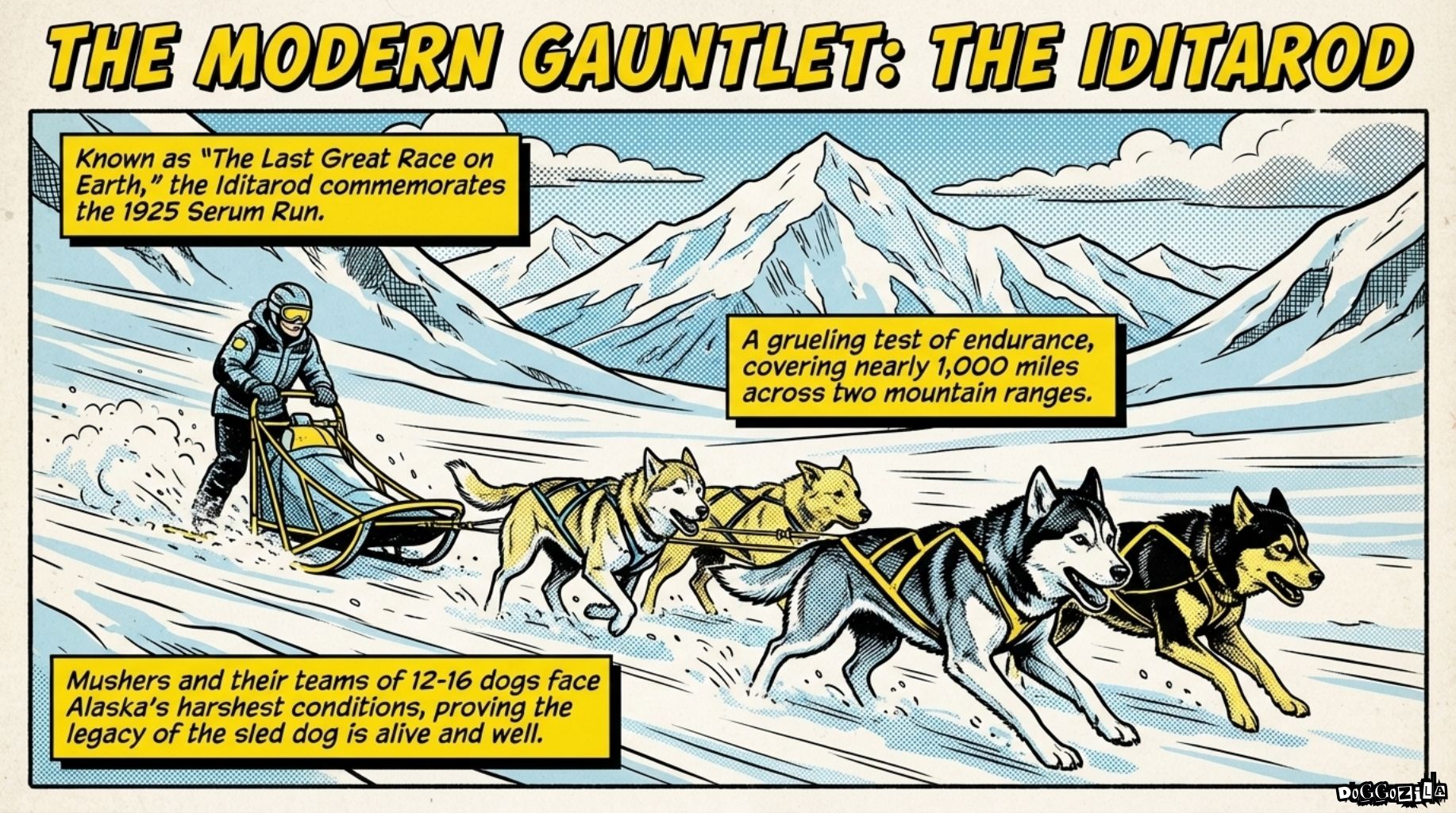
The most famous race is Alaska’s Iditarod. This roughly 1,000-mile race commemorates the serum run. It is a brutal test for mushers and their teams of sled dog breeds. The race draws global attention and top competitors. However, it also faces controversy over animal welfare. This important debate continues to shape the sport. Beyond the Iditarod, there are many other races worldwide. They all celebrate the speed, endurance, and heart of these amazing dogs.
Meet the Alaskan Husky: The Ultimate Racing Machine
In the world of competitive racing, one type rules, the Alaskan Husky. It is crucial to know this is not a purebred like a Siberian Husky. Instead, it is a category of dog bred purely for performance. Think of them as the purpose-built race cars of the sled dog world. They are mixed from various breeds like Huskies, Pointers, and Greyhounds. The goal is simple, create the fastest, most enduring athlete possible. This makes them the top choice for most serious mushers today.
The Specialized Eurohound and Sprint Sports
Breeding for speed has created amazing specialists. A great example is the Eurohound. This is a mix of an Alaskan Husky and a German Shorthaired Pointer. They are lean, incredibly fast, and love to run. Many consider them the best sprint racing dogs alive. The sport also includes fun variations like skijoring, where dogs pull a skier. There is also dryland mushing with wheeled carts. These activities let sled dog breeds and their owners have fun year-round.
🔑 Key Points: Today, sled dog breeds have evolved into elite sporting animals, with events like the Iditarod and the development of purpose-built types like the Alaskan Husky and Eurohound highlighting their speed and athleticism.
LIFE IN A TEAM: THE STRUCTURE OF SLED DOG BREEDS
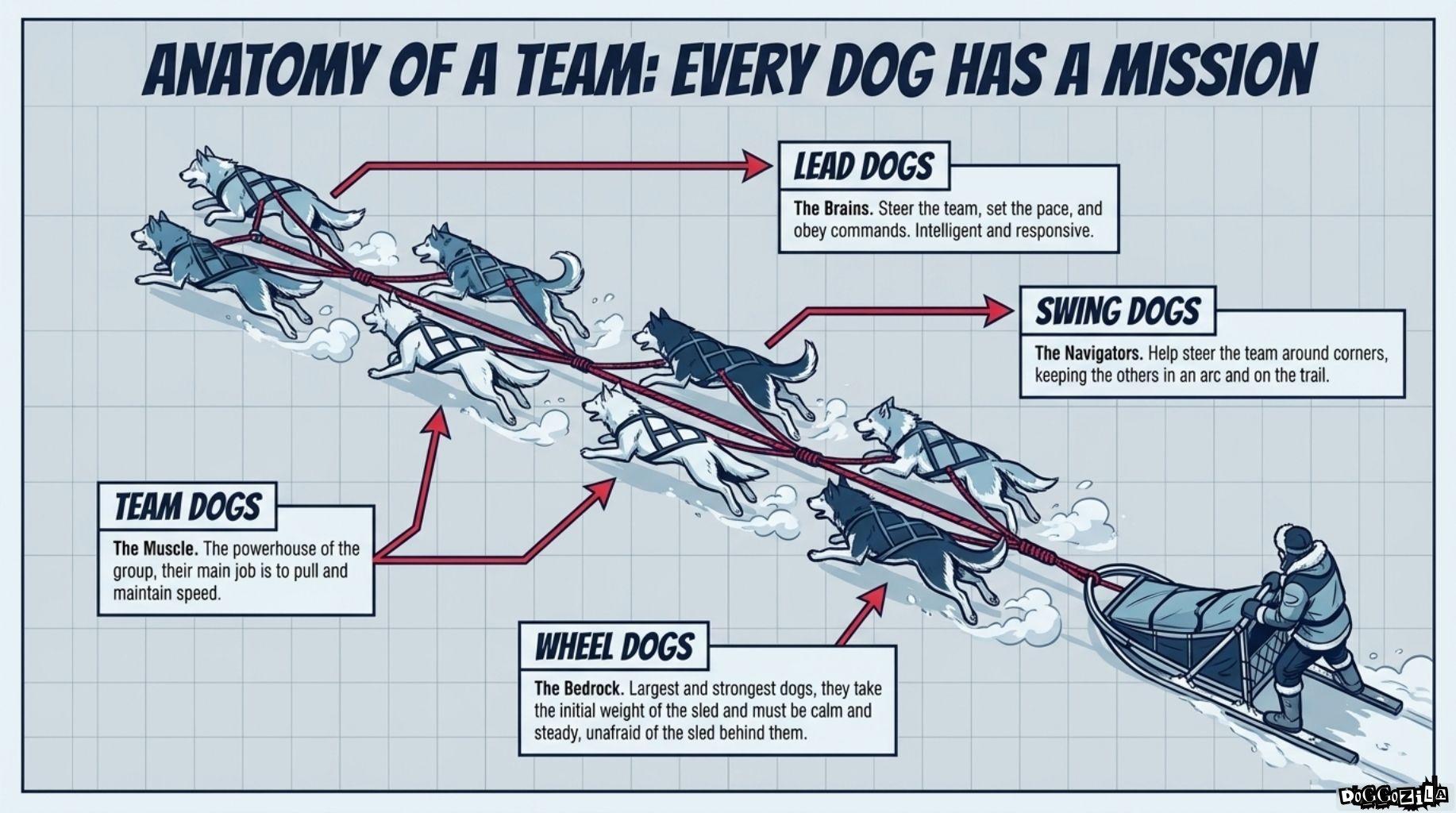
A winning team is not a random group of dogs. It is a carefully structured unit where every dog has a job. Understanding these roles shows the intelligence and teamwork involved. Each position uses different strengths and personalities. This organization is what turns individual power into smooth, efficient motion. It is a beautiful display of canine cooperation.
The composition of a sled dog team is strategically vital for success. A high-performing team is not a random collection of dogs but a highly structured unit where each position has a specialized role designed to maximize efficiency and power.
The Lead Dogs: The Smart Navigators
At the very front are the lead dogs. They are the brains of the operation. Their job is to steer the team, set the pace, and listen to the musher’s commands. They need to be intelligent, confident, and focused. A good lead dog can find the trail in a blinding snowstorm. Many teams use two lead dogs to share this critical duty. The famous Balto was a lead dog who navigated by scent alone in a blizzard.
The Swing and Team Dogs: The Mighty Engine
Right behind the leaders are the swing dogs. They help swing the team around turns smoothly. They make sure the whole line follows the leaders in a nice arc. Next come the team dogs. These dogs form the middle of the line. They are the powerhouse, the main engine providing steady pulling power. Most of the dogs on a team are in this position. They love to run and provide the relentless drive that moves the sled mile after mile.
The Steady Wheel Dogs: The Powerful Anchors
Closest to the sled are the wheel dogs. This job requires strength and a calm nerve. They must not be spooked by the sled bouncing right behind them. Wheel dogs are often the biggest and strongest on the team. They take the initial shock when the sled starts moving. These dogs also use their strength to help steer the heavy sled around tight corners. They are the dependable anchor that completes the team structure.
🔑 Key Points: Success depends on a highly organized team where each dog has a specialized role, from intelligent Lead Dogs to powerful Wheel Dogs, demonstrating remarkable dog teamwork and intelligence.
CARING FOR ATHLETIC SLED DOG BREEDS
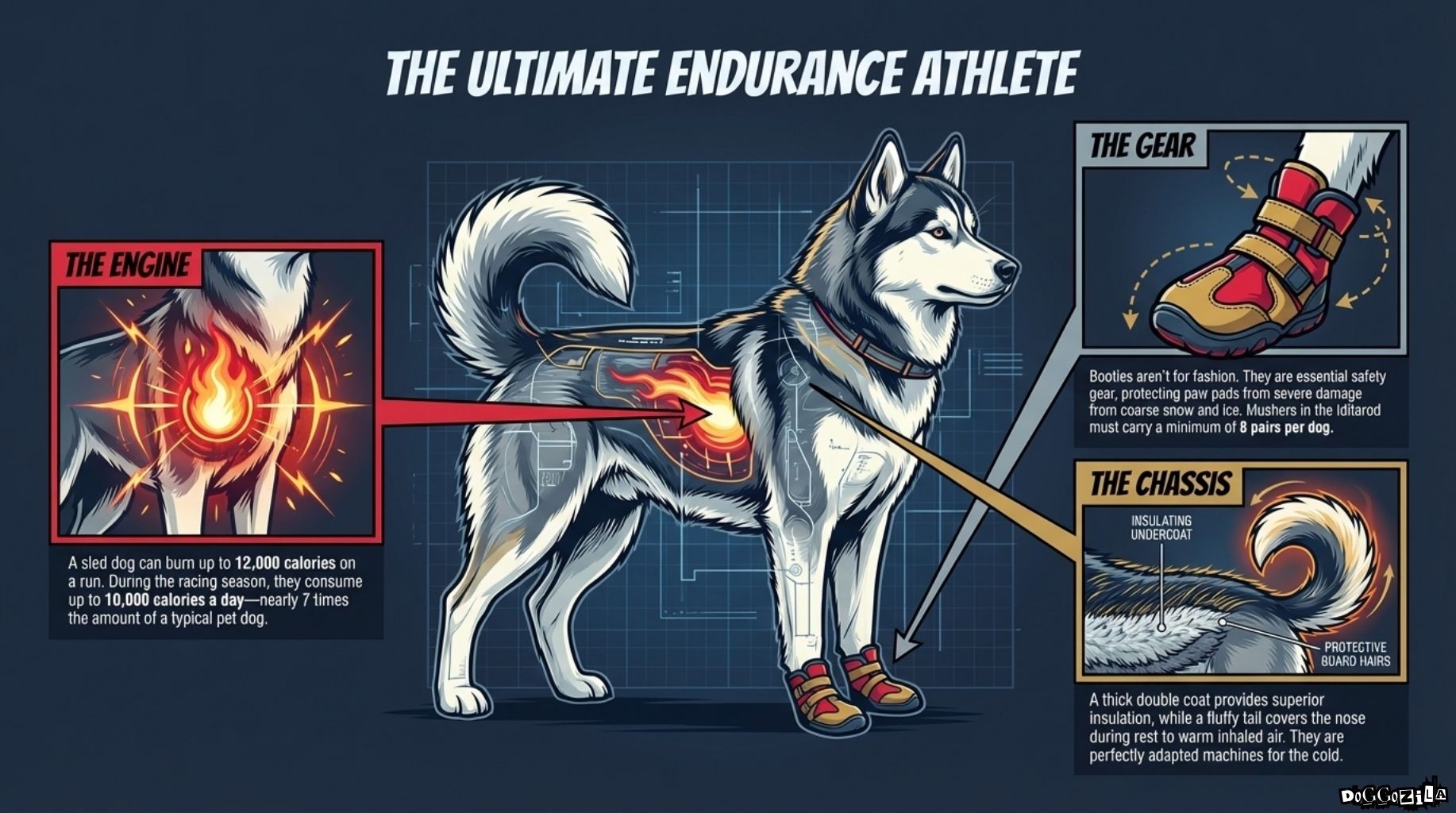
These dog athletes have very special support needs. Their care is a full-time job for any musher. It goes far beyond just feeding and grooming. It involves specialized nutrition, protective gear, and understanding their unique bodies. Proper care ensures the dogs are happy, healthy, and ready to perform. This dedication is at the heart of ethical mushing.
Booties are a critical piece of safety equipment for working sled dogs, not a fashion statement. They are essential for protecting a dog’s paw pads from damage caused by coarse snow and abrasive ice.
The Amazing 10,000-Calorie Diet
The energy needs of sled dog breeds are mind-blowing. During heavy training or racing, they can burn up to 12,000 calories a day. Compared to typical pet dog needs which roughly are 1,500 calories. To fuel this, they eat a high-fat, high-protein diet. It is common for them to consume 10,000 calories daily.
That is about six times what a normal pet dog eats! Their food is like premium fuel for a top athlete. This diet is carefully managed to keep them in peak condition. This specialized diet is crucial for all working sled dog breeds. Beyond team structure and physical care, the world of modern mushing faces significant contemporary challenges.
Essential Gear: More Than Just Booties
You have probably seen pictures of dogs wearing colorful little booties. These are not cute costumes, they are vital safety equipment. The booties protect their paw pads from sharp ice and snow. They also prevent painful ice balls from forming between their toes.
In long races like the Iditarod, mushers must carry hundreds of booties. Other gear includes specially designed harnesses that distribute weight evenly. This careful attention keeps the dogs comfortable and safe on the trail.
Built by Nature for the Cold
These dogs are marvels of natural engineering. Their thick double coats have a soft undercoat for warmth and a longer outer coat to shed snow. Many have fluffy tails they curl over their noses while sleeping. This warms the air they breathe. Their paws have a unique circulatory system that helps prevent frostbite. Even their metabolism is super-efficient at turning food into energy and heat. These traits make sled dog breeds perfectly adapted to their frosty world.
🔑 Key Points: These dog athletes require extraordinary care, including a high-calorie diet of up to 10,000 calories a day and essential protective gear like booties, due to their unique physiology and demanding workload.
SLED DOG BREEDS AS MODERN AMBASSADORS
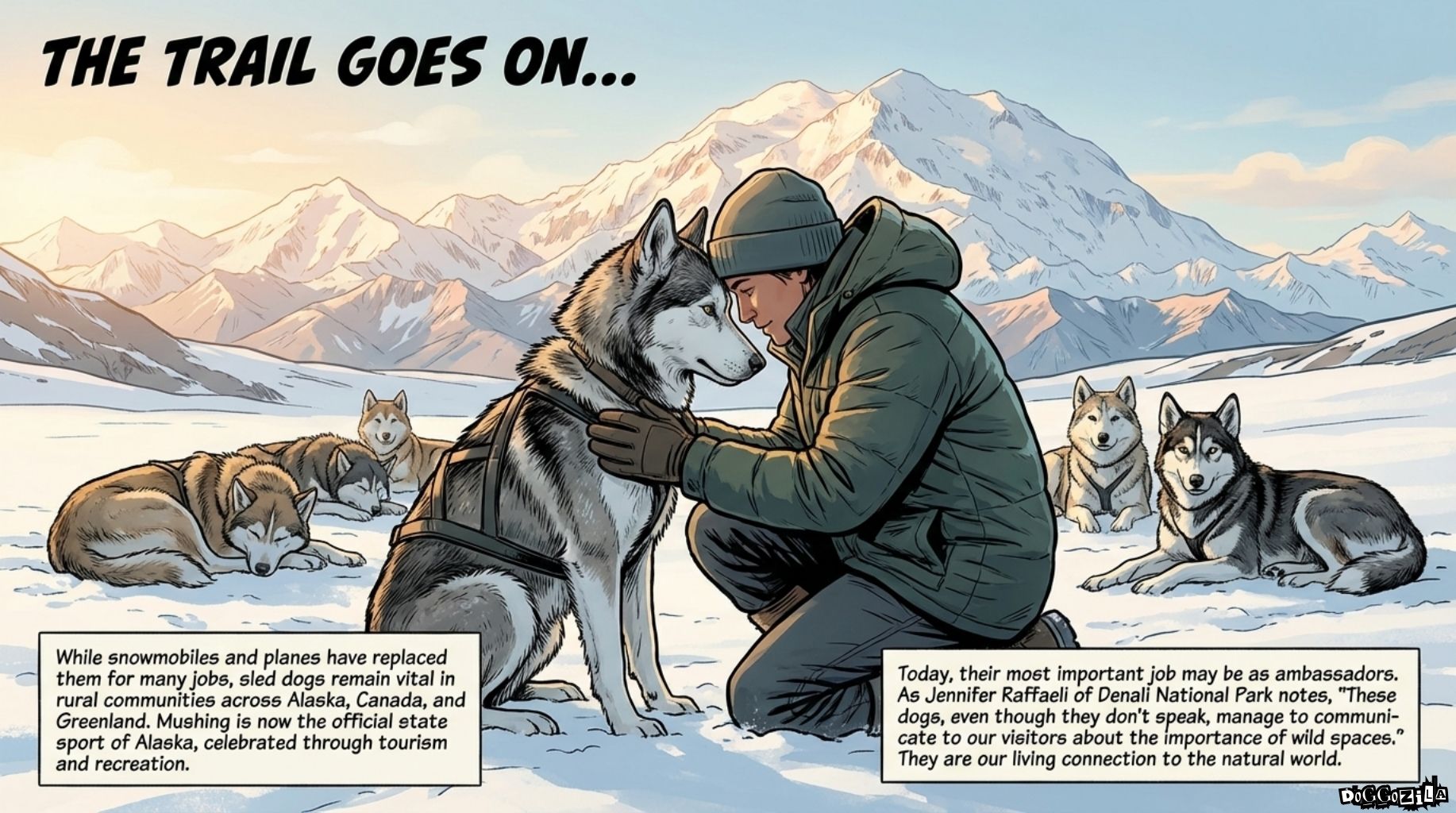
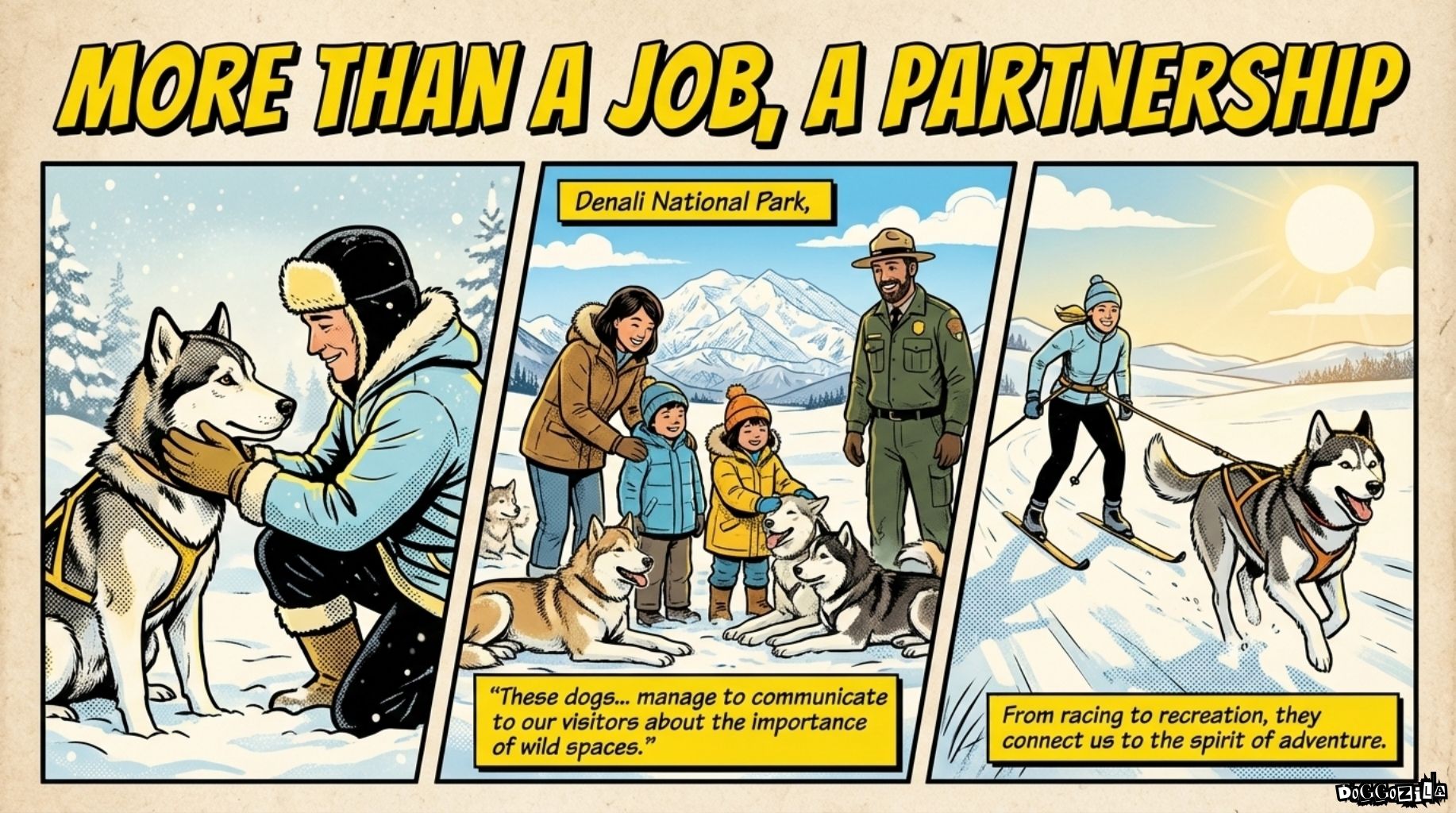
Today, the role of these incredible dogs is expanding once again. While racing is huge, they also serve as important teachers and companions. They connect people to history and to wild places. In a world of screens and cities, they offer a tangible link to nature. Their future may be changing, but their value as ambassadors is clearer than ever.
In a world of snowmobiles and modern transportation, the role of sled dog breeds has shifted once again. Today, they face new challenges and serve new purposes, acting as ambassadors for the natural world while their very way of life is threatened by a changing planet.
Educating the Public in National Parks
Places like Denali National Park in Alaska have working kennels. Here, sled dog breeds show visitors a living piece of history. As one kennel manager said, these dogs “communicate about the importance of wild spaces” without saying a word. They demonstrate traditional travel methods and steal hearts with their friendly personalities. This educational role is vital. It helps build support for conserving the wild landscapes these breeds call home.
Can a Retired Sled Dog Be a Family Pet?
This is a common and important question for many dog lovers. The answer is, well, it depends, but often yes! Retired sled dog breeds can make wonderful pets with the right family. They are typically intelligent, social, and energetic.
The transition from kennel to couch requires patience, especially with house training and leash skills. However, with love and consistent training, many adapt beautifully. They trade pulling a sled for pulling toys from the basket, becoming loyal, active family members.
The Biggest Threat: Climate Change
The greatest challenge facing sled dog breeds and their sports is climate change. Warmer temperatures mean less reliable snow and unsafe ice. Races are being canceled or altered due to poor conditions. The traditional mushing lifestyle is directly threatened by our warming planet. This makes their role as ambassadors even more urgent. They are a living reminder of what we stand to lose if we do not protect our environment. Their future is on thin, melting ice.
The Unbreakable Bond With Sled Dog Breeds
From ancient survival to modern sport, the journey with sled dog breeds is a powerful story of partnership. These dogs have carried our supplies, saved our lives, explored our planet, and now win our races. They have evolved alongside us, always adapting. Their spirit of endurance and teamwork inspires us. As we look ahead, we must work to protect the traditions and the environment they need. Their legacy is a gift of courage, strength, and loyalty written in the snow.
„If you are interested, continue reading more about the Winter Dog Breeds That Thrive in Snowy Conditions“
🔑 Key Points: Sled dog breeds now serve as vital educators in parks and potential family companions, while also facing the existential threat of climate change, which jeopardizes their traditional lifestyle and sports.
FREQUENTLY ASKED QUESTIONS ABOUT SLED DOG BREEDS